• HOME
  • NEWS
  • EXPLORE
    • CAREER
      • Companies
      • Jobs
    • EVENTS
    • iGEM
      • News
      • Team
    • PHOTOS
    • VIDEO
    • WIKI
  • BLOG
  • COMMUNITY
    • FACEBOOK
    • INSTAGRAM
    • TWITTER
Friday, May 1, 2026
BIOENGINEER.ORG
No Result
View All Result
  • Login
  • HOME
  • NEWS
  • EXPLORE
    • CAREER
      • Companies
      • Jobs
        • Lecturer
        • PhD Studentship
        • Postdoc
        • Research Assistant
    • EVENTS
    • iGEM
      • News
      • Team
    • PHOTOS
    • VIDEO
    • WIKI
  • BLOG
  • COMMUNITY
    • FACEBOOK
    • INSTAGRAM
    • TWITTER
  • HOME
  • NEWS
  • EXPLORE
    • CAREER
      • Companies
      • Jobs
        • Lecturer
        • PhD Studentship
        • Postdoc
        • Research Assistant
    • EVENTS
    • iGEM
      • News
      • Team
    • PHOTOS
    • VIDEO
    • WIKI
  • BLOG
  • COMMUNITY
    • FACEBOOK
    • INSTAGRAM
    • TWITTER
No Result
View All Result
Bioengineer.org
No Result
View All Result
Home NEWS Science News Biology

New method helps fabricate tissue-like wet and slippery hydrogels

Bioengineer by Bioengineer
December 9, 2021
in Biology
Reading Time: 2 mins read
0
Drawing of constructing tissues-like layered hydrogels
Share on FacebookShare on TwitterShare on LinkedinShare on RedditShare on Telegram

Chinese researchers recently demonstrated an innovative chemical method for engineering diverse layered hydrogels with wet and slippery features at room temperature.
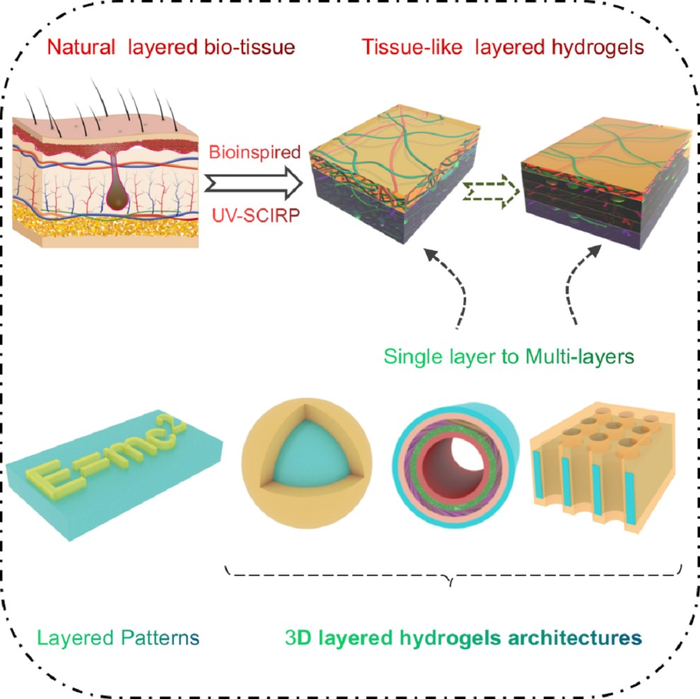
Drawing of constructing tissues-like layered hydrogels

Credit: LICP

Chinese researchers recently demonstrated an innovative chemical method for engineering diverse layered hydrogels with wet and slippery features at room temperature.

This method, known as “ultraviolet-triggered surface catalytically initiated radical polymerization (UV-SCIRP),” was proposed by Prof. ZHOU Feng’s group from the Lanzhou Institute of Chemical Physics (LICP) of the Chinese Academy of Sciences (CAS).

Numerous natural materials and biotissues-from nacres to muscle and arteries-possess microstructures with layered compositions and aligned architecture that are very beneficial because they have unique material properties and desirable multifunctionality.

For this reason, constructing layered structural hydrogels that are wet and slippery, anisotropic and hierarchical has attracted the interest of the biomedical, robotics and soft device fields due to their natural tissue-like properties.

Formation of natural, layered biotissue is a time-dominated living growing process by which the micro-network structure, geometry, thickness, composition and mechanical properties of each layer can be finely controlled.

“For current preparation techniques, they are typically physical manufacturing routes, like mechanically building a wall by continuously stacking bricks,” said Dr. MA Shuanhong, corresponding author of the study.

By adopting the redox mechanism, the researchers generated Fe2+ catalysts in situ on the surface of the hydrogel substrate, resulting in fast radical polymerization of monomer at the solid-liquid interface, along with the controllable growth of an interpenetrated single or multi-layered hydrogel network coating at room temperature.

According to the researchers, reiterative application of UV-SCIRP enables fabrication of multi-layered hydrogels with diverse components and layer features. The surface-catalyzed gelation enables the method to efficiently construct complex hydrogel patterns, non-flat arbitrary-shaped hydrogel objects and blood vessel-like intricate multi-layered hydrogel tubes.

The UV-SCIRP method appears suitable for effortlessly modifying the surface wettability and lubricating properties of hydrogels materials. It will have a transformative impact in the fields of polymer science and surface/interface science.

“It offers a completely new way to develop bio-inspired, layered hydrogel structures with wet and slippery features that are suitable for a wide range of applications including tissue-like models, soft robots and intelligent devices,” said Prof. ZHOU.

This study was published online in Matter and funded by the National Natural Science Foundation of China, the Key Research Program of CAS, and the Youth Innovation Promotion Association of CAS.


Journal

Matter

DOI

10.1016/j.matt.2021.11.018

Method of Research

Experimental study

Subject of Research

Not applicable

Article Title

Continuously Growing Multi-layered Hydrogel Structures with Seamless Interlocked Interface

Article Publication Date

9-Dec-2021

Share12Tweet7Share2ShareShareShare1

Related Posts

Cockatoos Mimic Peers to Sharpen Adaptation Skills, Study Finds — Biology

Cockatoos Mimic Peers to Sharpen Adaptation Skills, Study Finds

May 1, 2026
Gut Microbe’s Sulfated Bile Acid Eases Pediatric Sepsis — Biology

Gut Microbe’s Sulfated Bile Acid Eases Pediatric Sepsis

May 1, 2026

AI Breakthrough Solves One of Science’s Most Challenging Math Problems

May 1, 2026

Controllable Phage System Bridges Evolutionary Gaps

May 1, 2026

POPULAR NEWS

  • Research Indicates Potential Connection Between Prenatal Medication Exposure and Elevated Autism Risk

    831 shares
    Share 332 Tweet 208
  • New Study Reveals Plants Can Detect the Sound of Rain

    712 shares
    Share 284 Tweet 178
  • Scientists Investigate Possible Connection Between COVID-19 and Increased Lung Cancer Risk

    67 shares
    Share 27 Tweet 17
  • Salmonella Haem Blocks Macrophages, Boosts Infection

    61 shares
    Share 24 Tweet 15

About

We bring you the latest biotechnology news from best research centers and universities around the world. Check our website.

Follow us

Recent News

Swift Creation of Conductive Organic Compounds via Mechanochemistry

Scientists Reveal Atomic Mechanism Behind Water-Induced Hydroxylation in CoOx Nanostructures

Study Finds That Nose Prominence Influences Facial Attractiveness, Reports Plastic and Reconstructive Surgery®

Subscribe to Blog via Email

Enter your email address to subscribe to this blog and receive notifications of new posts by email.

Join 82 other subscribers
  • Contact Us

Bioengineer.org © Copyright 2023 All Rights Reserved.

Welcome Back!

Login to your account below

Forgotten Password?

Retrieve your password

Please enter your username or email address to reset your password.

Log In
No Result
View All Result
  • Homepages
    • Home Page 1
    • Home Page 2
  • News
  • National
  • Business
  • Health
  • Lifestyle
  • Science

Bioengineer.org © Copyright 2023 All Rights Reserved.