• HOME
  • NEWS
  • EXPLORE
    • CAREER
      • Companies
      • Jobs
    • EVENTS
    • iGEM
      • News
      • Team
    • PHOTOS
    • VIDEO
    • WIKI
  • BLOG
  • COMMUNITY
    • FACEBOOK
    • INSTAGRAM
    • TWITTER
Monday, June 29, 2026
BIOENGINEER.ORG
No Result
View All Result
  • Login
  • HOME
  • NEWS
  • EXPLORE
    • CAREER
      • Companies
      • Jobs
        • Lecturer
        • PhD Studentship
        • Postdoc
        • Research Assistant
    • EVENTS
    • iGEM
      • News
      • Team
    • PHOTOS
    • VIDEO
    • WIKI
  • BLOG
  • COMMUNITY
    • FACEBOOK
    • INSTAGRAM
    • TWITTER
  • HOME
  • NEWS
  • EXPLORE
    • CAREER
      • Companies
      • Jobs
        • Lecturer
        • PhD Studentship
        • Postdoc
        • Research Assistant
    • EVENTS
    • iGEM
      • News
      • Team
    • PHOTOS
    • VIDEO
    • WIKI
  • BLOG
  • COMMUNITY
    • FACEBOOK
    • INSTAGRAM
    • TWITTER
No Result
View All Result
Bioengineer.org
No Result
View All Result
Home NEWS Science News Chemistry

New material captures carbon dioxide

Bioengineer by Bioengineer
October 11, 2019
in Chemistry
Reading Time: 3 mins read
0
IMAGE
Share on FacebookShare on TwitterShare on LinkedinShare on RedditShare on Telegram

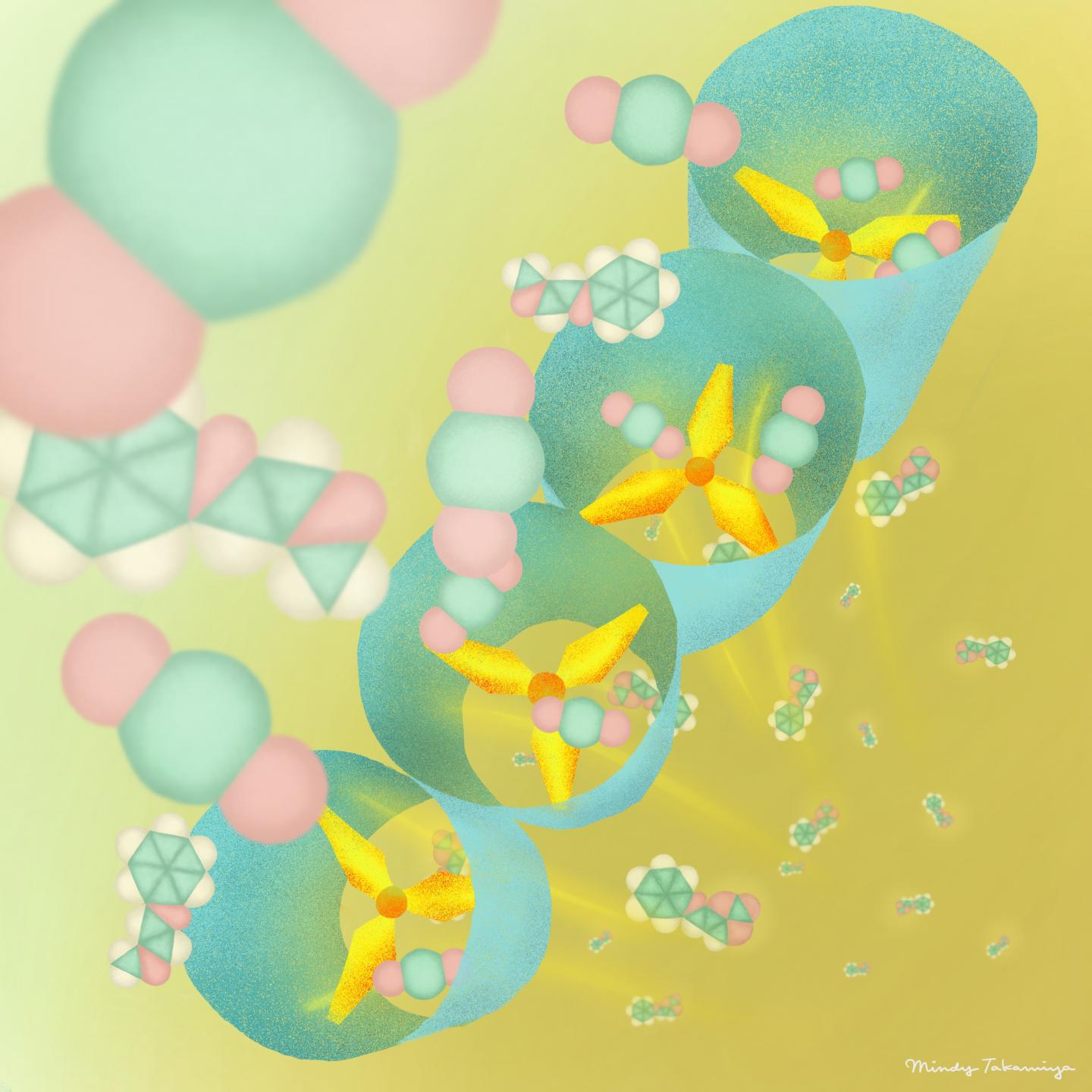
The captured CO2 can be converted into useful organic materials
IMAGE

Credit: Illustration by Mindy Takamiya


A new material that can selectively capture carbon dioxide (CO2) molecules and efficiently convert them into useful organic materials has been developed by researchers at Kyoto University, along with colleagues at the University of Tokyo and Jiangsu Normal University in China. They describe the material in the journal Nature Communications.

Human consumption of fossil fuels has resulted in rising global CO2 emissions, leading to serious problems associated with global warming and climate change. One possible way to counteract this is to capture and sequester carbon from the atmosphere, but current methods are highly energy intensive. The low reactivity of CO2 makes it difficult to capture and convert it efficiently.

“We have successfully designed a porous material which has a high affinity towards CO2 molecules and can quickly and effectively convert it into useful organic materials,” says Ken-ichi Otake, Kyoto University materials chemist from the Institute for Integrated Cell-Material Sciences (iCeMS).

The material is a porous coordination polymer (PCP, also known as MOF; metal-organic framework), a framework consisting of zinc metal ions. The researchers tested their material using X-ray structural analysis and found that it can selectively capture only CO2 molecules with ten times more efficiency than other PCPs.

The material has an organic component with a propeller-like molecular structure, and as CO2 molecules approach the structure, they rotate and rearrange to permit C02 trapping, resulting in slight changes to the molecular channels within the PCP – this allows it to act as molecular sieve that can recognize molecules by size and shape. The PCP is also recyclable; the efficiency of the catalyst did not decrease even after 10 reaction cycles.

“One of the greenest approaches to carbon capture is to recycle the carbon dioxide into high-value chemicals, such as cyclic carbonates which can be used in petrochemicals and pharmaceuticals,” says Susumu Kitagawa, materials chemist at Kyoto University.

After capturing the carbon, the converted material can be used to make polyurethane, a material with a wide variety of applications including clothing, domestic appliances and packaging.

This work highlights the potential of porous coordination polymers for trapping carbon dioxide and converting into useful materials, opening up an avenue for future research into carbon capture materials.

###

DOI: 10.1038/s41467-019-12414-z

About Kyoto University’s Institute for Integrated Cell-Material Sciences (iCeMS)

At iCeMS, our mission is to explore the secrets of life by creating compounds to control cells, and further down the road to create life-inspired materials that confront the myriad problems that afflict modern society. In only a decade, collaborative research at iCeMS has resulted in significant cutting-edge scientific discoveries, and the creation of over 1500 unique materials. We will keep running for the greater future of science.

https://www.icems.kyoto-u.ac.jp/en/

For more information, contact

Mari Toyama/I. Mindy Takamiya

[email protected]

Media Contact
Izumi Mindy Takamiya
[email protected]
81-757-539-764

Related Journal Article

http://dx.doi.org/10.1038/s41467-019-12414-z

Tags: Chemistry/Physics/Materials SciencesEnergy/Fuel (non-petroleum)Industrial Engineering/ChemistryMaterialsNanotechnology/Micromachines
Share12Tweet8Share2ShareShareShare2

Related Posts

AI and Physics Collaborate to Design Advanced Hydrogen Storage Materials

June 25, 2026

International Team Including Dresden Scientists Develops Novel Designer Proteins for Advanced Study of Living Tissue

June 25, 2026

New Study Uncovers Key Factors Driving Water Chemistry in Nanoscale Environments

June 25, 2026

Plasma Technology Extends Catalyst Lifespan in Hydrogen Production

June 24, 2026
Please login to join discussion

POPULAR NEWS

  • Saying Goodbye to PGY-6: Pediatric Fellowship Realities

    103 shares
    Share 41 Tweet 26
  • Multi-Hospital Study Reveals Long Covid Burden Is Twice as High as Current Estimates

    92 shares
    Share 36 Tweet 23
  • Detection of EDCs in Breast Milk and Infant Urine Up to Six Months Highlights Early Exposure Risks

    77 shares
    Share 31 Tweet 19
  • New Drug Candidate Developed at McMaster Shows Potential for Treating Brain Cancer

    58 shares
    Share 23 Tweet 15

About

We bring you the latest biotechnology news from best research centers and universities around the world. Check our website.

Follow us

Recent News

Tracking Lanthanide-Labeled Microplastics in Plants

POSTECH Researchers Slash Cost of Reconstituted Cell-Free Systems by 95%

AI and Physics Collaborate to Design Advanced Hydrogen Storage Materials

Subscribe to Blog via Email

Success! An email was just sent to confirm your subscription. Please find the email now and click 'Confirm' to start subscribing.

Join 82 other subscribers
  • Contact Us

Bioengineer.org © Copyright 2023 All Rights Reserved.

Welcome Back!

Login to your account below

Forgotten Password?

Retrieve your password

Please enter your username or email address to reset your password.

Log In
No Result
View All Result
  • Homepages
    • Home Page 1
    • Home Page 2
  • News
  • National
  • Business
  • Health
  • Lifestyle
  • Science

Bioengineer.org © Copyright 2023 All Rights Reserved.