WASHINGTON — Researchers have created a new glass-ceramic that emits light in response to mechanical stress, a property known as mechanoluminescence. With further development, the new material could be used to create a light source that is switched on by mechanical stress. This could be useful for monitoring stress in artificial joints in the body or providing warnings of dangerous stress or fractures in buildings, bridges and other structures.
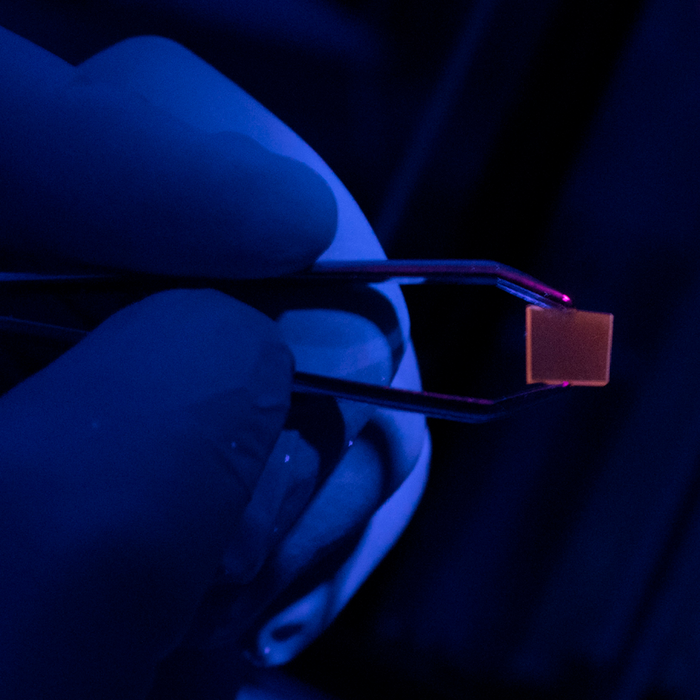
Credit: Lothar Wondraczek, Friedrich Schiller University Jena
WASHINGTON — Researchers have created a new glass-ceramic that emits light in response to mechanical stress, a property known as mechanoluminescence. With further development, the new material could be used to create a light source that is switched on by mechanical stress. This could be useful for monitoring stress in artificial joints in the body or providing warnings of dangerous stress or fractures in buildings, bridges and other structures.
“Most materials exhibiting mechanoluminescence have been made as powders, which aren’t very versatile,” said research team leader Lothar Wondraczek from Friedrich Schiller University Jena in Germany. “We designed a glass-ceramic material with mechanoluminescence, which allows glass-like processing approaches to be used to form virtually any shape — including fiber, beads or microspheres — that can be incorporated into various components and devices.”
The research is reported in a special issue of Optical Materials Express commemorating the United Nations International Year of Glass 2022, which celebrates the essential role that glass plays in society.
The new highly transparent glass-ceramic is made from chromium-doped zinc gallate (ZGO) crystals embedded in a potassium germanate glass matrix. These crystals give the material its mechanoluminescent properties but are so small that they don’t notably affect the visual transparency of the glass.
“Our work could help mechanoluminescent materials find widespread use in a variety of applications, including light-emitting product labels and security codes,” said Wondraczek. “It also ties in well with the International Year of Glass by demonstrating the wide versatility and unexpected properties of glassy materials.”
A more practical material
In addition to being difficult to form into various geometries, mechanoluminescent powders require extra processing steps such as encapsulation in a matrix material. To create a more practical material, the researchers turned to glass-ceramics.
Glass-ceramics are a relatively new type of material that consists of a crystalline material embedded into a glass matrix. The crystals can be used to give these materials very specific properties while the glass matrix allows them to be shaped with many of the same processes used for glass.
The researchers created the mechanoluminescent glass-ceramic by developing an exceptionally fast and stable crystallization process that allows the tiny ZGO crystals to precipitate homogeneously inside the glass after it has been shaped. They showed that the materials emitted light under mechanical stress by using the ball-drop test, a standard way of imparting a known impact force to a material. “We found that the mechanoluminescence response was reproducible and rechargeable and that it exhibited a direct correlation with the impact energy,” said Wondraczek.
Now that they have demonstrated the material’s light-emitting properties, they plan to adapt the glass composition so that it can be formed into sheet-like objects, optical fiber and microscale spherical beads and then explore how these could be used in components and devices. They also aim to exploit other features commonly attributed to glass-ceramics — such as thermal, chemical and mechanical stability — to gain new functions from the glassy materials.
Paper: J. Cao, Y. Ding, R. Sajzew, M. Sun, F. Langenhorst, L. Wondraczek, “Mechanoluminescence from highly transparent ZGO:Cr spinel glass ceramics,” Opt. Mater. Express Vol. 12, Issue 8, pp. 3238-3247 (2022).
https://doi.org/10.1364/OME.459185
About Optical Materials Express
Optical Materials Express is an open-access journal focusing on the synthesis, processing and characterization of materials for applications in optics and photonics. It is published by Optica Publishing Group and emphasizes advances in novel optical materials, their properties, modeling, synthesis and fabrication techniques; how such materials contribute to novel optical behavior; and how they enable new or improved optical devices. The Editor-in-Chief is Andrea Alù from City University of New York, USA. For more information. For more information, visit Optical Materials Express.
About Optica Publishing Group (formerly OSA)
Optica Publishing Group is a division of Optica (formerly OSA), Advancing Optics and Photonics Worldwide. It publishes the largest collection of peer-reviewed content in optics and photonics, including 18 prestigious journals, the society’s flagship member magazine, and papers from more than 835 conferences, including 6,500+ associated videos. With over 400,000 journal articles, conference papers and videos to search, discover and access, Optica Publishing Group represents the full range of research in the field from around the globe.
Journal
Optical Materials Express
DOI
10.1364/OME.459185
Article Title
Mechanoluminescence from highly transparent ZGO:Cr spinel glass ceramics
Article Publication Date
26-Jul-2022