• HOME
  • NEWS
  • EXPLORE
    • CAREER
      • Companies
      • Jobs
    • EVENTS
    • iGEM
      • News
      • Team
    • PHOTOS
    • VIDEO
    • WIKI
  • BLOG
  • COMMUNITY
    • FACEBOOK
    • INSTAGRAM
    • TWITTER
Sunday, July 12, 2026
BIOENGINEER.ORG
No Result
View All Result
  • Login
  • HOME
  • NEWS
  • EXPLORE
    • CAREER
      • Companies
      • Jobs
        • Lecturer
        • PhD Studentship
        • Postdoc
        • Research Assistant
    • EVENTS
    • iGEM
      • News
      • Team
    • PHOTOS
    • VIDEO
    • WIKI
  • BLOG
  • COMMUNITY
    • FACEBOOK
    • INSTAGRAM
    • TWITTER
  • HOME
  • NEWS
  • EXPLORE
    • CAREER
      • Companies
      • Jobs
        • Lecturer
        • PhD Studentship
        • Postdoc
        • Research Assistant
    • EVENTS
    • iGEM
      • News
      • Team
    • PHOTOS
    • VIDEO
    • WIKI
  • BLOG
  • COMMUNITY
    • FACEBOOK
    • INSTAGRAM
    • TWITTER
No Result
View All Result
Bioengineer.org
No Result
View All Result
Home NEWS Science News Health

New gene therapy method improves vision in mice with congenital blindness

Bioengineer by Bioengineer
February 7, 2020
in Health
Reading Time: 2 mins read
0
IMAGE
Share on FacebookShare on TwitterShare on LinkedinShare on RedditShare on Telegram

IMAGE

Credit: Koji Nishiguchi, Tohoku University Graduate School of Medicine


Mice born blind have shown significant improvement in vision after undergoing a new gene therapy developed by a team of Japanese scientists.

The results were published on January 24th in Nature Communications.

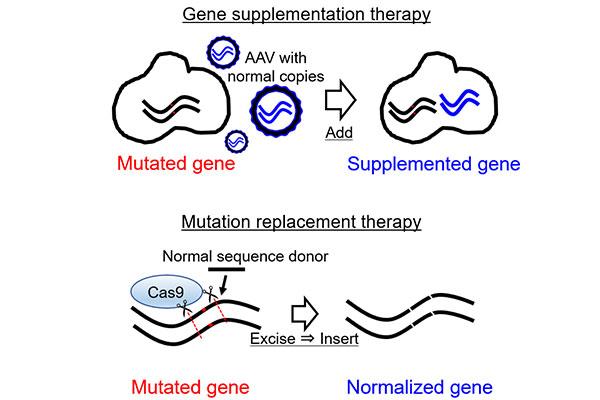
This new method is an alternative strategy of gene supplementation, which involves supplementing the defective gene, such as the ones that can lead to inherited retinal degeneration, with a healthy one. The healthy gene is delivered via the adeno-associated virus (AAV). However, the virus can only hold only a small healthy gene, and the vast majority of patients with defects in a larger gene cannot be treated with this method.

“To overcome this problem, we developed a single AAV gene therapy platform that allows local replacement of a mutated sequence with its healthy counterpart that can treat almost any mutation,” said Koji Nishiguchi, co-first author on the paper and associate professor in the Department of Advanced Ophthalmic Medicine at Tohoku University Graduate School of Medicine.

The single AAV gene therapy platform combines CRISPR-Cas9 technology with micro-homology-mediated end joining. These two thing act essentially as genetic scissors and genetic glue respectively. Researchers can target a specific defective gene, cut it out and glue in a healthy replacement.

In blind mice, this approach rescued approximately 10% of photoreceptors, resulting in improved light sensitivity and an increase in visual activity. The improvement in vision was about the same result gene supplementation can produce.

“By treating mice blinded by inherited retinal degeneration with the new treatment, we show that a robust visual restoration can be achieved at a level similar to that mediated by conventional gene supplementation, assuring its potential for clinical application,” Nishiguchi said. “The platform paves the way for treating patients with mutations in larger genes, which comprise the vast majority of those with inherited retinal degeneration. Furthermore, a similar approach can be applied to treat almost any ocular and non-ocular inherited conditions.”

Now, the researchers are applying the new genome editing platform to develop a therapy for human patients with retinitis pigmentosa, a group of rare conditions that can cause loss of peripheral vision and difficulty seeing at night. They will target common mutations among patients that remain untreatable by conventional gene therapy. Nishiguchi’s team plans to have therapy in a clinical trial by as early as 2025.

###

Media Contact
Koji Nishiguchi
[email protected]
81-227-177-294

Original Source

https://www.tohoku.ac.jp/en/press/new_gene_therapy_congenital_blindness.html

Related Journal Article

http://dx.doi.org/10.1038/s41467-019-14181-3

Tags: Medicine/Health
Share12Tweet8Share2ShareShareShare2

Related Posts

Nationwide Study Reveals Multimorbidity Factors in Older Chinese Adults

July 12, 2026

Clinicopathologic Study Reveals Amyloid Clearance in Alzheimer’s Disease

July 12, 2026

Long-Term Kidney Outcomes After Living Donation in Older Adults Explored

July 12, 2026

Living Alone and Poverty Heighten Risks for Older Nigerians in Cities

July 12, 2026
Please login to join discussion

POPULAR NEWS

  • Detection of EDCs in Breast Milk and Infant Urine Up to Six Months Highlights Early Exposure Risks

    77 shares
    Share 31 Tweet 19
  • New Drug Candidate Developed at McMaster Shows Potential for Treating Brain Cancer

    58 shares
    Share 23 Tweet 15
  • KTU Researchers Explore Ultrasound’s Role in Enhancing Blood Flow Beyond Diagnostics

    53 shares
    Share 21 Tweet 13
  • 高齢者の骨粗鬆症治療の持続性比較

    51 shares
    Share 20 Tweet 13

About

We bring you the latest biotechnology news from best research centers and universities around the world. Check our website.

Follow us

Recent News

Nationwide Study Reveals Multimorbidity Factors in Older Chinese Adults

Clinicopathologic Study Reveals Amyloid Clearance in Alzheimer’s Disease

Long-Term Kidney Outcomes After Living Donation in Older Adults Explored

Subscribe to Blog via Email

Enter your email address to subscribe to this blog and receive notifications of new posts by email.

Join 85 other subscribers
  • Contact Us

Bioengineer.org © Copyright 2023 All Rights Reserved.

Welcome Back!

Login to your account below

Forgotten Password?

Retrieve your password

Please enter your username or email address to reset your password.

Log In
No Result
View All Result
  • Homepages
    • Home Page 1
    • Home Page 2
  • News
  • National
  • Business
  • Health
  • Lifestyle
  • Science

Bioengineer.org © Copyright 2023 All Rights Reserved.