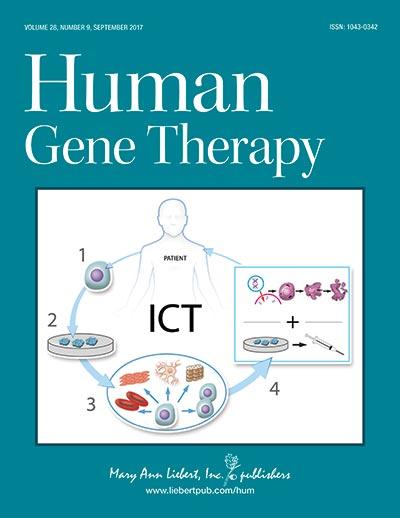
Credit: Mary Ann Liebert, Inc., publishers
New Rochelle, NY, Sept. 22, 2017 — Researchers added a scaffold/matrix attachment region (S/MAR) to a conventional adeno-associated virus (AAV) vector used for gene transfer, and the modified vectors were able to establish colonies and maintain long-term transgene expression in HeLa cells, as reported in Human Gene Therapy, a peer-reviewed journal from Mary Ann Liebert, Inc., publishers. The article is available free on the Human Gene Therapy website until October 22, 2017.
Hildegard Büning, PhD, Hannover Medical School, Germany and colleagues from University of Witten/Herdecke and University of Cologne, University Hospital Cologne, and German Center for Infection Research, Germany, and Cairo University, Egypt coauthored the article entitled " S/MAR Element Facilitates Episomal Long-Term Persistence of Adeno-Associated Virus Vector Genomes in Proliferating Cells." This novel approach, if applicable in other cell types, could help overcome the limitation of being able only to use AAV vectors for gene transfer to proliferating cells. In an unexpected finding, the researchers also showed that even AAV vectors lacking the S/MAR element were able to establish stable transgene-expressing colonies in HeLa cells.
"AAV vectors have so far been most useful in terminally differentiated cells, like neurons and photoreceptor cells, but this advance could greatly expand the utility of AAV vectors in actively dividing cells," says Editor-in-Chief Terence R. Flotte, MD, Celia and Isaac Haidak Professor of Medical Education and Dean, Provost, and Executive Deputy Chancellor, University of Massachusetts Medical School, Worcester, MA.
###
About the Journal
Human Gene Therapy, the Official Journal of the European Society of Gene and Cell Therapy, British Society for Gene and Cell Therapy, French Society of Cell and Gene Therapy, German Society of Gene Therapy, and five other gene therapy societies, is an authoritative peer-reviewed journal published monthly in print and online. Led by Editor-in-Chief Terence R. Flotte, MD, Celia and Isaac Haidak Professor of Medical Education and Dean, Provost, and Executive Deputy Chancellor, University of Massachusetts Medical School, Human Gene Therapy presents reports on the transfer and expression of genes in mammals, including humans. Related topics include improvements in vector development, delivery systems, and animal models, particularly in the areas of cancer, heart disease, viral disease, genetic disease, and neurological disease, as well as ethical, legal, and regulatory issues related to the gene transfer in humans. Its companion journals, Human Gene Therapy Methods, published bimonthly, focuses on the application of gene therapy to product testing and development, and Human Gene Therapy Clinical Development, published quarterly, features data relevant to the regulatory review and commercial development of cell and gene therapy products. Tables of contents for all three publications and a free sample issue may be viewed on the Human Gene Therapy website.
About the Publisher
Mary Ann Liebert, Inc., publishers is a privately held, fully integrated media company known for establishing authoritative peer-reviewed journals in many promising areas of science and biomedical research, including Nucleic Acid Therapeutics, Tissue Engineering, Stem Cells and Development, and Cellular Reprogramming. Its biotechnology trade magazine, GEN (Genetic Engineering & Biotechnology News), was the first in its field and is today the industry's most widely read publication worldwide. A complete list of the firm's 80 journals, books, and newsmagazines is available on the Mary Ann Liebert, Inc., publishers website.
Mary Ann Liebert, Inc.
140 Huguenot St.
New Rochelle NY 10801-5215
http://www.liebertpub.com
Phone: 914-740-2100
800-M-LIEBERT
Fax: 914-740-2101
Media Contact
Kathryn Ryan
[email protected]
914-740-2250
@LiebertPub
http://www.liebertpub.com
Original Source
http://www.liebertpub.com/global/pressrelease/new-gene-delivery-approach-could-allow-long-term-persistence-in-proliferating-cells/2258/ http://dx.doi.org/10.1089/hum.2017.025