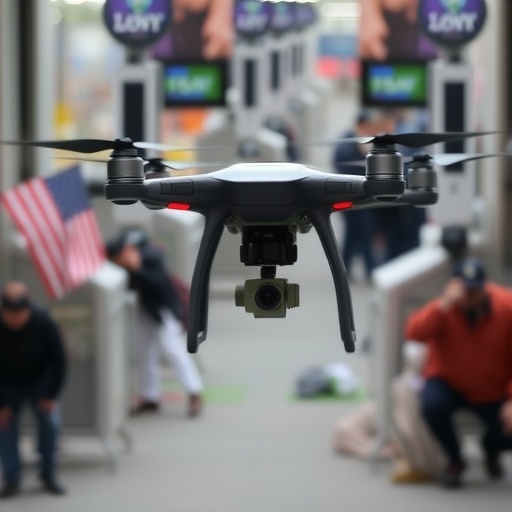
Detecting a small drone at the far edge of a camera’s field of view has long been one of the most stubborn problems in modern computer vision, and a newly published study from researchers in Shenzhen, China, claims a significant advance. Writing in the journal Complex & Intelligent Systems, Haiyuan Huang, Peidong Luo, Tianhong Zhao and Xiaole Shen of Shenzhen Technology University and Shenzhen University describe FLAD, a fusion-based detection framework built specifically to spot tiny unmanned aerial vehicles (UAVs) in long-range visible-light imagery, where targets shrink to a handful of pixels, sink to low signal-to-noise ratios, and compete with cluttered backgrounds and visually similar objects such as birds and distant aircraft.
The scale of the problem is easy to underestimate. A consumer drone at a kilometer’s distance may occupy just a few pixels in a standard video frame, offering almost none of the distinctive shape, texture or color cues that modern object detectors rely on. In such conditions, conventional deep learning detectors trained to recognize large, well-defined objects tend to fail in characteristic ways. Their shallow layers, which encode edges and contours, are drowned out by background noise. Their intermediate feature representations confuse the drone with irrelevant clutter, from power lines to birds. And their detection heads, which make the final bounding-box predictions, become unstable when trying to localize objects so small that a single misplaced pixel boundary can flip a correct detection into a miss.
The Shenzhen team’s key insight was to treat these as three distinct failure modes occurring at three distinct stages of the detection pipeline, and to design a targeted countermeasure for each. FLAD is a three-stage system built on a YOLO11-P2 baseline, an architecture that has been popular for real-time detection tasks because of its speed but which, like its predecessors, was not designed with extreme long-range targets in mind. Rather than redesigning the entire detector, the researchers grafted purpose-built modules onto each stage, a strategy that preserved the baseline’s real-time inference capability while substantially improving its robustness.
At the first stage, addressing contour degradation in shallow features, the team introduced LoGStem, a replacement for the detector’s initial stem layer. LoGStem combines Laplacian-of-Gaussian (LoG)-initialized edge enhancement with Gaussian-initialized residual smoothing. The Laplacian-of-Gaussian operator is a classical image-processing filter long used for blob and edge detection; by initializing convolution kernels with LoG values, the network starts its training from a geometry that is already tuned to respond to sharp intensity transitions, exactly the kind of weak contour signals a distant drone produces against sky or skyline. The companion Gaussian-initialized residual smoothing branch suppresses background noise so that the two effects together sharpen the drone’s outline while quietening everything around it. This matters because in a YOLO-style detector, whatever information the earliest layers discard can never be recovered by later stages, so strengthening the contour cues before they enter the deep network has an outsized influence on the final result.
The second stage addresses clutter-induced ambiguity in intermediate representations. Here the researchers deployed what they call RFAConvLSKBlock, a hybrid module combining receptive-field attention convolution with large selective kernel (LSK) spatial attention. Receptive-field attention convolution allows the network to weigh spatially uneven information within each convolutional window, adapting to the fact that for a tiny target, only a small fraction of a feature map’s receptive field actually carries signal. The large selective kernel, meanwhile, gives the network access to a very large effective field of view while letting it dynamically decide, channel by channel, which portions of that field to attend to. Together, the two mechanisms enhance contextual perception for tiny or weakly textured targets: the network learns to integrate sparse, feeble evidence scattered across a wide region into a confident detection, while damping the influence of the cluttered background that would otherwise trigger false positives.
The third stage tackles localization instability in the detection head. FLAD adopts LSDC-Head, a lightweight decoupled head that uses shared detail-enhanced convolution (DEConv) blocks together with group normalization and learnable per-level regression scaling, while retaining the YOLO-style distribution-based bounding-box regression formulation. Decoupling classification and localization into separate pathways is by now a familiar trick in object detection, but the FLAD design adds detail-enhanced convolutions that encode fine gradient and texture information directly into the head, helping it pin down pixel-tight boundaries around minuscule objects. Group normalization stabilizes training under small batch conditions typical of dense aerial imagery, and the learnable per-level regression scaling allows the network to calibrate how aggressively it refines box coordinates at each feature-map level, a flexibility that matters enormously when the object in question spans only a few pixels at one pyramid level and perhaps a dozen at another.
The empirical results, reported across three public benchmarks, show consistent improvements over the already competitive YOLO11-P2 baseline. On the DUT-Anti-UAV dataset, FLAD’s mAP at the stringent IoU threshold of 0.5 to 0.95 improves from 67.3 percent to 70.4 percent. On the Drone-vs.-Bird dataset, notoriously difficult because it forces the detector to distinguish drones from birds in flight, the same metric rises from 28.0 to 31.4 percent. And on LRDD, a dedicated long-range drone dataset, it climbs from 29.8 to 35.1 percent, a relative gain of roughly eighteen percent in one of the hardest settings. Higher mAP at the looser 0.5 threshold was recorded across all three datasets as well. The consistently modest starting scores on Drone-vs.-Bird and LRDD are themselves telling: they illustrate just how brutal long-range drone detection remains even for state-of-the-art networks, and why incremental-looking gains of several percentage points represent real progress rather than statistical noise.
Crucially, the authors report that these accuracy gains come without sacrificing the real-time inference capability that makes YOLO-family detectors attractive for practical anti-UAV deployments. That combination is rare. Many academic improvements to detection accuracy involve heavier attention modules, deeper feature fusion or larger backbones that push frame rates below usable thresholds. Lightweight decoupled heads and carefully engineered attention blocks, as used in FLAD, keep the computational budget in check, which is essential if the detector is to run on edge hardware at airport perimeters, stadium security posts or military checkpoints.
The broader context is the rapidly escalating challenge of low-altitude airspace security. As consumer and commercial drones proliferate, so do incidents involving unauthorized flights over airports, critical infrastructure, public events and restricted military zones. Counter-UAV systems rely on a layered stack of sensors, including radio-frequency scanners, acoustic arrays and radar, but visible-light and infrared cameras remain central because they provide the visual confirmation needed to classify a target and, ultimately, to document an incursion. Long-range electro-optical detection is the weakest link in that stack: radar may flag an anomaly, but at several hundred meters or more the camera image may be too poor to determine whether it is a bird, a balloon, a parcel drone or something more dangerous. Detectors like FLAD aim directly at that gap, and the choice of benchmarks in the study, spanning generic anti-UAV footage, drone-versus-bird confusion and extreme long-range imagery, reflects the operational scenarios where the technology would be needed.
The work also contributes to a wider research conversation about what makes small-object detection fundamentally hard. It is not simply a matter of resolution: even with high-resolution sensors, the signal-to-noise ratio of a few-pixel target is so low that it effectively vanishes into background statistics. The FLAD architecture embodies a growing consensus that the solution lies in aggressively fusing cues across scales and stages, contour evidence from the earliest layers, contextual evidence from mid-level attention, and calibrated localization from the head, rather than hoping any single component will solve the problem. Each module in the pipeline is, in effect, a claim about where information is being lost and how to recapture it, and the ablation-style three-stage framing of the paper makes that reasoning unusually explicit.
The study, which was funded by the Shenzhen Science and Technology Program and the Natural Science Foundation of Top Talent of Shenzhen Technology University, was published as an open-access article, meaning security researchers and detector developers worldwide can examine, replicate and build upon the architecture without restriction. The corresponding author, Xiaole Shen of the School of Artificial Intelligence at Shenzhen Technology University, led the team, which also belongs to the Guangdong Provincial Engineering Technology Research Center for Edge Intelligence, an affiliation that hints at the intended deployment environment: detection algorithms light enough to run at the network edge, close to the sensor, where latency and bandwidth constraints are tightest.
Whether FLAD or its descendants will find their way into commercial counter-drone products remains to be seen, but the direction of travel in the field is clear. As drones become cheaper, more capable and more common, the race between those who fly them and those who must find them is increasingly fought in pixels. Studies like this one suggest that the finding side is beginning to catch up.
Subject of Research: Fusion-based deep learning detection of small, long-range UAVs in complex backgrounds using visible-light imagery
Subject of Research: Technology and Engineering
Article Title: FLAD: Fusion-Based Long-Range Anti-UAV detection in complex backgrounds
Article References: Huang, H., Luo, P., Zhao, T., & Shen, X. (2026). FLAD: Fusion-Based Long-Range Anti-UAV detection in complex backgrounds. Complex & Intelligent Systems. https://doi.org/10.1007/s40747-026-02495-x
Image Credits: AI Generated
DOI: 10.1007/s40747-026-02495-x
Keywords: Anti-UAV detection, Object detection, YOLO11, Receptive-field attention, Large selective kernel, Decoupled detection head, Long-range drone detection, Laplacian-of-Gaussian, Small object detection, Complex backgrounds
Cite Scienmag News
APA MLA Chicago
Blake Davidson. (September 4, 2026). New Fusion-Based Method Detects Drones at Long Range in Cluttered Backgrounds. Scienmag. https://scienmag.com/new-fusion-based-method-detects-drones-at-long-range-in-cluttered-backgrounds/
Blake Davidson. “New Fusion-Based Method Detects Drones at Long Range in Cluttered Backgrounds.” Scienmag, 4 September 2026, https://scienmag.com/new-fusion-based-method-detects-drones-at-long-range-in-cluttered-backgrounds/. Accessed 4 September 2026.
Blake Davidson. “New Fusion-Based Method Detects Drones at Long Range in Cluttered Backgrounds.” Scienmag. September 4, 2026. https://scienmag.com/new-fusion-based-method-detects-drones-at-long-range-in-cluttered-backgrounds/
Copy citation Download RIS
Tags: advanced computer vision for aerial surveillancecluttered environment drone recognitiondeep learning challenges in drone detectiondrone detection in long-range imageryfusion-based UAV detection frameworklong-range visible-light drone detectionmulti-scale drone detection techniquesremote drone monitoring technologysmall drone identification in cluttered backgroundstiny unmanned aerial vehicle detection methodsUAV detection amidst birds and aircraftUAV detection in low signal-to-noise conditions