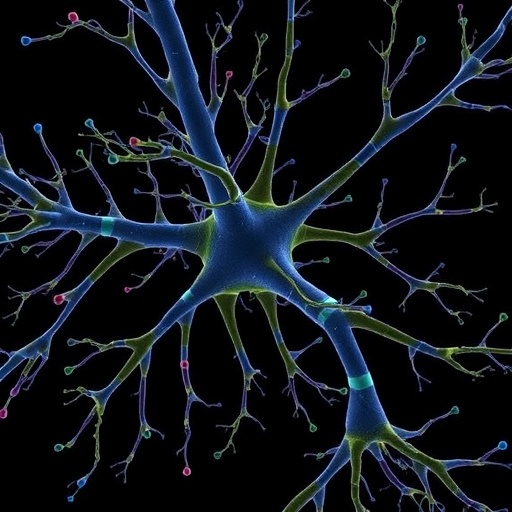
In a groundbreaking advance for neuroscience, researchers have unveiled a robust computational framework enabling the detailed comparative analysis of dendritic architecture in cortical neurons across humans and mice. This tool provides an unprecedented lens into how neuron structure varies between species in analogous brain regions, a step that promises to refine our understanding of brain evolution and function.
Dendrites, the branched extensions of neurons, are crucial for receiving and integrating synaptic inputs. While it is known that dendritic morphology plays a key role in neuronal function, direct comparisons of dendritic patterns between humans and common animal models like mice have been limited by technical and analytical challenges. This new framework overcomes these obstacles by systematically registering neuron images from corresponding cortical areas, aligning and quantifying dendritic features with high precision.
The methodology involves mapping neurons from specific cortical regions in both species, ensuring that the comparative analysis accounts for anatomical homology rather than arbitrary regional matching. This spatial correspondence is vital as it controls for the intrinsic variability that arises from the functional specialization of different cortical zones. The researchers digitally reconstruct neuron dendrites and apply sophisticated metrics to quantify branching patterns, total dendritic length, and other morphometric parameters.
One of the striking findings revealed by this comparative approach is the distinct complexity of human cortical neuron dendrites versus those in mice, even within the same cortical areas. Human neurons tend to have more intricate branching and longer total dendritic arborization, a feature thought to underlie enhanced computational capacity in the human brain. This structural divergence could explain species-specific cognitive abilities and neural processing strategies.
The framework also highlights variability within both species, demonstrating that dendritic morphology is influenced by local circuit function and possibly species-specific adaptations. Such insights are vital, as they caution against simplistic extrapolations from mouse models to human brain function in neurological research and drug development.
Technically, this framework integrates advanced imaging techniques with computational neuroscience tools, including machine learning algorithms designed to capture subtle morphological nuances. It thus represents a confluence of biology, informatics, and data science, enabling neuroscientists to push beyond traditional descriptive histology toward quantitative and comparative neuroanatomy.
By establishing a standardized platform for cross-species dendritic analysis, this approach sets the stage for future studies investigating how genetic, developmental, and environmental factors shape neuron structure. Moreover, it offers a blueprint for studying other brain cell types and circuits, expanding the comparative neurobiology horizon.
The implications of this research resonate broadly, from understanding human-specific brain diseases to improving the translational relevance of animal models. Ultimately, such comparative frameworks are indispensable for decoding the structural underpinnings of brain function and evolution.
Subject of Research: Comparative analysis of human and mouse cortical neuron dendrites
Article Title: A framework for comparative analysis of human and mouse cortical neuron dendrites in corresponding brain regions
Article References:
Yun, Z., Ye, W., Ji, N. et al. A framework for comparative analysis of human and mouse cortical neuron dendrites in corresponding brain regions. Nat Neurosci (2026). https://doi.org/10.1038/s41593-026-02376-z
Image Credits: AI Generated
DOI: https://doi.org/10.1038/s41593-026-02376-z
Tags: brain circuit architecturecomputational neuroscience toolscortical neuron dendrite comparisoncortical region homology mappingcross-species neuron structural analysisdendritic branching pattern measurementdendritic morphology analysishuman and mouse brain evolutionmorphometric analysis of dendritesneuron image registrationneuron reconstruction techniquesNeuroscience