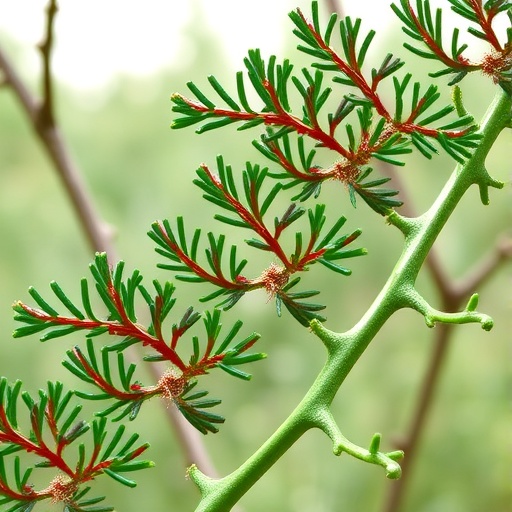
Biological invasions can bring once-isolated lineages into contact, and hybridization often follows. That genetic mixing may generate new combinations of traits and help invasive species establish quickly, even while maintaining unexpected levels of diversity. Now, a new genomic study links these processes to the ongoing spread of invasive saltcedar in the American Southwest.
Saltcedar (Tamarix spp.) poses major ecological challenges along river corridors, where it can alter water use, soil conditions, and native plant communities. Researchers focused on invasive populations in the southwestern United States and asked a central question: were these populations formed from one native source, or do they reflect repeated hybridization between parental lineages?
To investigate, the team analyzed genome-wide SNP data from 319 individuals, including representatives of the proposed parental lineages Tamarix chinensis and Tamarix ramosissima. By combining population genomics with ecological niche modeling and demographic inference, the study reconstructed likely origins of the introduced populations and quantified how ancestry is distributed across major river basins.
The results show that introduced saltcedar populations are predominantly admixed, with different proportions of ancestry from both parental lineages. Instead of a uniform genetic makeup, US populations display basin-specific patterns that suggest multiple waves and sources of genetic input over time.
Multiple statistical and comparative-genomic approaches independently supported widespread admixture. Hybrid indices indicated frequent intermediate ancestry, while f3-statistics provided formal tests consistent with gene flow. Phylogenetic network analyses further captured non-tree-like relationships expected when lineages exchange genes after secondary contact.
Demographic inference pointed to a recent invasion history consistent with historical records of introduction. Importantly, the data suggest that hybrid or admixed propagules were likely introduced first and then expanded, rather than hybridization occurring only after establishment.
Ecological niche modeling added a parallel layer of evidence. The introduced populations showed significant differentiation and signals consistent with niche expansion relative to their native parental counterparts, implying that hybridization may coincide with ecological opportunity in invaded habitats.
Taken together, the study indicates that hybridization—coupled with multiple introductions and post-introduction demographic processes—helped maintain neutral genetic diversity and may have contributed to saltcedar’s persistence. More broadly, it demonstrates how integrating genomic evidence with ecological modeling can clarify the evolutionary dynamics that underpin biological invasions.
Subject of Research: Biological invasions; hybridization; population genomics and ecological niche modeling
Article Title: Genomic evidence for widespread hybridization and demographic history in invasive saltcedar
Article References:
Lee, SR., Choi, TY. Genomic evidence for widespread hybridization and demographic history in invasive saltcedar. Heredity (2026). https://doi.org/10.1038/s41437-026-00866-1
Image Credits: AI Generated
DOI: https://doi.org/10.1038/s41437-026-00866-1
Keywords: not provided
Tags: basin-specific genetic structure in Tamarixecological impact of saltcedarecological niche modeling of invasive plantsgenetic diversity in invasive populationsgenomic analysis of invasive specieshybrid origin of saltcedarhybridization in invasive plantsinvasion pathways of saltcedarinvasive species demographic historySaltcedar invasion geneticsSNP data in plant invasionsTamarix spp. population genomics