• HOME
  • NEWS
  • EXPLORE
    • CAREER
      • Companies
      • Jobs
    • EVENTS
    • iGEM
      • News
      • Team
    • PHOTOS
    • VIDEO
    • WIKI
  • BLOG
  • COMMUNITY
    • FACEBOOK
    • INSTAGRAM
    • TWITTER
Sunday, May 10, 2026
BIOENGINEER.ORG
No Result
View All Result
  • Login
  • HOME
  • NEWS
  • EXPLORE
    • CAREER
      • Companies
      • Jobs
        • Lecturer
        • PhD Studentship
        • Postdoc
        • Research Assistant
    • EVENTS
    • iGEM
      • News
      • Team
    • PHOTOS
    • VIDEO
    • WIKI
  • BLOG
  • COMMUNITY
    • FACEBOOK
    • INSTAGRAM
    • TWITTER
  • HOME
  • NEWS
  • EXPLORE
    • CAREER
      • Companies
      • Jobs
        • Lecturer
        • PhD Studentship
        • Postdoc
        • Research Assistant
    • EVENTS
    • iGEM
      • News
      • Team
    • PHOTOS
    • VIDEO
    • WIKI
  • BLOG
  • COMMUNITY
    • FACEBOOK
    • INSTAGRAM
    • TWITTER
No Result
View All Result
Bioengineer.org
No Result
View All Result
Home NEWS Science News Biology

New fossils shed light on how snakes got their bite and lost their legs

Bioengineer by Bioengineer
November 20, 2019
in Biology
Reading Time: 2 mins read
0
IMAGE
Share on FacebookShare on TwitterShare on LinkedinShare on RedditShare on Telegram

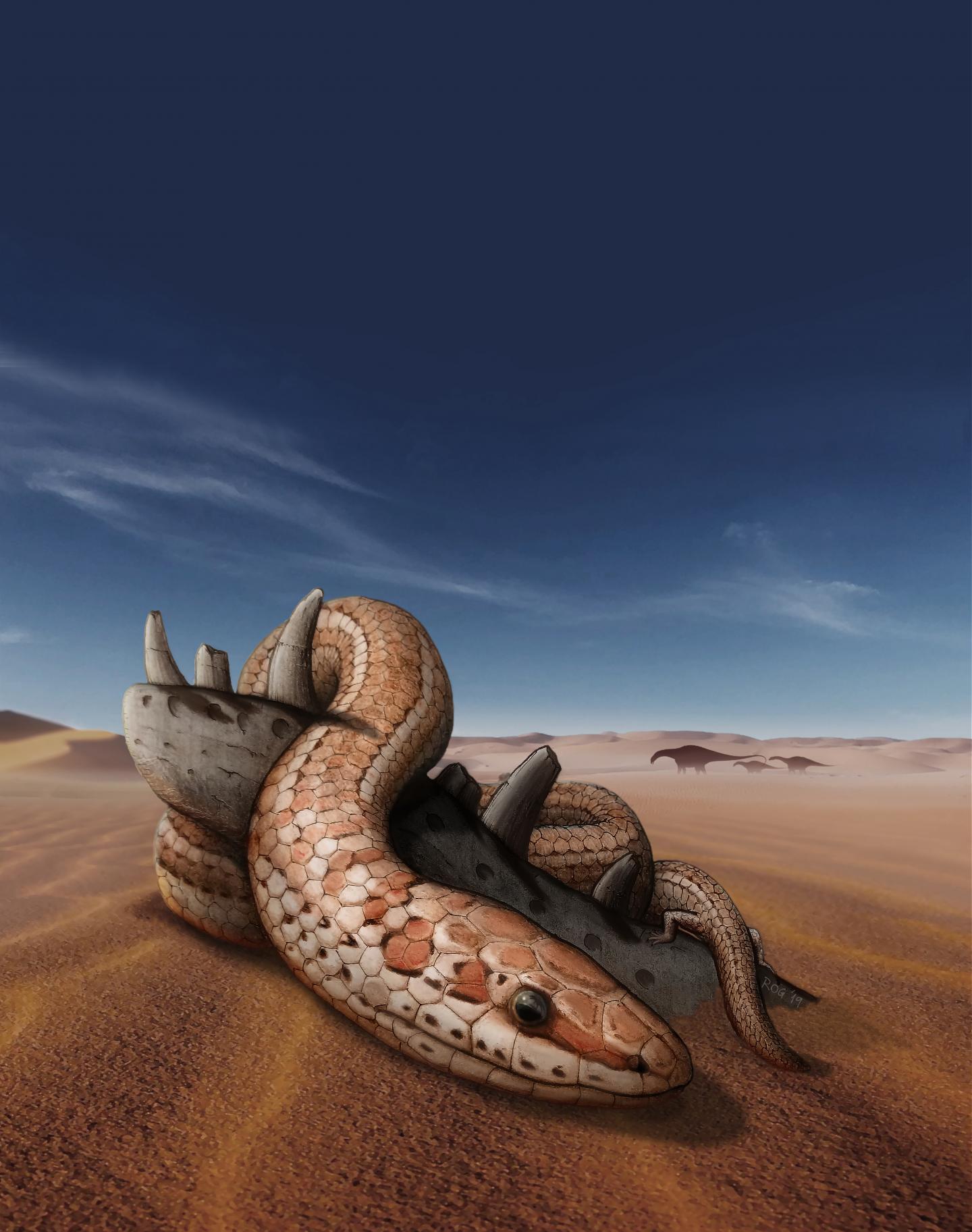
New fossils of an ancient legged snake, called Najash, shed light on the origin of the slithering reptiles.
IMAGE

Credit: Render of Najash by Raúl O. Gómez, Universidad de Buenos Aires, Buenos Aires, Argentina


New fossils of an ancient legged snake, called Najash, shed light on the origin of the slithering reptiles.

The fossil discoveries published in Science Advances have revealed they possessed hind legs during the first 70 million years of their evolution.

They also provide details about how the flexible skull of snakes evolved from their lizard ancestors.

The evolution of the snake body has captivated researchers for a long time – representing one of the most dramatic examples of the vertebrate body’s ability to adapt – but a limited fossil record has obscured our understanding of their early evolution until now.

Dr Alessandro Palci, from Flinders University, was part of the international research team that performed high-resolution (CT) scanning and light microscopy of the preserved skulls of Najash to reveal substantial new anatomical data on the early evolution of snakes.

“Snakes are famously legless, but then so are many lizards. What truly sets snakes apart is their highly mobile skull, which allows them to swallow large prey items. For a long time we have been lacking detailed information about the transition from the relatively rigid skull of a lizard to the super flexible skull of snakes”.

“Najash has the most complete, three-dimensionally preserved skull of any ancient snake, and this is providing an amazing amount of new information on how the head of snakes evolved. It has some, but not all of the flexible joints found in the skull of modern snakes. Its middle ear is intermediate between that of lizards and living snakes, and unlike all living snakes it retains a well-developed cheekbone, which again is reminiscent of that of lizards.”

Flinders University and South Australian Museum researcher Professor Mike Lee, was also part of the study, and adds “Najash shows how snakes evolved from lizards in incremental evolutionary steps, just like Darwin predicted.”

The new snake family tree also reveals that snakes possessed small but perfectly formed hind legs for the first 70 million years of their evolution.

“These primitive snakes with little legs weren’t just a transient evolutionary stage on the way to something better. Rather, they had a highly successful body plan that persisted across many millions of years, and diversified into a range of terrestrial, burowing and aquatic niches,” says Professor Lee.

###

The study was led by Fernando F. Garberoglio at Universidad Maimónides in Buenos Aires, with collaborators M.W. Caldwell at University of Alberta, Dr Alessandro Palci and Professor Mike Lee at Flinders University and the South Australian Museum in Adelaide, R.O. Gómez at Universidad de Buenos Aires, R.L. Nydam at Midwestern University AZ; H.C.E. Larsson at McGill University and T.R. Simões at Harvard University.

Media Contact
Dr Alessandro Palci
[email protected]
780-231-1307

Related Journal Article

http://dx.doi.org/10.1126/sciadv.aax5833

Tags: BiologyEvolutionGenesPaleontology
Share12Tweet8Share2ShareShareShare2

Related Posts

Ancient Plant Populations Reveal Fresh Insights into Climate Resilience — Biology

Ancient Plant Populations Reveal Fresh Insights into Climate Resilience

May 8, 2026
Rare Brain Disorders in Children Linked to Mutations in Lesser-Known Protein Complex — Biology

Rare Brain Disorders in Children Linked to Mutations in Lesser-Known Protein Complex

May 8, 2026

From Odd Insect to Underwater Predator: The Remarkable Evolution of a Bloodthirsty Fruit Fly

May 8, 2026

SNU Professor Sangwoo Seo’s Team Develops Next-Generation CRISPR Biocontainment Technology to Control Microbial Survival Without DNA Cleavage

May 8, 2026
Please login to join discussion

POPULAR NEWS

  • Research Indicates Potential Connection Between Prenatal Medication Exposure and Elevated Autism Risk

    840 shares
    Share 336 Tweet 210
  • New Study Reveals Plants Can Detect the Sound of Rain

    727 shares
    Share 290 Tweet 181
  • Scientists Investigate Possible Connection Between COVID-19 and Increased Lung Cancer Risk

    68 shares
    Share 27 Tweet 17
  • Salmonella Haem Blocks Macrophages, Boosts Infection

    61 shares
    Share 24 Tweet 15

About

We bring you the latest biotechnology news from best research centers and universities around the world. Check our website.

Follow us

Recent News

Urdu Fall Risk Questionnaire Adapted for Elderly

Key Pharmacological Markers for HIV Prevention in MSM

Taking 8,500 Steps Daily May Aid Long-Term Weight Management, Study Finds

Subscribe to Blog via Email

Enter your email address to subscribe to this blog and receive notifications of new posts by email.

Join 82 other subscribers
  • Contact Us

Bioengineer.org © Copyright 2023 All Rights Reserved.

Welcome Back!

Login to your account below

Forgotten Password?

Retrieve your password

Please enter your username or email address to reset your password.

Log In
No Result
View All Result
  • Homepages
    • Home Page 1
    • Home Page 2
  • News
  • National
  • Business
  • Health
  • Lifestyle
  • Science

Bioengineer.org © Copyright 2023 All Rights Reserved.