• HOME
  • NEWS
  • EXPLORE
    • CAREER
      • Companies
      • Jobs
    • EVENTS
    • iGEM
      • News
      • Team
    • PHOTOS
    • VIDEO
    • WIKI
  • BLOG
  • COMMUNITY
    • FACEBOOK
    • INSTAGRAM
    • TWITTER
Tuesday, June 30, 2026
BIOENGINEER.ORG
No Result
View All Result
  • Login
  • HOME
  • NEWS
  • EXPLORE
    • CAREER
      • Companies
      • Jobs
        • Lecturer
        • PhD Studentship
        • Postdoc
        • Research Assistant
    • EVENTS
    • iGEM
      • News
      • Team
    • PHOTOS
    • VIDEO
    • WIKI
  • BLOG
  • COMMUNITY
    • FACEBOOK
    • INSTAGRAM
    • TWITTER
  • HOME
  • NEWS
  • EXPLORE
    • CAREER
      • Companies
      • Jobs
        • Lecturer
        • PhD Studentship
        • Postdoc
        • Research Assistant
    • EVENTS
    • iGEM
      • News
      • Team
    • PHOTOS
    • VIDEO
    • WIKI
  • BLOG
  • COMMUNITY
    • FACEBOOK
    • INSTAGRAM
    • TWITTER
No Result
View All Result
Bioengineer.org
No Result
View All Result
Home NEWS Science News Health

New findings shed light on selective therapeutics for IDH1-mutated glioma

Bioengineer by Bioengineer
April 13, 2020
in Health
Reading Time: 2 mins read
0
IMAGE
Share on FacebookShare on TwitterShare on LinkedinShare on RedditShare on Telegram

IMAGE

Credit: DICP

Findings of a new study led by Prof. XU Guowang from the Dalian Institute of Chemical Physics (DICP) of the Chinese Academy of Sciences and Prof. YANG Chunzhang from the National Cancer Institute shed light on the selective therapeutics for IDH1-mutated glioma by targeting glutathione synthesis pathway.

The study was published in Proceedings of the National Academy of Sciences on Apr. 14.
Glioma is the most common type of primary brain tumors. Isocitrate dehydrogenase I (IDH1) mutation is a cancer-associated mutation highly prevalent in patients with glioma.

Although the oncogenic role of IDH1 mutation has been shown in several human solid tumors, selective therapeutics for IDH1-mutated malignancies remain unavailable.

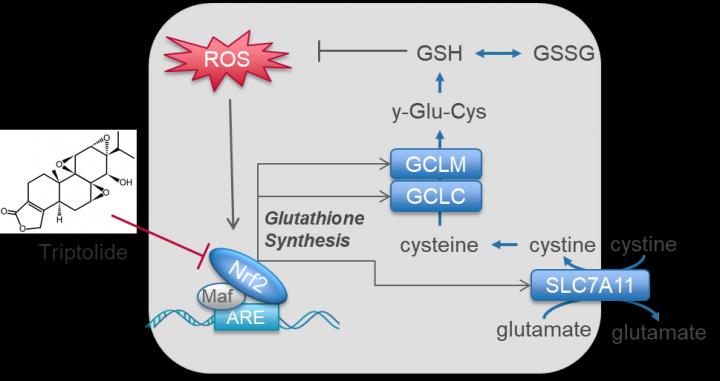
The researchers demonstrated that glutathione de novo synthesis plays an essential role in IDH1-mutated cancer cells. Glutathione synthesis was controlled by a transcription factor NF-E2-related factor 2 (Nrf2), which governs the gene expressions for antioxidative pathway.

“Our in vitro findings suggest that the disruption of Nrf2-driven glutathione synthesis pathway establishes synergistic lethality with a neomorphic IDH1 mutation, ” said Prof. XU.

Triptolide, a diterpenoid epoxide from Tripterygium wilfordii, served as a potent Nrf2 inhibitor. “Triptolide exhibited selective cytotoxicity to patient-derived IDH1-mutated glioma cells in vitro and in vivo. Furthermore, we studied the anticancer mechanism of triptolide.” YANG said.

Mechanistically, triptolide compromised the expression of GCLC, GCLM, and SLC7A11, which disrupted glutathione metabolism and established synthetic lethality with reactive oxygen species (ROS) derived from IDH1 mutant neomorphic activity.

The study highlights triptolide as a valuable therapeutic approach for IDH1-mutated malignancies by targeting the Nrf2-driven glutathione synthesis pathway.

###

Media Contact
CHEN Si
[email protected]

Original Source

http://english.cas.cn/

Related Journal Article

http://dx.doi.org/10.1073/pnas.1913633117

Tags: cancerMedicine/Health
Share12Tweet8Share2ShareShareShare2

Related Posts

Tracking Lanthanide-Labeled Microplastics in Plants

June 25, 2026

Neural Design Enables Zero-Shot Drug-Binding Proteins

June 25, 2026

Genomic Insights into Human Skin Fungi Diversity

June 25, 2026

Chiral Laser Gyroscopes Surpass Lock-In Limit

June 25, 2026
Please login to join discussion

POPULAR NEWS

  • Saying Goodbye to PGY-6: Pediatric Fellowship Realities

    103 shares
    Share 41 Tweet 26
  • Multi-Hospital Study Reveals Long Covid Burden Is Twice as High as Current Estimates

    92 shares
    Share 36 Tweet 23
  • Detection of EDCs in Breast Milk and Infant Urine Up to Six Months Highlights Early Exposure Risks

    77 shares
    Share 31 Tweet 19
  • New Drug Candidate Developed at McMaster Shows Potential for Treating Brain Cancer

    58 shares
    Share 23 Tweet 15

About

We bring you the latest biotechnology news from best research centers and universities around the world. Check our website.

Follow us

Recent News

Tracking Lanthanide-Labeled Microplastics in Plants

POSTECH Researchers Slash Cost of Reconstituted Cell-Free Systems by 95%

AI and Physics Collaborate to Design Advanced Hydrogen Storage Materials

Subscribe to Blog via Email

Success! An email was just sent to confirm your subscription. Please find the email now and click 'Confirm' to start subscribing.

Join 82 other subscribers
  • Contact Us

Bioengineer.org © Copyright 2023 All Rights Reserved.

Welcome Back!

Login to your account below

Forgotten Password?

Retrieve your password

Please enter your username or email address to reset your password.

Log In
No Result
View All Result
  • Homepages
    • Home Page 1
    • Home Page 2
  • News
  • National
  • Business
  • Health
  • Lifestyle
  • Science

Bioengineer.org © Copyright 2023 All Rights Reserved.