• HOME
  • NEWS
  • EXPLORE
    • CAREER
      • Companies
      • Jobs
    • EVENTS
    • iGEM
      • News
      • Team
    • PHOTOS
    • VIDEO
    • WIKI
  • BLOG
  • COMMUNITY
    • FACEBOOK
    • INSTAGRAM
    • TWITTER
Monday, May 18, 2026
BIOENGINEER.ORG
No Result
View All Result
  • Login
  • HOME
  • NEWS
  • EXPLORE
    • CAREER
      • Companies
      • Jobs
        • Lecturer
        • PhD Studentship
        • Postdoc
        • Research Assistant
    • EVENTS
    • iGEM
      • News
      • Team
    • PHOTOS
    • VIDEO
    • WIKI
  • BLOG
  • COMMUNITY
    • FACEBOOK
    • INSTAGRAM
    • TWITTER
  • HOME
  • NEWS
  • EXPLORE
    • CAREER
      • Companies
      • Jobs
        • Lecturer
        • PhD Studentship
        • Postdoc
        • Research Assistant
    • EVENTS
    • iGEM
      • News
      • Team
    • PHOTOS
    • VIDEO
    • WIKI
  • BLOG
  • COMMUNITY
    • FACEBOOK
    • INSTAGRAM
    • TWITTER
No Result
View All Result
Bioengineer.org
No Result
View All Result
Home NEWS Science News Chemistry

New exploration method for geothermal energy

Bioengineer by Bioengineer
November 12, 2019
in Chemistry
Reading Time: 2 mins read
0
IMAGE
Share on FacebookShare on TwitterShare on LinkedinShare on RedditShare on Telegram

International research team presents combination of mapping of underwater structures and geochemical measurements
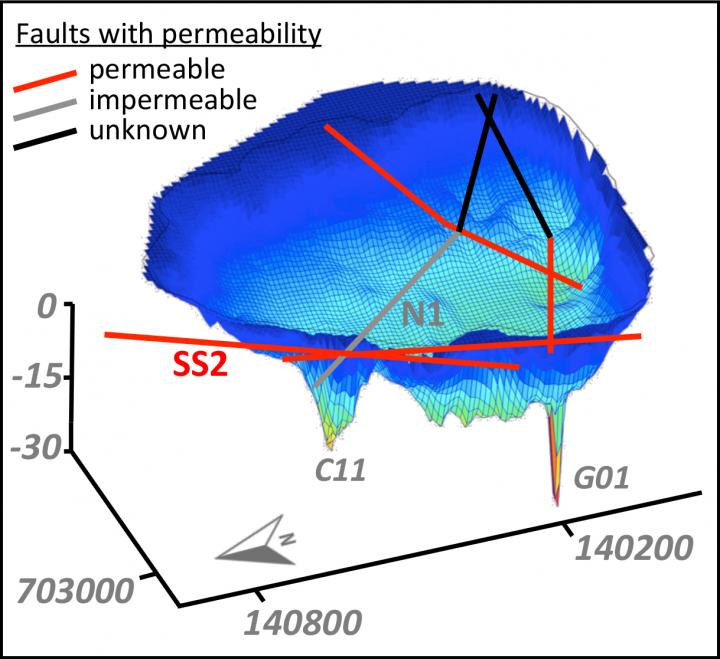
IMAGE

Credit: CC BY 4.0: Maren Brehme; DOI:10.1038/s41598-019-52638-z


Where to drill? This is the basic question in the exploration of underground energy resources, such as geothermal energy. Water in rocks flows along permeable pathways, which are the main target for geothermal drilling. Borehole, core and micro-earthquake data show that the pathways are spatially connected, permeable structures, such as fractures or faults in the rock. However, the geothermal potential of these structures cannot be fully exploited with the techniques available to date.

A research team led by Maren Brehme, research scientist at the GFZ German Research Centre for Geosciences until August 2019 and now Assistant Professor at the TU Delft, presents a new method for locating potential drilling sites that are covered by water. “In the future, our method will make it possible to map geological structures under water and draw conclusions about the inflow from surrounding layers,” says Maren Brehme.

Since geothermal fields are often located in volcanic areas, they usually occur near or below crater lakes. “However, these lakes hide structures that are important for geothermal energy,” explains Maren Brehme. “In the study, we showed that volcanic lakes such as the Lake Linau in Indonesia, which we investigated, have so-called ‘sweet spots’, deep holes with fluid inflow from the surrounding rock.” The method is not limited to volcanic lakes though. It can also be applied to other underwater areas.

*Novel combination of two technologies brings success*

The new approach combines bathymetry measurements with geochemical profiles. In this study, bathymetry (from Greek bathýs ‘deep’ and métron ‘measure’) is used to map fault zones and geyser-like holes in the lake floor. Its most important feature is the echo sounder. The geochemical profiles from data on temperature, salinity, density and pH at different depths show areas in the lake with inflows from the surrounding geothermal reservoir. The combination allows the distinction between permeable and non-permeable structures, which was previously not possible. With this method, promising locations for drilling can be located more precisely.

The related field work took place in 2018 during an expedition to Lake Linau led by Maren Brehme. It was part of the long-standing GFZ cooperation with Indonesian partners funded by the German Federal Ministry of Education and Research. The Lake Linau is only a few kilometres from the Lahendong site, where the first geothermal low-temperature demonstration power plant in Indonesia, jointly developed by GFZ and Indonesian partners, was successfully commissioned in 2017.

###

Media Contact
Philipp Hummel
[email protected]
49-331-288-1049

Original Source

https://www.gfz-potsdam.de/en/media-and-communication/news/details/article/new-exploration-method-for-geothermal-energy/

Related Journal Article

http://dx.doi.org/10.1038/s41598-019-52638-z

Tags: Climate ChangeEarth ScienceEnergy SourcesGeology/SoilHydrology/Water ResourcesTemperature-Dependent Phenomena
Share12Tweet8Share2ShareShareShare2

Related Posts

Sharpening Our View of Bacteria — Chemistry

Sharpening Our View of Bacteria

May 18, 2026
New Drexel Study Reveals Key to Keeping Students on Track in Physics Learning — Chemistry

New Drexel Study Reveals Key to Keeping Students on Track in Physics Learning

May 15, 2026

Reversible Glue Technology Powers Up with Electric Activation

May 15, 2026

Sweet as Honey: Unveiling a New Heat Transport Regime in Ultrathin Semiconductors

May 15, 2026
Please login to join discussion

POPULAR NEWS

  • Research Indicates Potential Connection Between Prenatal Medication Exposure and Elevated Autism Risk

    844 shares
    Share 338 Tweet 211
  • New Study Reveals Plants Can Detect the Sound of Rain

    731 shares
    Share 292 Tweet 182
  • Salmonella Haem Blocks Macrophages, Boosts Infection

    62 shares
    Share 25 Tweet 16
  • Breastmilk Balances E. coli and Beneficial Bacteria in Infant Gut Microbiomes

    58 shares
    Share 23 Tweet 15

About

We bring you the latest biotechnology news from best research centers and universities around the world. Check our website.

Follow us

Recent News

Hypoxic Burden Links to Bronchopulmonary Dysplasia Risk

Fossil Fuel Phase-Out: Challenges and Opportunities Under 1.5°C

Boosting Growth in Late Preterm Infants: Quality Approach

Subscribe to Blog via Email

Enter your email address to subscribe to this blog and receive notifications of new posts by email.

Join 82 other subscribers
  • Contact Us

Bioengineer.org © Copyright 2023 All Rights Reserved.

Welcome Back!

Login to your account below

Forgotten Password?

Retrieve your password

Please enter your username or email address to reset your password.

Log In
No Result
View All Result
  • Homepages
    • Home Page 1
    • Home Page 2
  • News
  • National
  • Business
  • Health
  • Lifestyle
  • Science

Bioengineer.org © Copyright 2023 All Rights Reserved.