• HOME
  • NEWS
  • EXPLORE
    • CAREER
      • Companies
      • Jobs
    • EVENTS
    • iGEM
      • News
      • Team
    • PHOTOS
    • VIDEO
    • WIKI
  • BLOG
  • COMMUNITY
    • FACEBOOK
    • INSTAGRAM
    • TWITTER
Friday, May 15, 2026
BIOENGINEER.ORG
No Result
View All Result
  • Login
  • HOME
  • NEWS
  • EXPLORE
    • CAREER
      • Companies
      • Jobs
        • Lecturer
        • PhD Studentship
        • Postdoc
        • Research Assistant
    • EVENTS
    • iGEM
      • News
      • Team
    • PHOTOS
    • VIDEO
    • WIKI
  • BLOG
  • COMMUNITY
    • FACEBOOK
    • INSTAGRAM
    • TWITTER
  • HOME
  • NEWS
  • EXPLORE
    • CAREER
      • Companies
      • Jobs
        • Lecturer
        • PhD Studentship
        • Postdoc
        • Research Assistant
    • EVENTS
    • iGEM
      • News
      • Team
    • PHOTOS
    • VIDEO
    • WIKI
  • BLOG
  • COMMUNITY
    • FACEBOOK
    • INSTAGRAM
    • TWITTER
No Result
View All Result
Bioengineer.org
No Result
View All Result
Home NEWS Science News Chemistry

New device quickly detects lithium ions in blood of bipolar disorder patients

Bioengineer by Bioengineer
May 21, 2020
in Chemistry
Reading Time: 2 mins read
0
IMAGE
Share on FacebookShare on TwitterShare on LinkedinShare on RedditShare on Telegram

IMAGE

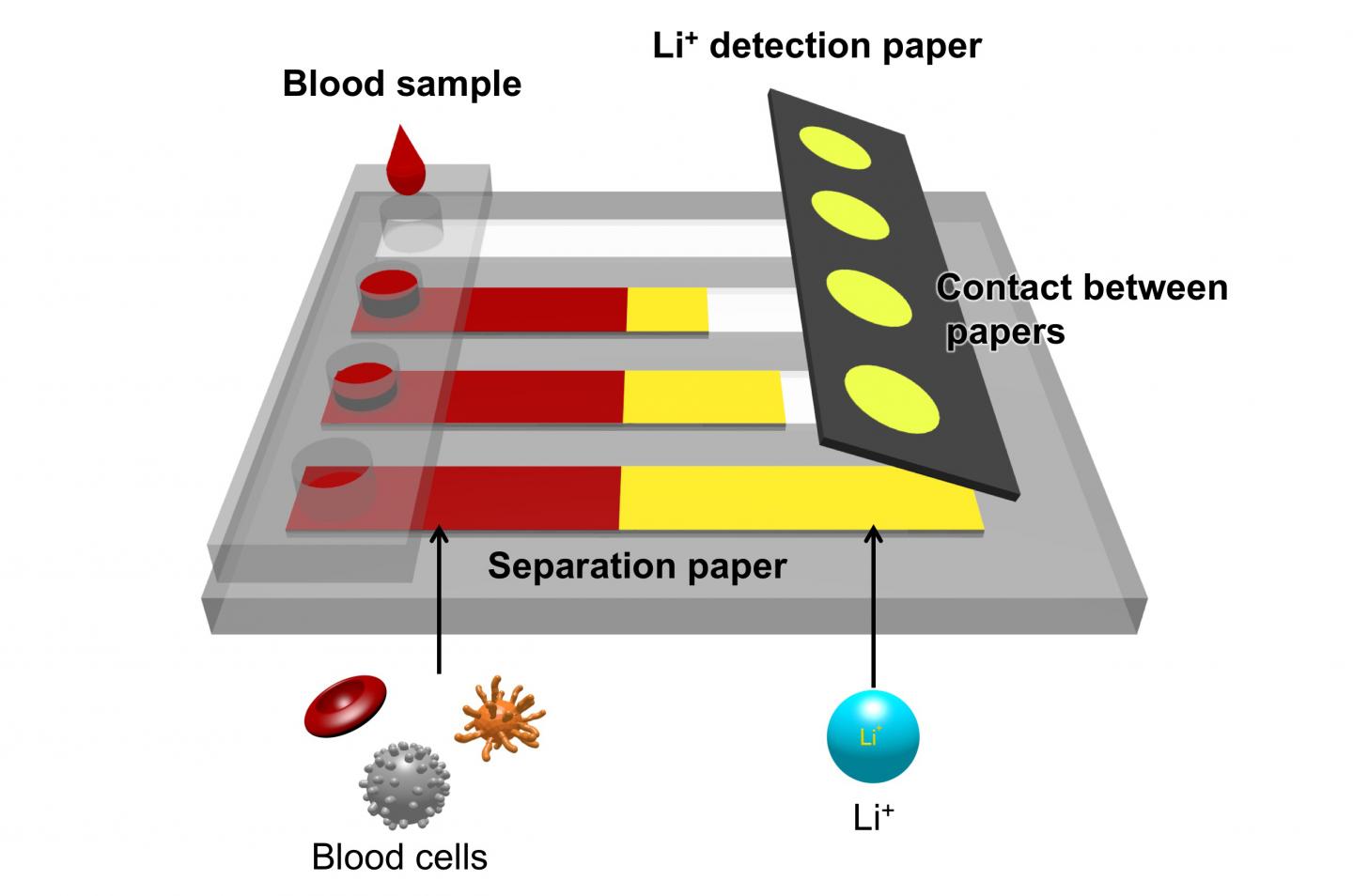
Credit: Komatsu T. et al., ACS Sensors, April 23, 2020

A group of Hokkaido University researchers has developed a paper-based device that can easily and cheaply measure lithium ion concentration in blood, which could greatly help bipolar disorder patients.

Lithium carbonate is used for treating bipolar disorder, a mental health condition that causes extreme mood swings. But using this drug requires caution because the therapeutic concentration range of lithium ions in blood is narrow and close to the toxic range. Japan’s Pharmaceuticals and Medical Devices Agency warns doctors to regularly examine lithium ion concentration levels in the blood of patients given the drug.

However, existing examination methods require a large amount of blood, special operations, and large, expensive devices. These methods can be performed only by certain testing laboratories.

The present study led by Takeshi Komatsu, a doctoral student at Hokkaido University’s Graduate School of Chemical Sciences and Engineering, and Professor Manabu Tokeshi of the university’s Faculty of Engineering was conducted to address this problem by developing a user-friendly, low-cost method. The study was published in ACS Sensors.

The researchers succeeded in making a colorimetric paper-based device that allows point-of-care testing in one step. The device consists of two paper-based elements linked to each other: a blood cell separation unit and a colorimetric detection unit. High-purity cotton blotting paper and blood cell separation membrane, which are both available on the market, are used as a substrate for each unit, respectively. Hydrophobic ink was coated on the device to allow easy liquid handling.

After a drop from a blood sample is placed on the end of the separation unit, plasma, or the liquid portion of the blood in the sample, is automatically separated and transported to the detection unit dry-coated with a reagent, which displays a diagnostic color. This process takes about a minute to complete. To measure the color, a digital camera obtains the image for analysis without any fixed light condition, a process that makes the conventional, special device for this task unnecessary. The researchers showed that the device’s detection ability is comparable to that of conventional instruments using the same colorimetric reaction.

“The device provides an alternative method for regularly monitoring lithium ion concentrations when treating bipolar disorder patients,” says Manabu Tokeshi. “In the future, we hope to develop a smartphone app for the image analysis so patients themselves or non-medical workers can check the lithium ion concentration in the blood.” The researchers also say that by tuning detection reagents and other components, the device can be used for measuring the concentration of blood components other than lithium ions.

###

Media Contact
Naoki Namba
[email protected]

Original Source

https://www.global.hokudai.ac.jp/blog/new-device-quickly-detects-lithium-ions-in-blood-of-bipolar-disorder-patients/

Related Journal Article

http://dx.doi.org/10.1021/acssensors.9b02218

Tags: BiochemistryBiomedical/Environmental/Chemical EngineeringDiagnosticsMedicine/HealthPharmaceutical Sciences
Share12Tweet8Share2ShareShareShare2

Related Posts

Personalized beverages offer vital nutrients for space missions, new study reveals — Chemistry

Personalized beverages offer vital nutrients for space missions, new study reveals

May 15, 2026
Synthetic Cell Microreactor with Dual Dynamic DNA Pores — Chemistry

Synthetic Cell Microreactor with Dual Dynamic DNA Pores

May 15, 2026

Hanyang University Researchers Pinpoint 2.5 Nanometers as Minimum Coating Thickness for Durable Solid-State EV Batteries

May 15, 2026

Smart Hydrogels Revolutionize Information Security with Photo-Patterning and Multi-Stimuli Responsive Structural Colors

May 15, 2026
Please login to join discussion

POPULAR NEWS

  • Research Indicates Potential Connection Between Prenatal Medication Exposure and Elevated Autism Risk

    843 shares
    Share 337 Tweet 211
  • New Study Reveals Plants Can Detect the Sound of Rain

    729 shares
    Share 291 Tweet 182
  • Salmonella Haem Blocks Macrophages, Boosts Infection

    62 shares
    Share 25 Tweet 16
  • Breastmilk Balances E. coli and Beneficial Bacteria in Infant Gut Microbiomes

    58 shares
    Share 23 Tweet 15

About

We bring you the latest biotechnology news from best research centers and universities around the world. Check our website.

Follow us

Recent News

Tocilizumab vs Sarilumab in COVID-19 Trial Emulation

Personalized beverages offer vital nutrients for space missions, new study reveals

Innovative Ultrasonic Framework Enhances Real-Time Measurement of Oil Film Thickness in Rolling Bearings

Subscribe to Blog via Email

Enter your email address to subscribe to this blog and receive notifications of new posts by email.

Join 82 other subscribers
  • Contact Us

Bioengineer.org © Copyright 2023 All Rights Reserved.

Welcome Back!

Login to your account below

Forgotten Password?

Retrieve your password

Please enter your username or email address to reset your password.

Log In
No Result
View All Result
  • Homepages
    • Home Page 1
    • Home Page 2
  • News
  • National
  • Business
  • Health
  • Lifestyle
  • Science

Bioengineer.org © Copyright 2023 All Rights Reserved.