• HOME
  • NEWS
  • EXPLORE
    • CAREER
      • Companies
      • Jobs
    • EVENTS
    • iGEM
      • News
      • Team
    • PHOTOS
    • VIDEO
    • WIKI
  • BLOG
  • COMMUNITY
    • FACEBOOK
    • INSTAGRAM
    • TWITTER
Saturday, February 7, 2026
BIOENGINEER.ORG
No Result
View All Result
  • Login
  • HOME
  • NEWS
  • EXPLORE
    • CAREER
      • Companies
      • Jobs
        • Lecturer
        • PhD Studentship
        • Postdoc
        • Research Assistant
    • EVENTS
    • iGEM
      • News
      • Team
    • PHOTOS
    • VIDEO
    • WIKI
  • BLOG
  • COMMUNITY
    • FACEBOOK
    • INSTAGRAM
    • TWITTER
  • HOME
  • NEWS
  • EXPLORE
    • CAREER
      • Companies
      • Jobs
        • Lecturer
        • PhD Studentship
        • Postdoc
        • Research Assistant
    • EVENTS
    • iGEM
      • News
      • Team
    • PHOTOS
    • VIDEO
    • WIKI
  • BLOG
  • COMMUNITY
    • FACEBOOK
    • INSTAGRAM
    • TWITTER
No Result
View All Result
Bioengineer.org
No Result
View All Result
Home NEWS Science News Chemistry

New device can measure toxic lead within minutes

Bioengineer by Bioengineer
August 26, 2020
in Chemistry
Reading Time: 2 mins read
0
IMAGE
Share on FacebookShare on TwitterShare on LinkedinShare on RedditShare on Telegram

Researchers create portable lab-on-a-chip that could detect many contaminants
IMAGE

Credit: Azam Gholizadeh

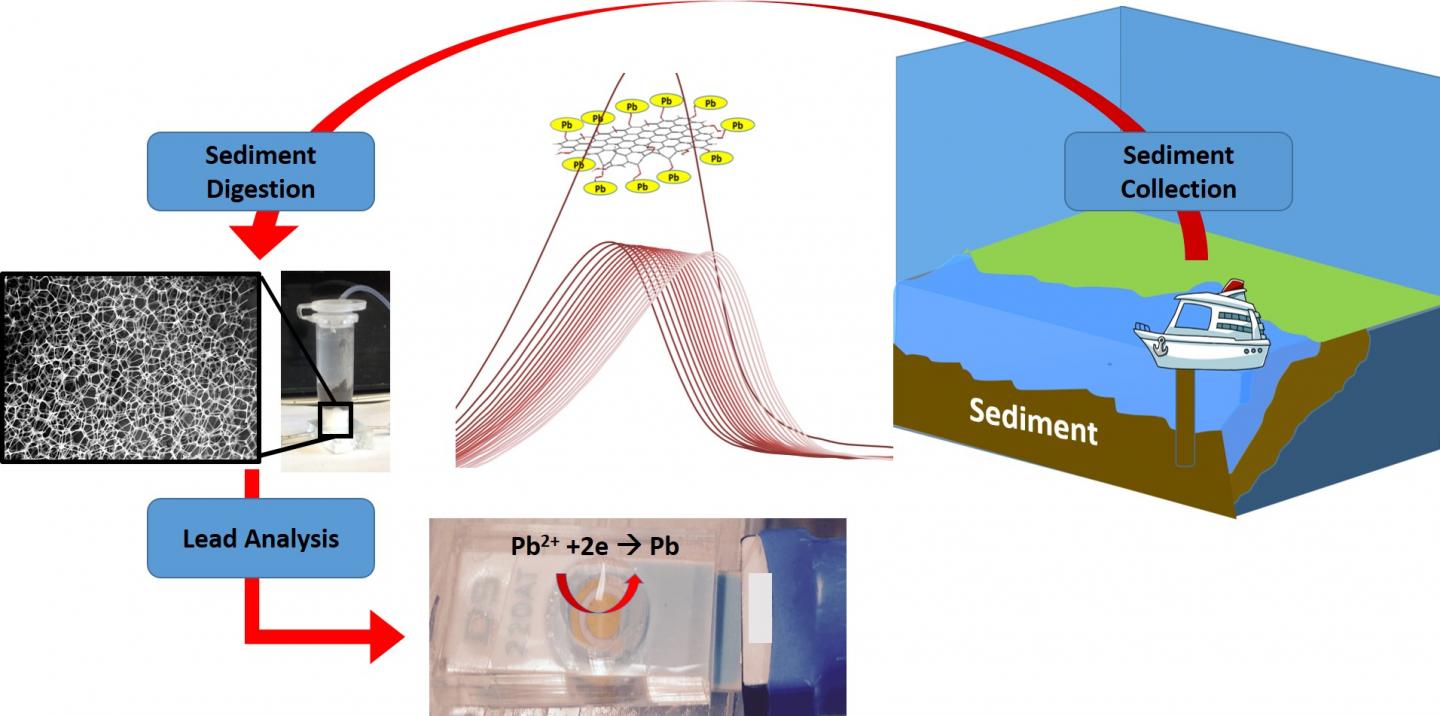
Rutgers researchers have created a miniature device for measuring trace levels of toxic lead in sediments at the bottom of harbors, rivers and other waterways within minutes – far faster than currently available laboratory-based tests, which take days.

The affordable lab-on-a-chip device could also allow municipalities, water companies, universities, K-12 schools, daycares and homeowners to easily and swiftly test their water supplies. The research is published in the IEEE Sensors Journal.

“In addition to detecting lead contamination in environmental samples or water in pipes in homes or elementary schools, with a tool like this, someday you could go to a sushi bar and check whether the fish you ordered has lead or mercury in it,” said senior author Mehdi Javanmard, an associate professor in the Department of Electrical and Computer Engineering in the School of Engineering at Rutgers University-New Brunswick.

“Detecting toxic metals like lead, mercury and copper normally requires collecting samples and sending them to a lab for costly analysis, with results returned in days,” Javanmard said. “Our goal was to bypass this process and build a sensitive, inexpensive device that can easily be carried around and analyze samples on-site within minutes to rapidly identify hot spots of contamination.”

The research focused on analyzing lead in sediment samples. Many river sediments in New Jersey and nationwide are contaminated by industrial and other waste dumped decades ago. Proper management of contaminated dredged materials from navigational channels is important to limit potential impacts on wildlife, agriculture, plants and food supplies. Quick identification of contaminated areas could enable timely and cost-effective programs to manage dredged materials.

The new device extracts lead from a sediment sample and purifies it, with a thin film of graphene oxide as a lead detector. Graphene is an atom thick layer of graphite, the writing material in pencils.

More research is needed to further validate the device’s performance and increase its durability so it can become a viable commercial product, possibly in two to four years.

###

This project was done in collaboration with the Department of Electrical and Computer Engineering and Rutgers’ Center for Advanced Infrastructure and Transportation (CAIT). It was funded by CAIT, the USDOT-University Transportation Research Center-Region II.

The lead author is Azam Gholizadeh, who earned a doctorate at Rutgers. Co-authors include Sakshi Sardar, who also earned a doctorate; Kelly Francisco, a postdoctoral research associate at CAIT; Ali Maher, CAIT director and a professor in the Department of Environmental and Civil Engineering; and Robert Miskewitz, an associate research professor in the Department of Environmental Sciences in the School of Environmental and Biological Sciences.

Media Contact
Todd Bates
[email protected]

Original Source

https://www.rutgers.edu/news/new-device-can-measure-toxic-lead-within-minutes

Related Journal Article

http://dx.doi.org/10.1109/JSEN.2020.3006021

Tags: Biomedical/Environmental/Chemical EngineeringCivil EngineeringEcology/EnvironmentElectrical Engineering/ElectronicsEnvironmental HealthHydrology/Water ResourcesNanotechnology/MicromachinesPollution/RemediationPublic HealthTechnology/Engineering/Computer Science
Share12Tweet8Share2ShareShareShare2

Related Posts

blank

Breakthrough in Environmental Cleanup: Scientists Develop Solar-Activated Biochar for Faster Remediation

February 7, 2026
blank

Cutting Costs: Making Hydrogen Fuel Cells More Affordable

February 6, 2026

Scientists Develop Hand-Held “Levitating” Time Crystals

February 6, 2026

Observing a Key Green-Energy Catalyst Dissolve Atom by Atom

February 6, 2026
Please login to join discussion

POPULAR NEWS

  • Robotic Ureteral Reconstruction: A Novel Approach

    Robotic Ureteral Reconstruction: A Novel Approach

    82 shares
    Share 33 Tweet 21
  • Digital Privacy: Health Data Control in Incarceration

    63 shares
    Share 25 Tweet 16
  • Study Reveals Lipid Accumulation in ME/CFS Cells

    57 shares
    Share 23 Tweet 14
  • Breakthrough in RNA Research Accelerates Medical Innovations Timeline

    53 shares
    Share 21 Tweet 13

About

We bring you the latest biotechnology news from best research centers and universities around the world. Check our website.

Follow us

Recent News

Palmitoylation of Tfr1 Drives Platelet Ferroptosis and Exacerbates Liver Damage in Heat Stroke

Oxygen-Enhanced Dual-Section Microneedle Patch Improves Drug Delivery and Boosts Photodynamic and Anti-Inflammatory Treatment for Psoriasis

Scientists Identify SARS-CoV-2 PLpro and RIPK1 Inhibitors Showing Potent Synergistic Antiviral Effects in Mouse COVID-19 Model

Subscribe to Blog via Email

Enter your email address to subscribe to this blog and receive notifications of new posts by email.

Join 73 other subscribers
  • Contact Us

Bioengineer.org © Copyright 2023 All Rights Reserved.

Welcome Back!

Login to your account below

Forgotten Password?

Retrieve your password

Please enter your username or email address to reset your password.

Log In
No Result
View All Result
  • Homepages
    • Home Page 1
    • Home Page 2
  • News
  • National
  • Business
  • Health
  • Lifestyle
  • Science

Bioengineer.org © Copyright 2023 All Rights Reserved.