• HOME
  • NEWS
  • EXPLORE
    • CAREER
      • Companies
      • Jobs
    • EVENTS
    • iGEM
      • News
      • Team
    • PHOTOS
    • VIDEO
    • WIKI
  • BLOG
  • COMMUNITY
    • FACEBOOK
    • INSTAGRAM
    • TWITTER
Wednesday, November 11, 2026
BIOENGINEER.ORG
No Result
View All Result
  • Login
  • HOME
  • NEWS
  • EXPLORE
    • CAREER
      • Companies
      • Jobs
        • Lecturer
        • PhD Studentship
        • Postdoc
        • Research Assistant
    • EVENTS
    • iGEM
      • News
      • Team
    • PHOTOS
    • VIDEO
    • WIKI
  • BLOG
  • COMMUNITY
    • FACEBOOK
    • INSTAGRAM
    • TWITTER
No Result
View All Result
Bioengineer.org
No Result
View All Result
Home NEWS Science News Health

New Deep Learning Model Segments Lung Nodules in CT Scans

by
November 10, 2026
in Health
Reading Time: 2 mins read
0
New Deep Learning Model Segments Lung Nodules in CT Scans

New Deep Learning Model Segments Lung Nodules in CT Scans

Share on FacebookShare on TwitterShare on LinkedinShare on RedditShare on Telegram

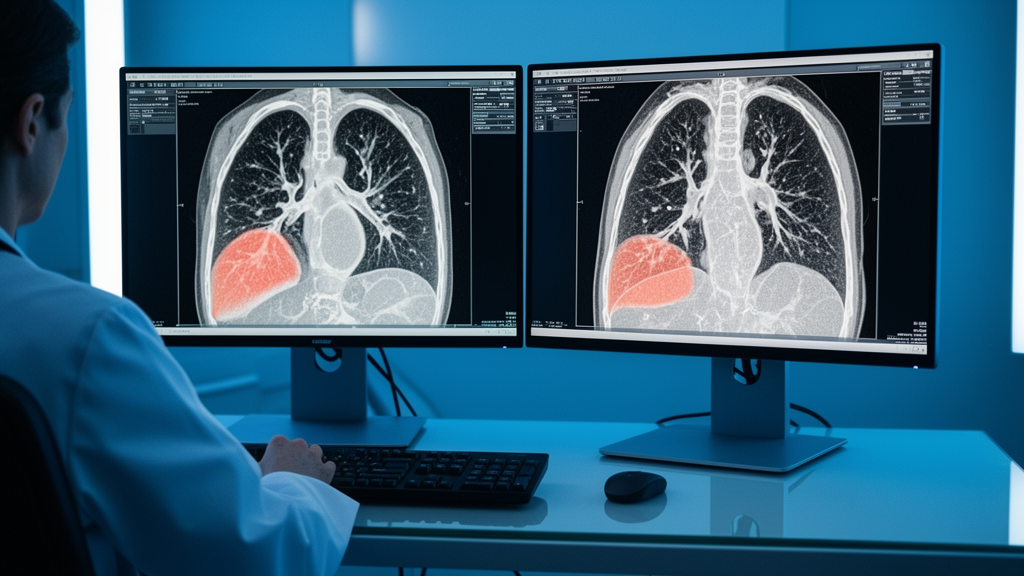
Researchers Mahender Erukala and Suresh Kumar Sanampudi have introduced a new deep learning framework designed to improve the segmentation of lung nodules in computed tomography images. The model, named CLAHE-RATSNet, addresses specific technical challenges that often hinder the accurate delineation of these nodules. Published in BMC Medical Imaging, the study presents a click-guided segmentation network that utilizes residual attention for a two-stage processing approach. The primary goal of this framework is to enhance computer-aided diagnosis, treatment planning, and the early detection of lung cancer by overcoming common imaging obstacles.

The segmentation of lung nodules is a difficult task in clinical practice due to several inherent factors. These include low contrast in the images, the small physical size of the nodules, and weak boundaries that make them hard to distinguish. Additionally, nodules often resemble surrounding vessels and lung tissues, which complicates the identification process. To solve these problems, the authors developed a system that combines image enhancement techniques with advanced neural network architectures to provide more precise localization and boundary correction.

The proposed framework integrates Contrast Limited Adaptive Histogram Equalization, or CLAHE, with a Gaussian click map. This click map is generated from the centroid of the nodules to provide spatial guidance, while CLAHE provides enhanced CT contrast at the local level.

The architecture of CLAHE-RATSNet employs a two-stage segmentation process. A first-stage attention network is utilized for the coarse localization of the nodules. Following this initial step, a second-stage residual refinement module is applied to correct boundary errors.

Experiments were conducted using the LIDC-IDRI computed tomography images to evaluate the performance of the new framework. The results of CLAHE-RATSNet were compared against several baseline models to determine its relative effectiveness.

Under an oracle-guided test condition, the proposed model achieved a Dice score of 0.9238 and an Intersection over Union, or IoU, of 0.8610. The model also recorded a precision of 0.9239 and a recall of 0.9238.

Statistical analyses were performed to compare CLAHE-RATSNet with the evaluated baseline models. Patient-level paired analyses showed statistically significant differences in Dice, IoU, precision, and recall. These differences remained significant after applying the Holm correction for multiple comparisons.

It is important to note that these findings characterize segmentation performance under a controlled oracle-guided evaluation protocol. The results should not be interpreted as end-to-end lesion-localization or fully automatic clinical performance.

As the study is published early to provide faster access to peer-reviewed research, it remains subject to further edits before the final version of record is released.

Subject of Research: Deep learning framework for lung nodule segmentation in CT images

Article Title: CLAHE-RATSNet: a deep learning framework for accurate lung nodule segmentation in computed tomography images

Article References: Erukala, M., & Sanampudi, S. K. (2026). CLAHE-RATSNet: a deep learning framework for accurate lung nodule segmentation in computed tomography images. BMC Medical Imaging. https://doi.org/10.1186/s12880-026-02991-z

Image Credits: AI Generated

DOI: 10.1186/s12880-026-02991-z

Keywords: lung nodule segmentation, computed tomography, deep learning, medical imaging, CLAHE-RATSNet, computer-aided diagnosis, image enhancement, attention network, deep, learning, framework, accurate

News Source: Ophelia Keating. (November 10, 2026). New Deep Learning Model Segments Lung Nodules in CT Scans. Scienmag.
Tags: accurateattention networkCLAHE-RATSNetcomputed tomographycomputer-aided diagnosisdeepdeep learningframeworkImage Enhancementlearninglung nodule segmentationMedical Imaging
Share12Tweet7Share2ShareShareShare1

Related Posts

Rare Breast Acinic Cell Carcinomas Consistently Exhibit Mutant p53 Expression Patterns

Rare Breast Acinic Cell Carcinomas Consistently Exhibit Mutant p53 Expression Patterns

November 11, 2026
Core-Needle Lung Nodule Biopsy Outperforms Aspiration but Increases Bleeding Risks

Core-Needle Lung Nodule Biopsy Outperforms Aspiration but Increases Bleeding Risks

November 11, 2026

Egyptian Neurologists Propose Recovery Framework Integrating Stroke Rehabilitation and Adjunctive Therapies

November 11, 2026

New Confocal Microscope Captures Live Cell Dynamics at 4 Hz

November 11, 2026

POPULAR NEWS

  • Thicker Fetal Nuchal Translucency Linked to Higher Pregnancy Risks

    Thicker Fetal Nuchal Translucency Linked to Higher Pregnancy Risks

    29 shares
    Share 12 Tweet 7
  • CT Markers Show Most Reproducible Links to Death by Neurologic Criteria

    29 shares
    Share 12 Tweet 7
  • Young Swiss Cancer Survivors Report Growth After Diagnosis, But Resilience Tells a Different Story

    29 shares
    Share 12 Tweet 7
  • Transvalvular Leads Not Associated With Worse Tricuspid Repair Success in Selected Patients

    29 shares
    Share 12 Tweet 7

About

We bring you the latest biotechnology news from best research centers and universities around the world. Check our website.

Follow us

Recent News

Rare Breast Acinic Cell Carcinomas Consistently Exhibit Mutant p53 Expression Patterns

Core-Needle Lung Nodule Biopsy Outperforms Aspiration but Increases Bleeding Risks

Egyptian Neurologists Propose Recovery Framework Integrating Stroke Rehabilitation and Adjunctive Therapies

Subscribe to Blog via Email

Enter your email address to subscribe to this blog and receive notifications of new posts by email.

Join 87 other subscribers
  • Contact Us

Bioengineer.org © Copyright 2023 All Rights Reserved.

Welcome Back!

Login to your account below

Forgotten Password?

Retrieve your password

Please enter your username or email address to reset your password.

Log In
No Result
View All Result
  • Homepages
    • Home Page 1
    • Home Page 2
  • News
  • National
  • Business
  • Health
  • Lifestyle
  • Science

Bioengineer.org © Copyright 2023 All Rights Reserved.