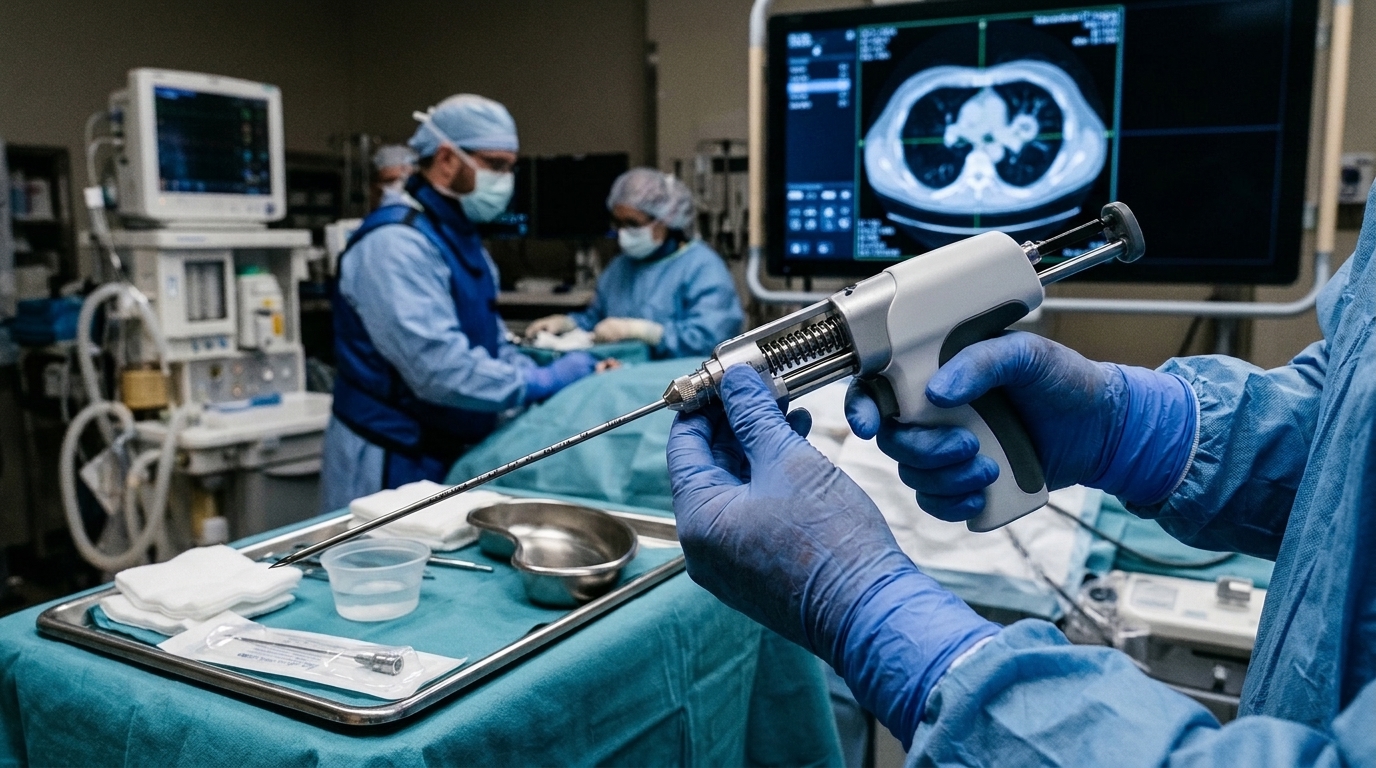
In a comparative evaluation of diagnostic procedures for pulmonary ground-glass nodules, computed tomography-guided core-needle biopsy demonstrated higher unadjusted diagnostic accuracy and sensitivity than fine-needle aspiration, while presenting significantly increased risks of hemorrhagic complications.
The investigation evaluated consecutive patients who underwent computed tomography-guided percutaneous biopsy of pulmonary ground-glass nodules between January 2021 and August 2022. Researchers initially assessed 657 patients for inclusion. Following eligibility screening, 538 patients were enrolled in the study cohort, comprising 448 patients who underwent core-needle biopsy and 90 patients who received fine-needle aspiration.
To evaluate diagnostic efficacy, the researchers established final diagnoses using a composite reference standard requiring either definitive surgical pathology or clinical imaging follow-up spanning at least 12 months. Six fine-needle aspiration procedures yielded atypical cells and were categorized as indeterminate; these cases were excluded from binary diagnostic performance calculations, resulting in 532 classifiable biopsy cases.
Across the entire classifiable cohort of 532 biopsies, computed tomography-guided percutaneous biopsy achieved an overall diagnostic accuracy of 93.2 percent, an overall sensitivity of 91.4 percent, and a specificity of 100.0 percent under the composite reference standard. These findings indicated that percutaneous sampling provided definitive diagnostic determinations for the vast majority of evaluated nodules.
When diagnostic performance was evaluated without statistical adjustment, core-needle biopsy demonstrated statistically significant advantages over fine-needle aspiration. Core-needle biopsy attained an unadjusted diagnostic accuracy of 94.6 percent compared to 85.7 percent for fine-needle aspiration (P = 0.007). Similarly, core-needle biopsy exhibited an unadjusted sensitivity of 93.2 percent, outperforming the 82.4 percent sensitivity recorded for fine-needle aspiration (P = 0.008).
Safety outcomes across the full cohort of 538 procedures were evaluated using multivariable logistic regression alongside inverse probability of treatment weighting to adjust for baseline confounding. In these multivariable models, core-needle biopsy was associated with significantly elevated odds of intrapulmonary hemorrhage (adjusted odds ratio 2.91; P < 0.001) and hemoptysis (adjusted odds ratio 3.07; P < 0.001). Conversely, the analysis observed no statistically significant association between biopsy modality and the incidence of pneumothorax.
The study authors highlighted critical methodological caveats, noting that because diagnostic performance comparisons were conducted without adjustment for baseline differences, the apparent diagnostic superiority of core-needle biopsy requires cautious interpretation. They concluded that clinicians should individualize the selection between core-needle biopsy and fine-needle aspiration according to specific nodule characteristics and patient-level complication risks.
The study was published in the journal Cancer Imaging and is available as an open access article. The article was published on August 8, 2026, and carries a permanent DOI, allowing it to be cited immediately while subject to further edits before the final version of record is released.
Subject of Research: Diagnostic performance and complication risks of CT-guided core-needle biopsy versus fine-needle aspiration for pulmonary ground-glass nodules
Article Title: CT-guided biopsy of pulmonary ground-glass nodules: core-needle biopsy versus fine-needle aspiration
Article References: Li, S., Li, Q., Wang, M., Gao, F., Shi, X., & Zhou, Z. (2026). CT-guided biopsy of pulmonary ground-glass nodules: core-needle biopsy versus fine-needle aspiration. Cancer Imaging, 26(1), Article 153. https://doi.org/10.1186/s40644-026-01108-7
Image Credits: AI Generated
DOI: 10.1186/s40644-026-01108-7
Keywords: pulmonary ground-glass nodules, CT-guided biopsy, core-needle biopsy, fine-needle aspiration, diagnostic accuracy, diagnostic sensitivity, diagnostic specificity, intrapulmonary hemorrhage, hemoptysis, pneumothorax, percutaneous biopsy, surgical pathology, imaging follow-up, multivariable logistic regression, inverse probability of treatment weighting, complication profiles
News Source: Ophelia Keating. (November 11, 2026). Core-Needle Lung Nodule Biopsy Outperforms Aspiration but Increases Bleeding Risks. Scienmag.