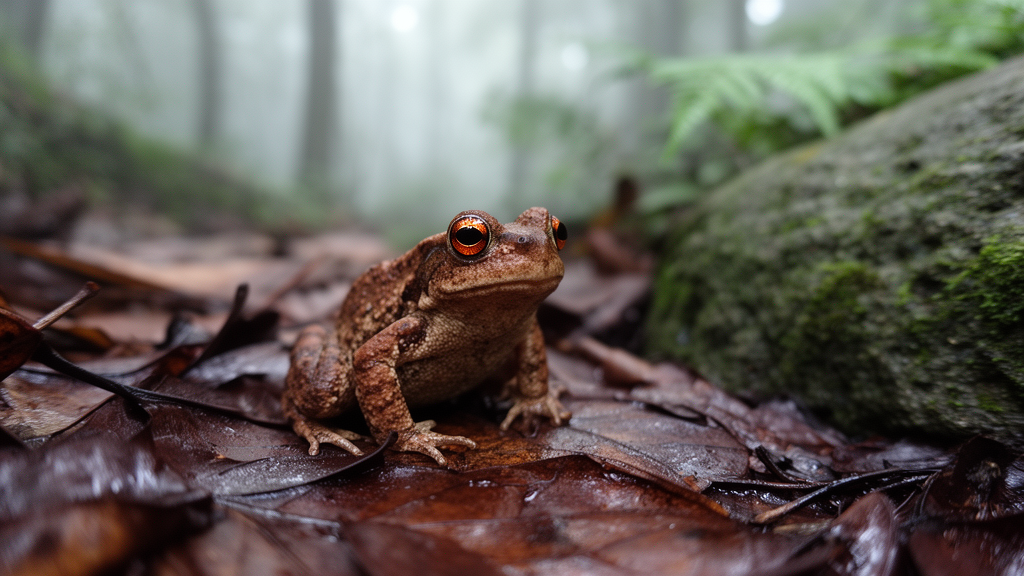
Deep in the subtropical forests of Mayanghe National Nature Reserve, in northeastern Guizhou Province, China, a small brown frog with striking copper-colored eyes has turned out to be a species entirely new to science. Researchers surveying the reserve’s mountain streams in March 2025 collected seven male specimens of a leaf litter toad belonging to the genus Leptobrachella, a group of tiny amphibians that spend their lives camouflaged among fallen leaves near forest waterways. After detailed morphological comparisons and genetic analysis, the team has formally described the animal as Leptobrachella mayanghe, a new species named after the reserve where it was found.
The discovery, published in the journal ZooKeys, adds to a remarkable wave of new Leptobrachella species being uncovered across southern China in recent years. The genus comprises small Asian leaf litter frogs distributed from southern China and northeastern India through Myanmar, Indochina, the Malay Peninsula, and Borneo. These frogs predominantly inhabit leaf litter close to forest streams and display high ecological and morphological diversity. Historical taxonomic confusion once scattered members of the group across multiple genera, including Paramegophrys and Leptolalax, but recent integrated phylogenetic studies have unified all of these names under Leptobrachella.
Guizhou Province, situated on the Yunnan-Guizhou Plateau, harbors exceptionally high amphibian diversity, with eleven recorded Leptobrachella species before this study. Mayanghe National Nature Reserve lies in the northern section of the Wuling Mountains, one of the region’s recognized biodiversity hotspots. The reserve features complex topography, well-developed river networks, and subtropical evergreen broad-leaved forests, conditions that provide suitable habitat for these stream-associated frogs. The new find brings the provincial tally to twelve species and underscores how much undocumented diversity may still be hiding in China’s karst landscapes.
The specimens were collected on 22 March 2025 at approximately 550 meters above sea level, perched on rocks or plant leaves near waterfalls of clear perennial mountain streams. All seven individuals were adult males, fixed in buffered formalin and transferred to ethanol for permanent curation at the Moutai Institute in Renhuai, Guizhou. Tissue samples were preserved separately before fixation, allowing the researchers to extract DNA and sequence two mitochondrial gene fragments: 16S rRNA and cytochrome oxidase subunit I, or COI. No female specimens, eggs, or tadpoles were obtained during the survey, leaving aspects of the species’ reproductive biology unknown.
The genetic evidence proved decisive. The researchers concatenated 501 base pairs of the 16S gene with 603 base pairs of COI and reconstructed the evolutionary relationships of the genus using both maximum likelihood and Bayesian inference methods, which produced consistent tree topologies with strong support at major nodes. All samples of the new species clustered into a distinct clade, sister to a group containing its three closest known relatives: L. wulingensis, L. yongshunensis, and L. xinshaoensis, all described from the Wuling Mountain region of Guizhou and neighboring Hunan Province.
Genetic distances told a similar story. The uncorrected p-distances of the 16S rRNA gene between the new species and its closest congeners range from 1.8 to 3.4 percent, while the COI gene diverges by 8.5 to 9.3 percent. These values meet or exceed the levels of divergence observed between most valid species pairs within the genus. For comparison, the COI difference between L. bijie and L. jinshaensis, two recognized species, is only 3.8 percent. The researchers compared their new samples against sequence data from dozens of Leptobrachella species across China, Vietnam, Thailand, Laos, Cambodia, India, and Malaysia, spanning the full geographic range of the genus.
Morphology provided the second line of evidence. Using dial calipers accurate to 0.1 millimeters, the team measured eighteen morphometric characters on each specimen, from snout-vent length and head dimensions to tibia width and tympanum diameter. The new species is small, with males measuring 27.4 to 31.8 millimeters in snout-vent length. Its toes are rudimentarily webbed and lack lateral fringes, its tympanum is distinct and not surrounded by prominent tubercles, and its dorsal surface is shagreened, covered with dense small raised tubercles and irregular longitudinal ridges. The ventral surface is creamy white with indistinct brown markings on the lateral abdomen and chest, and distinct black spots mark the flanks.
Several features make the animal particularly distinctive in life. When the hindlimbs are flexed at right angles to the body axis, the heels slightly overlap, and the tibia-tarsal articulation reaches the middle of the eye. Most striking is the iris, which is uniformly bright copper-colored, a feature that separates it from its close relatives, whose irises are bicolored, golden or coppery in the upper half and fading to dark silver in the lower half. In life, the dorsum is brownish with an inverted triangular marking between the eyes and a W-shaped marking on the anterior mid-dorsum, while a conspicuous orange patch adorns the upper arm near the axilla. The supra-axillary gland appears prominently raised and orange in living specimens.
Distinguishing the new species from its three phylogenetically closest congeners required careful character-by-character comparison. It differs from L. wulingensis by the absence of lateral fringes on the toes and by its dorsal skin texture of shagreened small tubercles and ridges rather than sparse large warts. From L. xinshaoensis, it differs by having heels that overlap when the hindlimbs are flexed, whereas those of its relative do not meet, and by the tibia-tarsal articulation reaching the middle of the eye rather than the eye and tympanum. From L. yongshunensis, it differs again in toe fringes, eye articulation, iris coloration, and dorsal skin texture. Against the broader genus, the combination of moderate body size, black flank spots, rudimentary toe webbing without fringes, and the specific eye and heel positions eliminates all other candidates.
The species is currently known only from its type locality, and its dependence on clear mountain streams makes it vulnerable to habitat disturbance. Amphibians worldwide face threats from habitat loss, climate change, and emerging diseases, and restricted-range stream breeders are especially at risk. The researchers recommend that the conservation status of Leptobrachella mayanghe be assessed according to IUCN Red List criteria and that protection of its habitat be strengthened, particularly focusing on stream integrity and riparian vegetation. Advertisement calls of the new species could be heard from March to May, suggesting a breeding season within that window, and sympatric amphibians include the endangered Leptobrachium boringii and Quasipaa boulengeri. The team also recommends more systematic biodiversity surveys across the region’s karst ecosystems, which may harbor additional undiscovered cryptic species due to their complex geological and microhabitat conditions.
Subject of Research: A new Asian leaf litter toad of the genus Leptobrachella (Amphibia, Anura, Megophryidae) from northeastern Guizhou, China
Article Title: A new Asian leaf litter toad of the genus Leptobrachella ( Amphibia , Anura , Megophryidae ) from northeastern Guizhou, China
Article References: Yang, Z., Liu, J., Zhang, F., Cheng, Y., Zou, Q., Chen, Y., Mu, L., Zhou, J., Li, S., & Zhao, H. (2026). A new Asian leaf litter toad of the genus Leptobrachella (Amphibia, Anura, Megophryidae) from northeastern Guizhou, China. ZooKeys, 1295, 25-51. https://doi.org/10.3897/zookeys.1295.206395
Image Credits: AI Generated
DOI: 10.3897/zookeys.1295.206395
Keywords: Asian, leaf, litter, toad, genus, Leptobrachella, Amphibia, Anura, Megophryidae, northeastern, Guizhou, China
News Source: Margaret Porter. (October 19, 2026). New copper-eyed leaf litter toad discovered in Guizhou nature reserve. Scienmag.