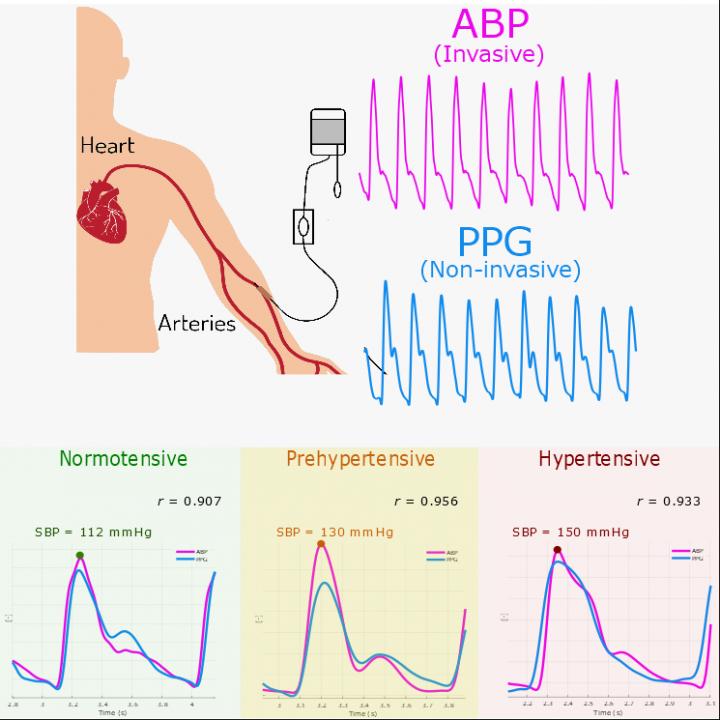
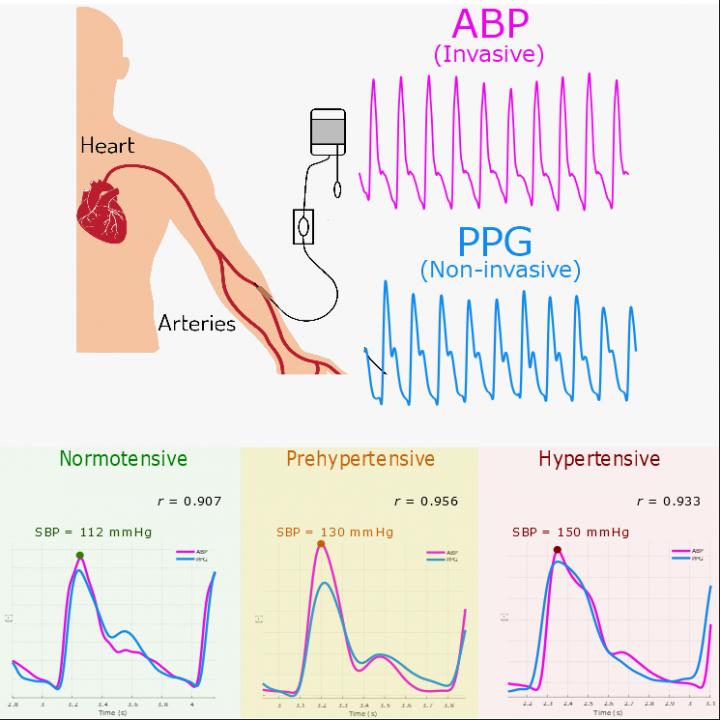
Credit: Mohamed Elgendi/UBC
Fast and easy blood pressure monitoring could soon be at your fingertips–literally–thanks to new University of British Columbia research that showed BP can be assessed by a fingertip oximeter, a tool not generally used for that purpose.
"We found that the oximeter, which clips on to a finger or toe to measure heart rate and the amount of oxygen in the blood, can detect normal, elevated or high blood pressure with up to 95 per cent accuracy," said lead researcher Mohamed Elgendi, an adjunct professor of electrical and computer engineering at UBC.
"This suggests that it can, with a few tweaks, do double duty as a BP monitor in the future."
Hypertension or high blood pressure is linked to 1,100 deaths each day in the U.S. alone, so it's critical to regularly monitor people at risk. The challenge is that current BP monitoring methods have their limitations.
"While the inflatable cuff is easy to use, its accuracy depends on its placement on the arm and the observer's skill," said Elgendi. "Another technique, intra-arterial blood pressure measurement, is highly accurate but invasive, requiring the doctor to insert a needle into an artery."
Past studies have explored using oximeters for blood pressure assessment, but the UBC study is the first to provide supportive evidence based on actual patient records and the first to examine large sample sizes obtained in two different countries, according to Elgendi.
For their analysis, the UBC team examined oximeter records from 121 patients registered at a hospital in Boston, and 219 admitted to a hospital in the Chinese province of Guilin. They ran the oximeter information through a unique mathematical program they had developed, and found nine electrical signatures, or patterns, that correlated significantly with hypertension.
"The consistent presence of these patterns in data collected from two different countries proves that the pulse oximeter is a reliable tool for hypertension assessment," said Elgendi, a postdoctoral fellow in the faculty of medicine at UBC and at BC Women's Hospital. "When we added electrocardiogram data to oximeter data, we were able to improve the detection of pre-hypertension."
Blood pressure is measured in millimetres of mercury (mmHg) with the systolic number recorded first, followed by the diastolic number. Normal blood pressure is under 120/80 mmHg, elevated blood pressure or pre-hypertension is between 121/80 mmHg and 139/89 mmHg, and high blood pressure or hypertension is 140/90 mmHg or higher. Pre-hypertension increases the risk of heart disease, so early detection is vital for diagnosis and treatment.
Elgendi and his team are working on replicating their studies on other groups of patients over the next several months. They're also refining their algorithm so that it can be used on a larger scale by oximeter manufacturers.
"With the addition of our algorithm and a few other changes, it's entirely feasible to produce a science-based oximeter that provides highly accurate blood pressure assessment–hopefully contributing to faster detection of hypertension and potentially saving lives," said Elgendi.
###
The research was described recently in the Journal of Clinical Medicine, Biosensors, Diagnostics, and Scientific Data. (LINKS follow)
Clinical Medicine: https://www.mdpi.com/2077-0383/7/10/316
Biosensors: https://www.mdpi.com/2079-6374/8/4/101
Diagnostics: https://www.mdpi.com/2075-4418/8/3/65/htm
Scientific Data: https://www.nature.com/articles/sdata201876
Media Contact
Lou Bosshart
[email protected]
604-999-0473
@UBCnews
http://www.ubc.ca
Related Journal Article
http://dx.doi.org/10.3390/jcm7100316