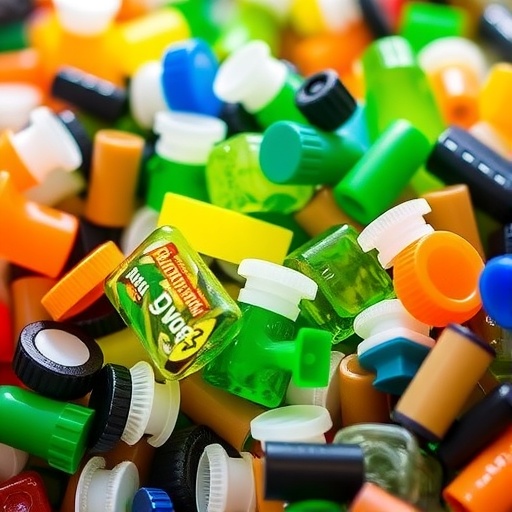
A groundbreaking catalyst developed in Japan promises to revolutionize plastic recycling by selectively degrading polyurethane (PU) in mixed plastic waste without harming valuable polyester and nylon components. This new chemical strategy introduces a practical solution to the persistent problem of recycling complex multi-material plastics long considered too challenging to separate and reuse.
Polyurethane, the sixth most commonly used polymer globally, features prominently in consumer products such as textiles, sponges, and automotive seats. Unlike polymers like PET, PU does not melt upon heating, rendering traditional recycling methods ineffective. The chemical bonds within PU must be broken down instead, but past approaches indiscriminately degrade other polymers present, complicating material recovery.
The innovation emerged from a collaboration between Kyushu University, the University of Tokyo, and Japan’s National Institute of Advanced Industrial Science and Technology. By employing an iridium-based catalyst activated with a phenolate salt and hydrogen gas under moderate temperatures (130–170°C), the researchers achieved selective hydrogenolysis of PU. Remarkably, the coexisting polyester and polyamide structures remained chemically intact, enabling their subsequent recycling.
What makes this method especially notable is its challenge to long-standing principles of organic chemistry. Typically, reactivity hierarchies dictate that ester bonds break before amide bonds, and amides before urethanes (the chemical units in PU). Yet this iridium catalyst system inverts that order, cleaving the chemically “least reactive” urethane bonds first while sparing more reactive ester and amide bonds. This selectivity is unprecedented and widens possibilities for controlled polymer degradation.
The team demonstrated the technique’s real-world applicability by treating commercially used items, such as kitchen sponges and blended textiles, where PU coexists with polyester and nylon. The process efficiently recovered PU degradation products for reuse, all while preserving the other polymers for further processing. Tests on items including smartphone cases and car seats further confirm the method’s broad potential.
Beyond technical achievements, this single-step approach to simultaneous material separation and chemical recycling could transform recycling industries, especially in sectors like automotive and furniture manufacturing, which generate vast quantities of PU-rich waste. Furthermore, it offers a sustainable alternative to the common trade-off between material performance and recyclability, illustrated by replacements like polyester cushions in newer Japanese Shinkansen trains.
Despite these advances, cost and scalability hurdles remain. Iridium is a rare and expensive metal, prompting ongoing efforts to identify more affordable catalysts or increase catalytic efficiency. Nevertheless, this catalyst system marks a paradigm shift, representing a bridge between fundamental chemistry and practical solutions to pressing environmental challenges.
Lead investigator Professor Takanori Iwasaki emphasizes the broader implications: “Selective overriding of chemical reactivity rules opens exciting avenues not only for plastic recycling but also for complex synthetic processes across chemistry and materials science.” As the world grapples with mounting plastic waste, this catalytic breakthrough could herald a new era of smarter, safer, and more efficient polymer reuse.
Subject of Research: Not applicable
Article Title: Selective Degradation of Polyurethanes in Mixed Plastic Wastes via Ir-Catalyzed Hydrogenolysis
News Publication Date: 9-Jul-2026
Web References: Kyushu University
References: Yuto Yamada, Takanori Iwasaki, Shinji Tanaka, Kyoko Nozaki, Angewandte Chemie International Edition
Image Credits: Takanori Iwasaki / Kyushu University
Keywords
Plastic recycling, polyurethane degradation, iridium catalyst, hydrogenolysis, polymer chemistry, selective catalysis, mixed plastics, sustainable materials, chemical recycling
Tags: Advanced recycling technologiesbreaking chemical bonds in plasticschemical recycling of polyurethanehydrogenolysis of polymersinnovative catalysts for complex plasticsiridium-based catalysts for plasticsmulti-material plastic recyclingplastic recyclingpreserving polyester and nylon during recyclingrecycling of mixed plasticsselective polyurethane degradationsustainable plastic waste management