• HOME
  • NEWS
  • EXPLORE
    • CAREER
      • Companies
      • Jobs
    • EVENTS
    • iGEM
      • News
      • Team
    • PHOTOS
    • VIDEO
    • WIKI
  • BLOG
  • COMMUNITY
    • FACEBOOK
    • INSTAGRAM
    • TWITTER
Thursday, August 20, 2026
BIOENGINEER.ORG
No Result
View All Result
  • Login
  • HOME
  • NEWS
  • EXPLORE
    • CAREER
      • Companies
      • Jobs
        • Lecturer
        • PhD Studentship
        • Postdoc
        • Research Assistant
    • EVENTS
    • iGEM
      • News
      • Team
    • PHOTOS
    • VIDEO
    • WIKI
  • BLOG
  • COMMUNITY
    • FACEBOOK
    • INSTAGRAM
    • TWITTER
  • HOME
  • NEWS
  • EXPLORE
    • CAREER
      • Companies
      • Jobs
        • Lecturer
        • PhD Studentship
        • Postdoc
        • Research Assistant
    • EVENTS
    • iGEM
      • News
      • Team
    • PHOTOS
    • VIDEO
    • WIKI
  • BLOG
  • COMMUNITY
    • FACEBOOK
    • INSTAGRAM
    • TWITTER
No Result
View All Result
Bioengineer.org
No Result
View All Result
Home NEWS Science News Chemistry

New catalyst proved efficient to electrosynthesis of ammonia

Bioengineer by Bioengineer
May 18, 2021
in Chemistry
Reading Time: 2 mins read
0
IMAGE
Share on FacebookShare on TwitterShare on LinkedinShare on RedditShare on Telegram

IMAGE

Credit: GENG Jing

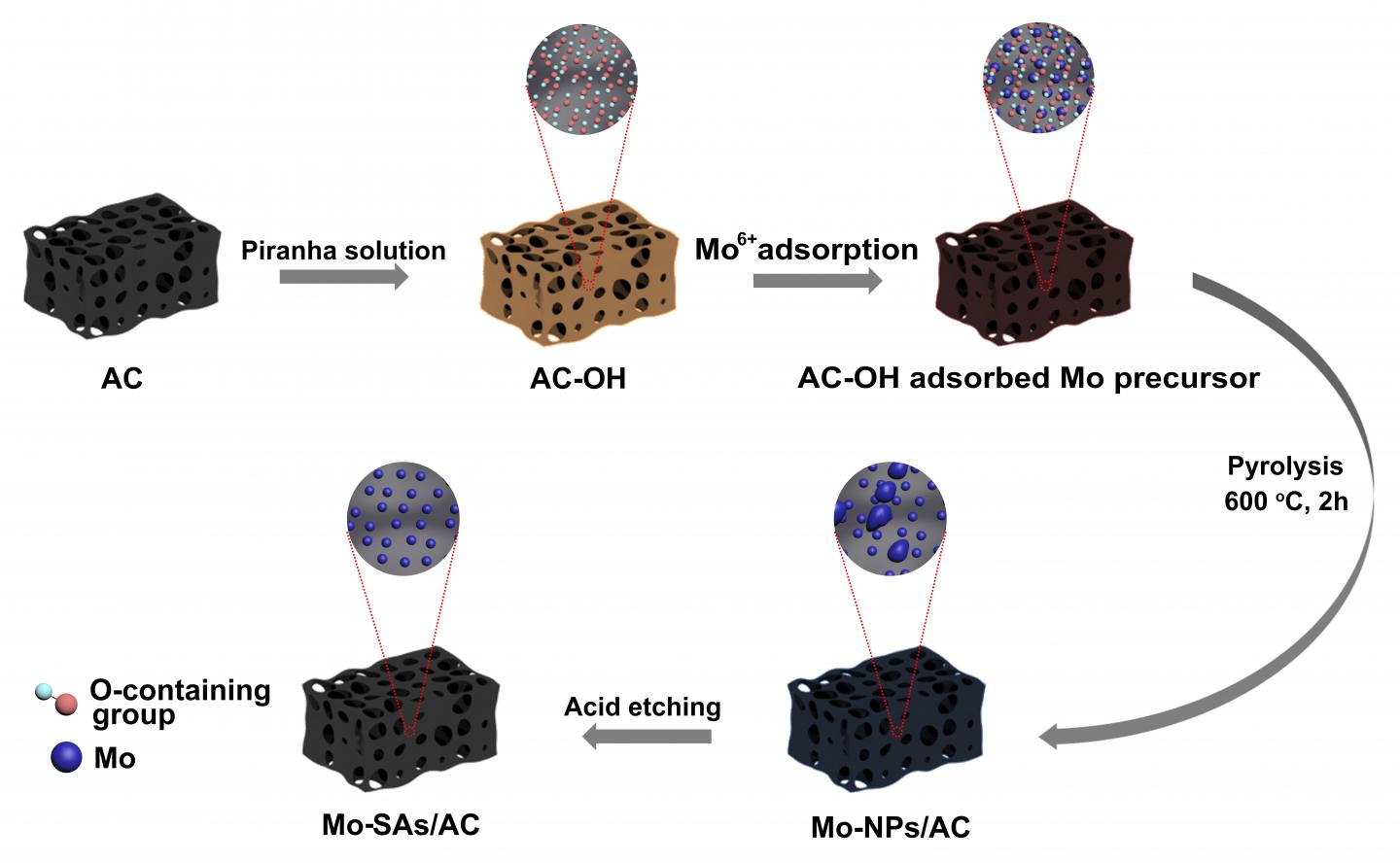
In a recent research, researchers led by Prof. ZHANG Haimin from the Institute of Solid State Physics of the Hefei Institutes of Physical Science (HFIPS) realized the synthesis of Mo single atoms anchored on activated carbon (Mo-SAs/AC) by the formed Mo-Ox bonds. The result was published on Chemical Communications.

According to the researchers, this new oxygen-coordinated molybdenum single atom catalyst was proved efficient to electrosynthesis of ammonia. The O-coordinated environment in this study, different from N-coordinated environment reported before, provided the sites to anchor Mo single atoms and form Mo-Ox sites, which could be used as the active centers for the adsorption and activation of N2, resulting in high nitrogen reduction reaction (NRR) activity.

“We have been curious about the key to the high NRR catalytic activity,” said GENG Jing, first author of the study, “then we found the Mo-Ox site in the catalyst.”

In this research, the surface-rich oxygen functional groups of pre-treated activated carbon played an important role in capturing the Mo precursor, forming Mo-O coordination to anchor Mo atoms as the catalytic active sites.

As a result, in Na2SO4 electrolyte, the Mo-SAs/AC can produce ammonia and attain a faradaic efficiency with high stability and good durability.

This work would be very helpful for designing and developing oxygen-coordinated single atom NRR electrocatalysts for high efficiency electrosynthesis of ammonia.

This work was financially supported by the National Key R&D Program of China, the Natural Science Foundation of China, the China Postdoctoral Science Foundation, and the HFIPS Director’s Fund.

###

Media Contact
ZHAO Weiwei
[email protected]

Original Source

http://english.hf.cas.cn/new/news/rn/202105/t20210514_269407.html

Related Journal Article

http://dx.doi.org/10.1039/D1CC01455B

Tags: Chemistry/Physics/Materials SciencesMaterials
Share12Tweet8Share2ShareShareShare2

Related Posts

Jet engines can’t tell coconut-blend fuel from jet fuel—but the environment can

Jet engines can’t tell coconut-blend fuel from jet fuel—but the environment can

August 20, 2026
Scientists Create Twisted, Two-Faced Polymer with Unique Properties

Scientists Create Twisted, Two-Faced Polymer with Unique Properties

August 20, 2026

Scientists Move Closer to Controlling Individual Electrons

August 20, 2026

New molecular building block combines proteins with diverse molecules

August 20, 2026
Please login to join discussion

POPULAR NEWS

  • Seoul Study Links Short-Term VOC Exposure to Children’s Eczema and Asthma Burden

    29 shares
    Share 12 Tweet 7
  • How Nicotine Products Affect Heart Health and Global Cardiovascular Risks

    29 shares
    Share 12 Tweet 7
  • Jet engines can’t tell coconut-blend fuel from jet fuel—but the environment can

    29 shares
    Share 12 Tweet 7
  • Engineers Develop Self-Powered Pacemaker 恒一

    29 shares
    Share 12 Tweet 7

About

BIOENGINEER.ORG

We bring you the latest biotechnology news from best research centers and universities around the world. Check our website.

Follow us

Recent News

Seoul Study Links Short-Term VOC Exposure to Children’s Eczema and Asthma Burden

How Nicotine Products Affect Heart Health and Global Cardiovascular Risks

Jet engines can’t tell coconut-blend fuel from jet fuel—but the environment can

Subscribe to Blog via Email

Enter your email address to subscribe to this blog and receive notifications of new posts by email.

Join 85 other subscribers
  • Contact Us

Bioengineer.org © Copyright 2023 All Rights Reserved.

Welcome Back!

Login to your account below

Forgotten Password?

Retrieve your password

Please enter your username or email address to reset your password.

Log In
No Result
View All Result
  • Homepages
    • Home Page 1
    • Home Page 2
  • News
  • National
  • Business
  • Health
  • Lifestyle
  • Science

Bioengineer.org © Copyright 2023 All Rights Reserved.