• HOME
  • NEWS
  • EXPLORE
    • CAREER
      • Companies
      • Jobs
    • EVENTS
    • iGEM
      • News
      • Team
    • PHOTOS
    • VIDEO
    • WIKI
  • BLOG
  • COMMUNITY
    • FACEBOOK
    • INSTAGRAM
    • TWITTER
Friday, June 26, 2026
BIOENGINEER.ORG
No Result
View All Result
  • Login
  • HOME
  • NEWS
  • EXPLORE
    • CAREER
      • Companies
      • Jobs
        • Lecturer
        • PhD Studentship
        • Postdoc
        • Research Assistant
    • EVENTS
    • iGEM
      • News
      • Team
    • PHOTOS
    • VIDEO
    • WIKI
  • BLOG
  • COMMUNITY
    • FACEBOOK
    • INSTAGRAM
    • TWITTER
  • HOME
  • NEWS
  • EXPLORE
    • CAREER
      • Companies
      • Jobs
        • Lecturer
        • PhD Studentship
        • Postdoc
        • Research Assistant
    • EVENTS
    • iGEM
      • News
      • Team
    • PHOTOS
    • VIDEO
    • WIKI
  • BLOG
  • COMMUNITY
    • FACEBOOK
    • INSTAGRAM
    • TWITTER
No Result
View All Result
Bioengineer.org
No Result
View All Result
Home NEWS Science News Chemistry

New book traces expeditions to test Einstein’s theory of relativity

Bioengineer by Bioengineer
April 18, 2019
in Chemistry
Reading Time: 3 mins read
0
IMAGE
Share on FacebookShare on TwitterShare on LinkedinShare on RedditShare on Telegram

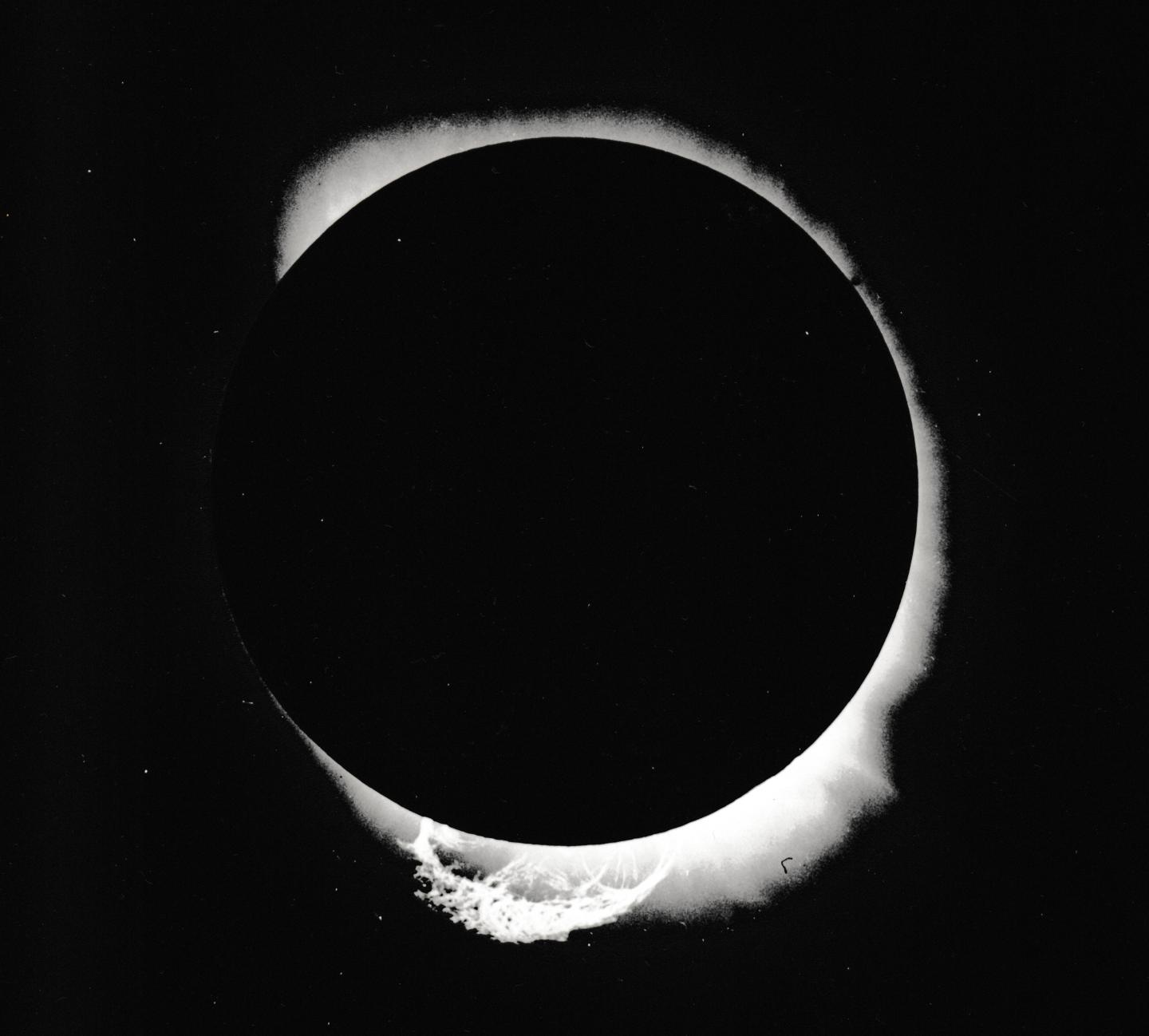
University of Arkansas physics professor Daniel Kennefick writes about the 1919 eclipse, which provided the data to confirm the revolutionary theory
IMAGE

Credit: Royal Astronomical Society

No Shadow of a Doubt, a new book by Daniel Kennefick, associate professor of physics at the University of Arkansas, tells the story of two research teams, organized by Arthur Stanley Eddington and Sir Frank Watson Dyson, who tested Einstein’s theory of relativity. These expeditions traveled to Brazil and Africa to collect images of stars during the 1919 eclipse, and their results confirmed and brought mainstream attention to the theory.

“Einstein was a well-known scientist before, but this made him a celebrity,” said Kennefick.

Einstein’s theory of relativity proposed a new way of looking at gravity. The prevailing theory at the time, Newton’s law of universal gravitation, described gravity as a force between massive objects. According to physicists in 1900, starlight, which they thought had no mass, would not be affected by gravity.

Einstein contradicted this expectation twice. First he showed, through his famous equation E=mc2, that light has mass, since it clearly has energy, and therefore should be affected by gravity. Then he theorized that gravity actually causes a curving of spacetime. According to his theory, light would follow this curve, so it would be affected by gravity, whether or not it had mass. If Einstein were to be correct, starlight traveling past the sun would follow a curved path as it traveled to Earth.

So if someone on Earth viewed a star during the night, when they were facing away from the sun, the star would appear to be in one place. But, according to Einstein’s theory, if someone were to look at the same star during the daytime, when the sun is between the Earth and the star, the star should appear to be in a slightly different position than it was when viewed at night.

In order to gather data to test this theory, scientists would need to photograph the stars while the sun was present, a situation that was only possible during a total eclipse. The 1919 eclipse presented an opportunity to make the necessary observations, but scientists had to travel to locations where the eclipse was total, which included Sobral, Brazil, and Principe, an island off the coast of Africa.

The two expeditions overcame many challenges, transporting large and delicate instruments on the long trips and facing the risk that a passing cloud would ruin the whole experiment.

Kennefick explained that he wanted to bring light to the story of these researchers, who have been overshadowed by Einstein’s fame.

“The passage of time has caused us to lose sight of their cruicial roles,” he said in the prologue of the book. “This book aims to correct this oversight, which could cripple serious attempts to understand how the science of the eclipse was accomplished.”

###

The book will be published by Princeton University Press on April 30.

CONTACTS:

Daniel Kennefick, associate professor of physics

J. William Fulbright College of Arts and Sciences

479-575-6784, [email protected]

Camilla Shumaker, director of science and research communications

University Relations

479-575-7422, [email protected]

Media Contact
Camilla Shumaker
[email protected]

Tags: AstronomyAstrophysicsChemistry/Physics/Materials SciencesHistorySpace/Planetary ScienceStars/The Sun
Share14Tweet8Share2ShareShareShare2

Related Posts

AI and Physics Collaborate to Design Advanced Hydrogen Storage Materials

June 25, 2026

International Team Including Dresden Scientists Develops Novel Designer Proteins for Advanced Study of Living Tissue

June 25, 2026

New Study Uncovers Key Factors Driving Water Chemistry in Nanoscale Environments

June 25, 2026

Plasma Technology Extends Catalyst Lifespan in Hydrogen Production

June 24, 2026
Please login to join discussion

POPULAR NEWS

  • Saying Goodbye to PGY-6: Pediatric Fellowship Realities

    103 shares
    Share 41 Tweet 26
  • Multi-Hospital Study Reveals Long Covid Burden Is Twice as High as Current Estimates

    92 shares
    Share 36 Tweet 23
  • Detection of EDCs in Breast Milk and Infant Urine Up to Six Months Highlights Early Exposure Risks

    77 shares
    Share 31 Tweet 19
  • New Drug Candidate Developed at McMaster Shows Potential for Treating Brain Cancer

    58 shares
    Share 23 Tweet 15

About

We bring you the latest biotechnology news from best research centers and universities around the world. Check our website.

Follow us

Recent News

Tracking Lanthanide-Labeled Microplastics in Plants

POSTECH Researchers Slash Cost of Reconstituted Cell-Free Systems by 95%

AI and Physics Collaborate to Design Advanced Hydrogen Storage Materials

Subscribe to Blog via Email

Success! An email was just sent to confirm your subscription. Please find the email now and click 'Confirm' to start subscribing.

Join 82 other subscribers
  • Contact Us

Bioengineer.org © Copyright 2023 All Rights Reserved.

Welcome Back!

Login to your account below

Forgotten Password?

Retrieve your password

Please enter your username or email address to reset your password.

Log In
No Result
View All Result
  • Homepages
    • Home Page 1
    • Home Page 2
  • News
  • National
  • Business
  • Health
  • Lifestyle
  • Science

Bioengineer.org © Copyright 2023 All Rights Reserved.