


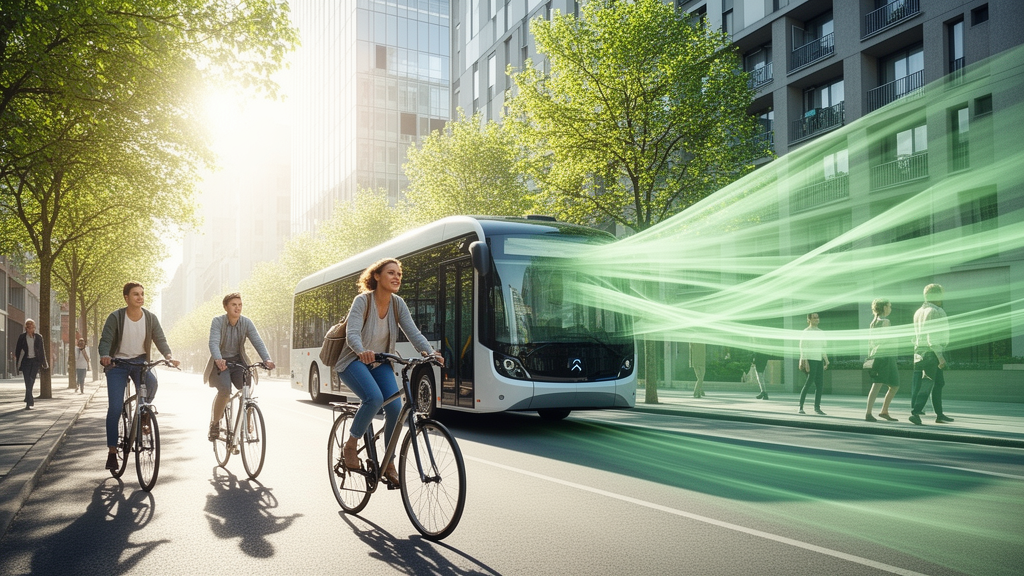
Researchers have unveiled a step-by-step method for predicting the social perks of climate policies before they are implemented, and their first case study delivers a sobering insight: simply making public transport better does not guarantee that drivers will abandon their cars. The study, published in the journal Energy, Sustainability and Society, presents a multi-staged methodology that combines Theories-of-Change, Bayesian reasoning and causal diagrams to trace how sufficiency-oriented decarbonization measures might ripple outward into benefits such as cleaner air and better health. Sufficiency, in this context, refers to strategies that reduce overall consumption and demand, such as shifting mobility away from private vehicles, and the authors argue it is a critical but frequently overlooked pillar of decarbonization.
The work, led by Jens Teubler and Malte Neumann, addresses a persistent gap in sustainability assessment. Analysts often possess an ex-ante impact hypothesis, a rough model of potential impacts, and scattered evidence, but no systematic way to connect the three into a plausible causal pathway. The new methodology is designed to bridge exactly that divide: it identifies the variables that matter along an impact chain and guides which of them must be statistically controlled in future empirical studies. According to the authors, it is particularly useful when additional empirical data is needed or when meaningful indicators for social co-benefits are missing altogether.
The framework unfolds in four iterative steps. First, researchers assemble plausible causal narratives, in this case with the help of abductive reasoning, drawing on Inferences-to-the-Best-Explanation logic. Second, these narratives are formalized into a linear Theory-of-Change, a logic model that maps inputs to activities, outputs, intermediate outcomes and long-term societal impacts. Third, each causal claim embedded in the model is converted into a formal hypothesis and its credibility is assessed using Bayesian epistemology, which treats beliefs as degrees of confidence ranging from zero to one and updates them in light of evidence. Fourth, the refined model is translated into causal diagrams of the kind developed by Judea Pearl, directed acyclic graphs that distinguish genuine causal variables from confounders, mediators and colliders, and thereby reveal which parameters an empirical investigation must control for.
The Bayesian component is the methodological heart of the approach. The authors distinguish a qualitative variant, suited to claims already well established in the literature, from a quantitative variant that assigns explicit credence ranges. The qualitative version proceeds through four tests: an argument from triviality, which asks whether a claim is so obvious that no evidence could sway a rational observer; an argument from theoretical certainty, which asks whether relevant evidence could even exist; an argument from empirical certainty, which checks whether expected supporting evidence is actually present; and an argument from empirical uniqueness, which weighs whether the available evidence is more likely under the hypothesis than under its alternatives. Claims that fail these tests must be discarded or reworked.
To demonstrate the method, the team examined a sufficiency scenario from the EU-funded FULFILL project: a policy intervention that successfully improves the performance and capacity of public transport systems across European urban communities. Their analysis identified two principal pathways to health co-benefits. The first runs through pollution: shifting journeys from internal combustion vehicles to public transport reduces emissions of ozone, particulate matter, sulphur dioxide and nitrogen oxides, leading to cleaner air and fewer cases of asthma, chronic bronchitis, lung cancer and heart disease. The second runs through physical activity, since people who use public transport typically walk or cycle to stations and stops, gaining exercise that improves cardiovascular health, weight management and mental well-being.
The pollution pathway itself survived scrutiny with high confidence. Vehicle emissions are well-documented causes of bronchitis, asthma and cardiovascular mortality, and have been traced to premature deaths. Fine particulate matter has been described in the literature as the dominant contributor to the global health burden of outdoor air pollution, ozone effects are more pronounced in dense urban areas, and public transport has repeatedly been shown to be safer than individual car use. Because these relationships are so firmly established, the authors judged the downstream link from reduced fossil fuel combustion to health benefits to be highly credible, requiring only a qualitative Bayesian assessment.
The real weak link proved to be the very first step: whether improved public transport actually triggers a modal shift away from cars. Using a quantitative Bayesian argument, the researchers assembled background knowledge and evidence on pricing policies, service quality, free fares and rider psychology, then calculated how likely that evidence would be under the hypothesis that system performance drives the shift versus under its negation. The evidence, they found, fit the alternative explanations better, in one comparison by a factor of up to 21. Their posterior credence in the unqualified hypothesis collapsed to a range of roughly 0.07 to 0.75. The decisive complication is that car users are not a homogeneous group: their preferences, motivations and economic, physical and legal capabilities heavily moderate whether they switch at all.
This disconfirmation is precisely where the methodology earns its keep. Rather than abandoning the pathway, the authors adapted their Theory-of-Change by adding an explicit pre-condition: the modal shift occurs only if policies account for the preferences and capabilities of the target population. With that condition in place, their credence rebounded to a range of 0.81 to 0.98. The exercise illustrates the iterative core of the framework, in which hypotheses are re-evaluated in light of evidence to avoid causal fallacies and biased expectations. The authors note that the same pre-condition applies to all three pathways they examined, since each depends on the same behavioural shift.
The causal diagrams then convert these refined hypotheses into a concrete evaluation design. By distinguishing chains, forks and colliders, the researchers identified what must be measured and controlled: individual preferences and capabilities mediate or moderate the shift, traffic density and vehicle distribution confound the link between reduced combustion and air quality, and pre-existing health factors such as nutrition, smoking and exercise habits confound the final health outcomes. Battery-electric vehicle ownership emerges as another potential confounder, since some drivers might swap a conventional car for an electric one rather than switching to public transport. The authors predict that the indirect effect, operating through matched preferences and capabilities, will be far stronger than any direct effect of the policy, and that the modal shift will follow individual thresholds rather than a linear dose-response relationship.
The framework also generates a prioritized list of data needs: local surveys of target-group preferences, pre- and post-intervention measurements of airborne particle concentrations, and tracked physical activity data for a large share of the population. The authors are candid about the limitations. The approach relies on heuristics and general knowledge rather than direct empirical data, only randomized controls can fully eliminate researcher bias, and the simplified diagrams assume pathways that are simple, one-directional and unchanging. The study itself is a methodological demonstration without new empirical data, and the authors intend to test the novel integration of causal diagrams in future work. Still, they argue the framework closes the gap between qualitative, case-oriented research and quantitative, population-oriented evaluation, and can extend beyond transport to sustainable finance, scenario analysis and the design of more effective decarbonization policies.
Subject of Research: A multi-staged Bayesian and causal-diagram methodology for predicting health co-benefits of sufficiency-based decarbonization policies
Article Title: Causal heuristics for predicting co-benefits from decarbonization and sufficiency: presenting a multi-staged methodology based on Theories-of-Change and causal diagrams
Article References: Teubler, J., & Neumann, M. (2026). Causal heuristics for predicting co-benefits from decarbonization and sufficiency: presenting a multi-staged methodology based on Theories-of-Change and causal diagrams. Energy, Sustainability and Society, 16(1), Article 42. https://doi.org/10.1186/s13705-026-00604-9
Image Credits: AI Generated
DOI: 10.1186/s13705-026-00604-9
Keywords: sufficiency, decarbonization, public transport, Bayesian epistemology, causal diagrams, Theory-of-Change, health co-benefits, air pollution, modal shift, social impact assessment, sustainability, methodology
News Source: Sloane Callahan. (October 29, 2026). New Bayesian Method Maps How Green Transport Policies Deliver Hidden Health Benefits. Scienmag.



