An international team of researchers has developed a new theoretical framework that bridges physics and biology to provide a unified approach for understanding how complexity and evolution emerge in nature. This new work on “Assembly Theory,” published today in Nature, represents a major advance in our fundamental comprehension of biological evolution and how it is governed by the physical laws of the universe.
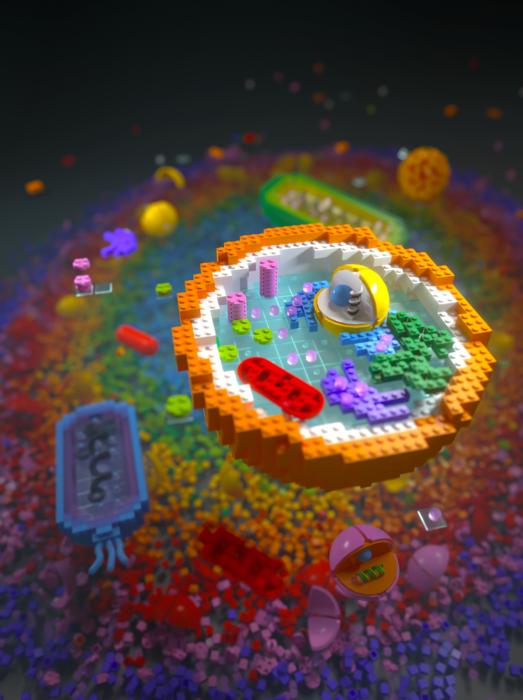
Credit: Dr Anna Tanczos, Sci-Comm Studios.
An international team of researchers has developed a new theoretical framework that bridges physics and biology to provide a unified approach for understanding how complexity and evolution emerge in nature. This new work on “Assembly Theory,” published today in Nature, represents a major advance in our fundamental comprehension of biological evolution and how it is governed by the physical laws of the universe.
This research builds on the team’s previous work developing Assembly Theory as an empirically validated approach to life detection, with implications for the search for alien life and efforts to evolve new life forms in the laboratory. In prior work, the team assigned a complexity score to molecules called the molecular assembly index, based on the minimal number of bond-forming steps required to build a molecule. They showed how this index is experimentally measurable and how high values correlate with life-derived molecules.
The new study introduces mathematical formalism around a physical quantity called “Assembly” that captures how much selection is required to produce a given set of complex objects, based on their abundance and assembly indices.
“Assembly Theory provides a completely new lens for looking at physics, chemistry and biology as different perspectives of the same underlying reality,” explained lead author professor Sara Walker, a theoretical physicist and origin of life researcher from Arizona State University. “With this theory, we can start to close the gap between reductionist physics and Darwinian evolution – it’s a major step toward a fundamental theory unifying inert and living matter.”
The researchers demonstrated how Assembly Theory can be applied to quantify selection and evolution in systems ranging from simple molecules to complex polymers and cellular structures. It explains both the discovery of new objects and the selection of existing ones, allowing open-ended increases in complexity characteristic of life and technology.
“Assembly Theory provides an entirely new way to look at the matter that makes up our world, as defined not just by immutable particles but by the memory needed to build objects through selection over time,” said professor Lee Cronin, a chemist from the University of Glasgow and co-lead author. “With further work, this approach has the potential to transform fields from cosmology to computer science. It represents a new frontier at the intersection of physics, chemistry, biology and information theory.”
The researchers aim to further refine Assembly Theory and explore its applications for characterizing known and unknown life, and testing hypotheses about how life emerges from non-living matter. “A key feature of the theory is that it is experimentally testable,” said Cronin. “This opens up the exciting possibility of using Assembly Theory to design new experiments that could solve the origin of life by creating living systems from scratch in the laboratory.”
The theory opens up many new questions and research directions at the boundary of the physical and life sciences. Overall, Assembly Theory promises to provide profound new insights into the physics underlying biological complexity and evolutionary innovation.
Journal
Nature
DOI
10.1038/s41586-023-06600-9
Method of Research
Experimental study
Subject of Research
Not applicable
Article Title
Assembly theory explains and quantifies selection and evolution
Article Publication Date
4-Oct-2023