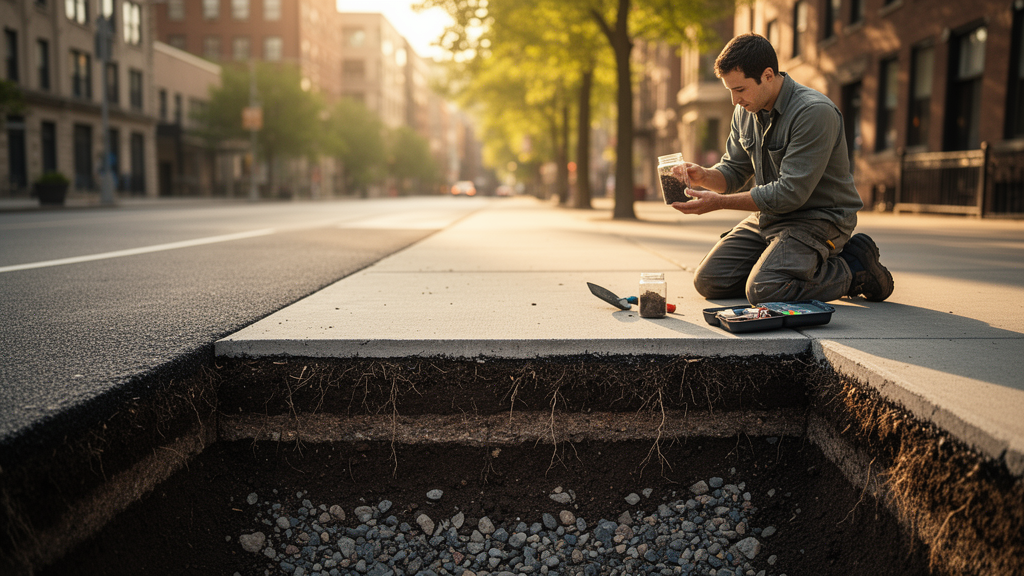
Beneath the cracked pavement and compacted verges of one of Europe’s busiest port cities lies a microbial universe far stranger and more varied than scientists expected. A team of researchers at the University of Antwerp has mapped the bacterial communities living in the soils of street trees across Antwerp, Belgium, and discovered that a single city can harbor more than 1,800 bacterial genera, with communities differing dramatically from one street corner to the next. The study, published in the journal Web Ecology, offers one of the most detailed portraits yet of the urban soil microbiome, and it carries a provocative message for city planners: the invisible life under our feet is shaped less by soil chemistry than by the ghosts of construction past.
Urban soils are workhorses of the modern city. They buffer floods, counter the urban heat island effect, capture and degrade pollutants, support infrastructure, enable urban agriculture, and provide the green spaces that benefit both physical and mental health. Many of these ecosystem services depend on soil microbial communities, which drive nutrient cycling, decompose organic matter, and sustain plant health. There is even growing evidence that exposure to natural microbial biodiversity can benefit the human immune system. Yet while the microbiomes of forests and farmland have been studied extensively, urban soil microbes have remained strikingly underexplored, largely because urban soils are notoriously difficult to characterize. Construction, sealing, soil compaction, debris burial, and pollution from traffic and industry all scramble the physical, chemical, and biological properties of city ground in ways that vary block by block.
To untangle this complexity, the researchers designed an unusually rigorous sampling scheme. They selected 20 sites across Antwerp, each anchored by solitary London plane trees (Platanus × acerifolia) growing in unsealed soil strips next to paved streets. Using a single tree species kept the vegetation effect consistent across sites. At each site, soils were sampled under two trees spaced 3 to 20 meters apart; under each tree, samples were taken on the north and south sides, 1 to 3 meters apart; and at each orientation, the upper mineral soil was collected at two depths, from 0 to 5 centimeters and from 10 to 15 centimeters. In total, 160 soil samples were gathered between mid-February and the end of March 2023, spanning spatial distances from 2 meters to 7 kilometers.
The molecular work was equally ambitious. DNA was extracted from every sample and the bacterial 16S rRNA gene was amplified and sequenced on an Illumina MiSeq platform. After stringent quality filtering with the DADA2 pipeline, which discards low-quality reads and removes chimeric sequences, the final dataset contained roughly 1.3 million reads across 122 samples, resolving 11,093 amplicon sequence variants representing 1,835 bacterial genera. The dominant phyla were familiar players from natural soils: Proteobacteria accounted for about 24 percent of reads, followed by Acidobacteriota at 20 percent, Actinobacteriota at 19 percent, Firmicutes at 7 percent, and Verrucomicrobiota at 6 percent. Genera such as Renibacterium, Bradyrhizobium, Nitrosocosmicus, and Hyphomicrobium were among the most abundant, hinting at active carbon, nitrogen, and pollutant cycling even in this heavily engineered environment.
Alongside the sequencing, the team measured a battery of soil and environmental variables. Gravimetric moisture content averaged 15 percent, notably drier than the roughly 21 percent reported for nearby agricultural soils, consistent with previous observations that urban soils tend to be parched. Soil pH, measured in potassium chloride, had a median of 6.4, and a striking 93 percent of samples were more alkaline than the median pH of 4.6 typical for comparable forest soils in the same region, a signature of calcareous leaching from concrete. The researchers also measured soil density and saturation isothermal remanent magnetization, a magnetic proxy for traffic-derived heavy metal pollution, and pulled modelled concentrations of particulate matter and nitrogen oxides from high-resolution air quality maps. Land use classes around each site were extracted from the Copernicus Urban Atlas.
When the team ran permutational multivariate analyses of variance on the community data, a clear hierarchy emerged. The single strongest driver of bacterial community composition was the sampling site itself, explaining 40 percent of the variation, far outweighing any soil characteristic. The identity of the individual tree added another 13 percent, and soil depth and orientation contributed further significant effects. Soil properties did matter: pH, moisture, density, depth, air pollution, and land use class were all significantly associated with community composition, with pH emerging as the most influential soil variable. But its explanatory power was an order of magnitude smaller than that of spatial location. The researchers speculate that this overwhelming site effect reflects dispersal limitation combined with the historic movement of soil during construction, meaning the microbial inhabitants of whatever soil was originally dumped or disturbed decades ago still dominate the community today.
Two findings stand out for their practical implications. First, bacterial diversity dropped significantly as soil moisture declined, a relationship that became especially steep in the drier soils that dominate the city. Since urban soils are already prone to drying, this suggests that simple interventions, from removing sealing and installing permeable pavements to adding organic ground covers and improving water retention, could help preserve the microbial diversity that underpins urban soil function. Second, the age of the vegetation left a clear fingerprint on community dynamics. Soils under trees with smaller trunks, and therefore presumably younger trees and less developed root systems, varied enormously in bacterial composition, while soils under larger, older trees converged toward significantly more similar communities. The influence of pH and heavy metal pollution on community composition also weakened as trunk circumference increased, with the explained variation for pH falling from around 0.19 to 0.09 in surface soils. The interpretation is tantalizing: as trees and their root systems mature, the associated bacterial communities stabilize and may become more resilient to chemical stress.
The study also confirmed patterns familiar from natural ecosystems. Bacterial diversity peaked at a near-neutral pH between 6 and 7, echoing classic findings from continental-scale surveys of non-urban soils. But the urban context adds a twist: because concrete alkalizes city soils, much of the urban pH range sits above this optimum, and elevated pH has been linked to reduced microbial function. A global study of 56 cities previously found that urban green space microbiomes lean toward faster nutrient cycling, more greenhouse gas emissions, and greater pathogenic potential compared with nearby natural soils, and the Antwerp results add a crucial nuance: within a single city, the legacy of soil disturbance may matter as much as any global trend.
The authors are careful about the limits of their exploratory, single-time-point design. They sampled only bacteria, leaving fungi, archaea, protists, and other eukaryotes unexamined, and they could not directly observe successional dynamics without sampling over multiple years. They also note that without a proper definition of what constitutes a healthy urban soil microbiome, management recommendations remain partly hypothetical. Still, the message for urban planning is hard to ignore. Soil moisture, pH, vegetation age, and the history of ground disturbance all leave measurable signatures on the bacterial communities that deliver urban ecosystem services. As cities expand and redevelop, the researchers argue, microbial soil diversity deserves a seat at the planning table, alongside permeable surfaces, moisture-retaining designs, and conservation of older, undisturbed soils. The ground beneath our streets, it turns out, is not dead matter but a living archive of the city’s construction history, and learning to read and manage it may be one of the most underappreciated opportunities in modern urban sustainability.
Subject of Research: Urban soil bacterial diversity and its relationship with soil physicochemical properties in Antwerp
Article Title: Heterogeneity of the urban soil microbiome and associations with physicochemical soil characteristics
Article References: Smets, W., Bosiers, T., De Groof, N., Diels, E., Dubois, J., Gilis, F., Santullo Latorre, A., & Wuyts, K. (2026). Heterogeneity of the urban soil microbiome and associations with physicochemical soil characteristics. Web Ecology, 26(1), 35-45. https://doi.org/10.5194/we-26-35-2026
Image Credits: AI Generated
Keywords: urban soil microbiome, soil bacteria, Antwerp, 16S rRNA sequencing, soil pH, soil moisture, London plane trees, urban planning, ecosystem services, soil pollution, PERMANOVA, microbial diversity
News Source: Morgan Morrow. (October 9, 2026). Beneath the Pavement: City Soils Hide a Startlingly Diverse Bacterial World Shaped by Construction History. Scienmag.