


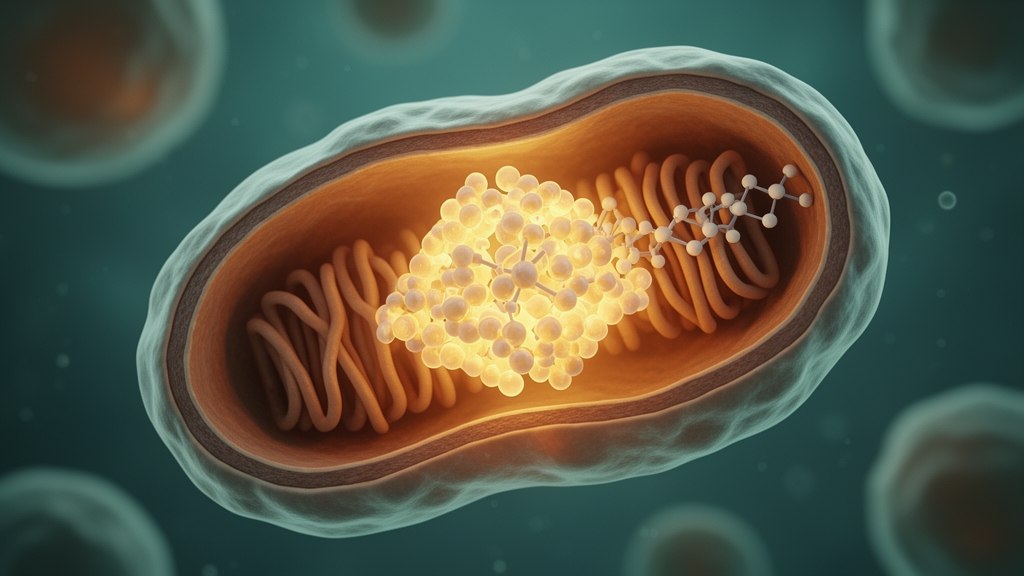
Inside the mitochondria of baker’s yeast, a newly characterized four-protein assembly line has been caught coordinating the construction of two of the cell’s most important energy machines. Researchers report that a previously obscure inner membrane protein called Aim11 works together with three partners, Mtc3, Gep7 and Iai11, to form a complex they have named AMIGa, which helps build both cytochrome c oxidase, the final electron acceptor of the respiratory chain, and ATP synthase, the enzyme that manufactures most of the cell’s ATP. The work, published in EMBO Reports, also identifies the human protein TMEM242 as an Aim11 orthologue, which was able to compensate for the loss of Aim11 in yeast.
The study built on a puzzle left over from large-scale protein interaction surveys. Those experiments had shown that Aim11 physically associates with several subunits and assembly factors of complex IV and ATP synthase, including Cox2, Cox20, Cox6 and the ATP synthase subunits alpha, beta, delta and epsilon, but the relevance of these interactions was not established. Aim11 is a small mitochondrial inner membrane protein of roughly 15 kilodaltons with two transmembrane helices, and earlier genetic work had shown that losing it is lethal when the mitochondrial scaffold proteins called prohibitins are also absent. The team, led by Ulrik Pedroza-Dávila and Xochitl Perez-Martinez, characterized the role of Aim11 in complex IV and ATP synthase biogenesis.
The first clue came from growth tests. When the researchers deleted the AIM11 gene, the mutant yeast grew normally on glucose, which cells can ferment, but struggled on ethanol and glycerol or on lactate, carbon sources that force them to respire. The defect was more pronounced on lactate, which feeds electrons directly to cytochrome c and therefore straight into complex IV. Enzyme measurements in isolated mitochondria confirmed where the damage lay: complex IV activity dropped to about 30 percent of the wild-type level, complex III2 activity fell to 73 percent, and complex II activity actually rose slightly to 120 percent. Blue native gel analysis showed that the mutant had lower levels of monomeric complex IV and of the large respiratory supercomplexes, while ATP synthase activity staining looked essentially unchanged.
Importantly, the problem was not that the mutant failed to make the building blocks. When the researchers labeled newly synthesized mitochondrial proteins with radioactive methionine, production of Cox2 and Cox3 was slightly increased and synthesis of the ATP synthase subunit Atp6 rose sharply, while Cox1, cytochrome b and Var1 were unaffected. Yet steady-state levels of Cox1 and Cox2 fell, and neither Atp6 steady-state levels nor ATP synthase levels reflected the increase in Atp6 translation. The authors conclude that Aim11 is required for the optimal assembly of complex IV rather than for the synthesis of its components, and that Cox1 stability is compromised in its absence. An unexplained low-molecular-weight band that appeared in the Δaim11 mutant may, the authors suggest, originate from Atp9.
To see exactly where assembly stalls, the team turned to complexome profiling, a technique that solubilizes mitochondria in digitonin, separates the protein complexes on a native gel, slices the lane into dozens of fractions and identifies the peptides in each by mass spectrometry. In wild-type mitochondria, Aim11 migrated in complexes ranging from about 50 to 400 kilodaltons, with its strongest signal near 150 kilodaltons. In the mutant, several complex IV subunits, including Cox3, Cox7 and Cox8, piled up in low-mass intermediates between roughly 50 and 150 kilodaltons, while the average signal of complex IV subunits within supercomplexes dropped. The Cox2-Cox20 subcomplex, normally seen at about 68 and 90 kilodaltons, accumulated, indicating that even the early steps of the Cox2 assembly module are affected.
The clearest thread led to Cox6, a small nuclear-encoded subunit of the Cox1 assembly module. Most Cox6 in wild-type cells comigrates with mature complex IV and the supercomplexes, but a small fraction travels with Aim11 at about 60 kilodaltons, and that peak vanished in the mutant. Cox6 levels fell when AIM11 was deleted, and when the researchers overexpressed the COX6 gene from a high-copy plasmid, the respiratory growth defect of the mutant partially recovered. The authors propose that the Cox6-Aim11 interaction could help stabilize Cox6 and facilitate its assembly into the Cox1 module; in the Δaim11 mutant, Cox6 levels decreased, Cox1-containing intermediates at roughly 90 to 100 and 160 kilodaltons accumulated, and the Cox3 module was also affected, with Cox3 accumulating alongside Cox7, Rcf1 or Cox4 in subcomplexes whose apparent molecular masses exceed their theoretical masses, suggesting the presence of additional unidentified proteins.
Aim11, it turns out, does not work alone. Immunoprecipitating tagged versions of Iai11, Mtc3 or Gep7 pulled down Aim11 in every case, confirming a four-protein cluster the authors named the Aim11-Mtc3-Iai11-Gep7 assembly complex, or AMIGa. Deleting any one of the three partner genes also impaired respiratory growth and lowered complex IV subunit levels, although less severely than losing Aim11 itself. Double mutants showed no additional respiratory growth defects, and in the complexome data Gep7 showed a very similar migration pattern to Aim11 and was mostly undetectable in the Δaim11 strain, while Iai11 and Mtc3 presented a similar migration pattern, and in the ~150, 200 and 400 kilodalton peaks where all four proteins were present, Iai11 and Mtc3 levels were greatly reduced when Aim11 was absent. Strikingly, overexpressing AIM11 compensated for the respiratory growth defect of the single Δgep7, Δiai11 and Δmtc3 mutants as well as the triple Δgep7/Δiai11/Δmtc3 mutant, whereas overexpressing GEP7, IAI11 or MTC3 did not compensate for the absence of Aim11, suggesting that Aim11 is the central component of the AMIGa complex, while Gep7, Iai11 and Mtc3 play ancillary roles in complex IV biogenesis.
The connection to ATP synthase emerged from a different angle. Because the human protein TMEM242, an established ATP synthase assembly factor, turned out to be structurally similar to Aim11 and Iai11, the researchers wondered whether Aim11 also touches the ATP synthase membrane domain. In an in-organello translation assay coupled with digitonin solubilization and Aim11-3xFLAG immunoprecipitation, Aim11 copurified with the newly synthesized Atp9 c-ring, and no other mitochondrial-encoded protein interaction was clearly detected. Complexome profiling of the mutant showed Atp9 migrating at various size subcomplexes ranging from about 45 to 400 kilodaltons, with its most enriched population near 75 kilodaltons, close to the theoretical molecular mass of the yeast c10-ring, while Atp25 and the INA complex accumulated at low molecular masses, which could be the result of an alteration in the formation of the Atp9 ring in the Δaim11 mutant. A genetic interaction between AIM11 and INA22, seen as decreased respiratory growth of the Δaim11/Δina22 double mutant compared to the Δaim11 single mutant, supports a possible role of Aim11 in the formation of the membrane domain of ATP synthase.
Why would one factor serve two enzymes at once? The authors point to the Atco complex, a common intermediate in yeast composed of the Atp9 ring and the CIV subunit Cox6, which is proposed to coordinate complex IV and ATP synthase biogenesis and maintain a proper ratio between these OXPHOS complexes. Aim11 contacts both components of this junction. Based on the fact that Aim11 interacts with both components, the authors propose a model where the AMIGa complex could function as a scaffold for the association of Cox6 and the Atp9 ring; in its absence, Cox6 is less likely to bind to the c-ring, and is thus degraded, resulting in the accumulation of both intermediates of complex IV and ATP synthase. The arrangement echoes the Atco system's known asymmetry, in which the absence of Atp9 results in a defect in complex IV levels, but a COX6 null mutant does not affect ATP synthase levels, which is reminiscent of the phenotypes observed in the Δaim11 mutant, where complex IV is affected but ATP synthase is not.
The evolutionary analysis is perhaps the most striking part. By searching for structural rather than sequence similarity, the team found that Aim11 and Iai11 resemble TMEM242 in humans, flies and worms, despite sharing only about 21 percent amino acid identity and having opposite membrane topologies, with Aim11’s termini facing the intermembrane space and TMEM242’s facing the matrix. When the human gene was expressed in yeast, it compensated for the loss of Aim11, Gep7, Iai11 or Mtc3 and restored Cox1 levels in the mutant, though only when overexpressed. No metazoan orthologues of the other three AMIGa members were found, and Gep7 and Mtc3 instead showed structural kinship with the COX4 subunit. The authors suggest that the Aim11/TMEM242 orthologue pair could be the first assembly chaperone of the membrane portion of ATP synthase shared between humans and yeast, since no human orthologues of yeast Atp25, Atp23, Atp10, Ina17 and Ina22 have been identified, and that further work must be carried out to understand the relationship between prohibitins, the AMIGa complex and OXPHOS complexes assembly.
Subject of Research: A newly characterized mitochondrial protein complex that coordinates the assembly of cytochrome c oxidase and ATP synthase in yeast
Article Title: The AMIGa complex is at the crossroads of cytochrome c oxidase and ATP synthase biogenesis
Article References: Pedroza-Dávila, U., Camacho-Villasana, Y., Vázquez-Acevedo, M., Lutikurti, M., González-Halphen, D., Cabrera-Orefice, A., & Perez-Martinez, X. (2026). The AMIGa complex is at the crossroads of cytochrome c oxidase and ATP synthase biogenesis. EMBO Reports. https://doi.org/10.1038/s44319-026-00946-7
Image Credits: AI Generated
DOI: 10.1038/s44319-026-00946-7
Keywords: mitochondria, AMIGa complex, Aim11, cytochrome c oxidase, ATP synthase, assembly factors, complexome profiling, Saccharomyces cerevisiae, TMEM242, Atco complex, oxidative phosphorylation, respiratory chain
News Source: Drew Townsend. (October 30, 2026). New AMIGa complex links mitochondrial enzyme assembly in yeast. Scienmag.



