• HOME
  • NEWS
  • EXPLORE
    • CAREER
      • Companies
      • Jobs
    • EVENTS
    • iGEM
      • News
      • Team
    • PHOTOS
    • VIDEO
    • WIKI
  • BLOG
  • COMMUNITY
    • FACEBOOK
    • INSTAGRAM
    • TWITTER
Thursday, May 14, 2026
BIOENGINEER.ORG
No Result
View All Result
  • Login
  • HOME
  • NEWS
  • EXPLORE
    • CAREER
      • Companies
      • Jobs
        • Lecturer
        • PhD Studentship
        • Postdoc
        • Research Assistant
    • EVENTS
    • iGEM
      • News
      • Team
    • PHOTOS
    • VIDEO
    • WIKI
  • BLOG
  • COMMUNITY
    • FACEBOOK
    • INSTAGRAM
    • TWITTER
  • HOME
  • NEWS
  • EXPLORE
    • CAREER
      • Companies
      • Jobs
        • Lecturer
        • PhD Studentship
        • Postdoc
        • Research Assistant
    • EVENTS
    • iGEM
      • News
      • Team
    • PHOTOS
    • VIDEO
    • WIKI
  • BLOG
  • COMMUNITY
    • FACEBOOK
    • INSTAGRAM
    • TWITTER
No Result
View All Result
Bioengineer.org
No Result
View All Result
Home NEWS Science News Biology

New 3D nanoprinting strategy opens door to revolution in medicine, robotics

Bioengineer by Bioengineer
January 23, 2019
in Biology
Reading Time: 3 mins read
0
IMAGE
Share on FacebookShare on TwitterShare on LinkedinShare on RedditShare on Telegram

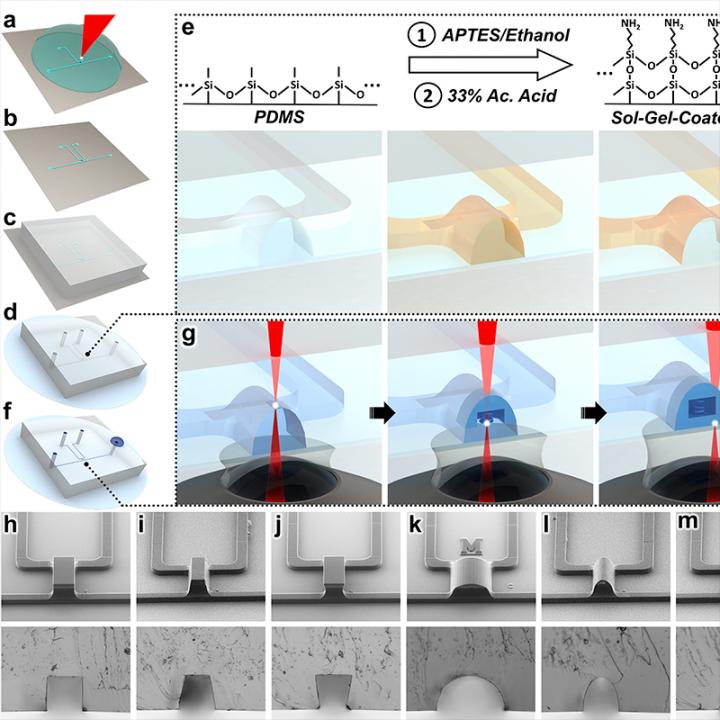
UMD engineers demonstrate their approach by printing the smallest-known 3D microfluidic circuit element
IMAGE

Credit: DOI: 10.1038/s41598-018-36727-z


Engineers at the University of Maryland (UMD) have created the first 3D-printed fluid circuit element so tiny that 10 could rest on the width of a human hair. The diode ensures fluids move in only a single direction–a critical feature for products like implantable devices that release therapies directly into the body.

The microfluidic diode also represents the first use of a 3D nanoprinting strategy that breaks through previous cost and complexity barriers hindering advancements in areas from personalized medicine to drug delivery.

“Just as shrinking electric circuits revolutionized the field of electronics, the ability to dramatically reduce the size of 3D printed microfluidic circuitry sets the stage for a new era in fields like pharmaceutical screening, medical diagnostics, and microrobotics,” said Ryan Sochol, an assistant professor in mechanical engineering and bioengineering at UMD’s A. James Clark School of Engineering.

Sochol, along with graduate students Andrew Lamont and Abdullah Alsharhan, outlined their new strategy in a paper published today in the open-access journal Scientific Reports.

Scientists have in recent years tapped into the emerging technology of 3D nanoprinting to build medical devices and create “organ-on-a-chip” systems. But the complexity of pushing pharmaceuticals, nutrients, and other fluids into such small environments without leakage–and the costs of overcoming those complexities–made the technology impractical for most applications requiring precise fluid control.

Instead, researchers were limited to additive manufacturing technologies that print features significantly larger than the new UMD fluid diode.

“This really put a limit on how small your device could be,” said Lamont, a bioengineering student who developed the approach and led the tests as part of his doctoral research. “After all, the microfluidic circuitry in your microrobot can’t be larger than the robot itself.”

What sets the Clark School team’s strategy apart is its use of a process known as sol-gel, which allowed them to anchor their diode to the walls of a microscale channel printed with a common polymer. The diode’s minute architecture was then printed directly inside of the channel–layer-by-layer, from the top of the channel down.

The result is a fully sealed, 3D microfluidic diode created at a fraction of the cost and in less time than previous approaches.

The strong seal they achieved, which will protect the circuit from contamination and ensure any fluid pushed through the diode isn’t released at the wrong time or place, was further strengthened by a reshaping of the microchannel walls.

“Where previous methods required researchers to sacrifice time and cost to build similar components, our approach allows us to essentially have our cake and eat it too,” Sochol said. “Now, researchers can 3D nanoprint complex fluidic systems faster, cheaper, and with less labor than ever before.”

###

Media Contact
Melissa L. Andreychek
[email protected]
301-405-0292

Original Source

https://eng.umd.edu/release/new-3d-nanoprinting-strategy-opens-door-to-revolution-in-medicine-robotics

Related Journal Article

http://dx.doi.org/10.1038/s41598-018-36727-z

Tags: BiotechnologyNanotechnology/MicromachinesTechnology/Engineering/Computer Science
Share12Tweet8Share2ShareShareShare2

Related Posts

“‘Last Titan’: Discovery of Southeast Asia’s Largest Dinosaur Unveiled” — Biology

“‘Last Titan’: Discovery of Southeast Asia’s Largest Dinosaur Unveiled”

May 14, 2026
Study Offers In-Depth Analysis of Changes in Toxin-Producing Phytoplankton Populations — Biology

Study Offers In-Depth Analysis of Changes in Toxin-Producing Phytoplankton Populations

May 14, 2026

UMass Chan Scientists Pioneer Gene Editing Technology That Rewrites Entire Genome Chapters

May 13, 2026

Scientists Observe Rice Plants Capturing and Eliminating Fall Armyworm Caterpillars

May 13, 2026
Please login to join discussion

POPULAR NEWS

  • Research Indicates Potential Connection Between Prenatal Medication Exposure and Elevated Autism Risk

    842 shares
    Share 337 Tweet 211
  • New Study Reveals Plants Can Detect the Sound of Rain

    729 shares
    Share 291 Tweet 182
  • Salmonella Haem Blocks Macrophages, Boosts Infection

    62 shares
    Share 25 Tweet 16
  • Breastmilk Balances E. coli and Beneficial Bacteria in Infant Gut Microbiomes

    57 shares
    Share 23 Tweet 14

About

We bring you the latest biotechnology news from best research centers and universities around the world. Check our website.

Follow us

Recent News

“‘Last Titan’: Discovery of Southeast Asia’s Largest Dinosaur Unveiled”

Alpine Fires Surge in Central Africa Mountains

Physical Activity Mitigates Sedentary Risks in Elderly

Subscribe to Blog via Email

Enter your email address to subscribe to this blog and receive notifications of new posts by email.

Join 82 other subscribers
  • Contact Us

Bioengineer.org © Copyright 2023 All Rights Reserved.

Welcome Back!

Login to your account below

Forgotten Password?

Retrieve your password

Please enter your username or email address to reset your password.

Log In
No Result
View All Result
  • Homepages
    • Home Page 1
    • Home Page 2
  • News
  • National
  • Business
  • Health
  • Lifestyle
  • Science

Bioengineer.org © Copyright 2023 All Rights Reserved.