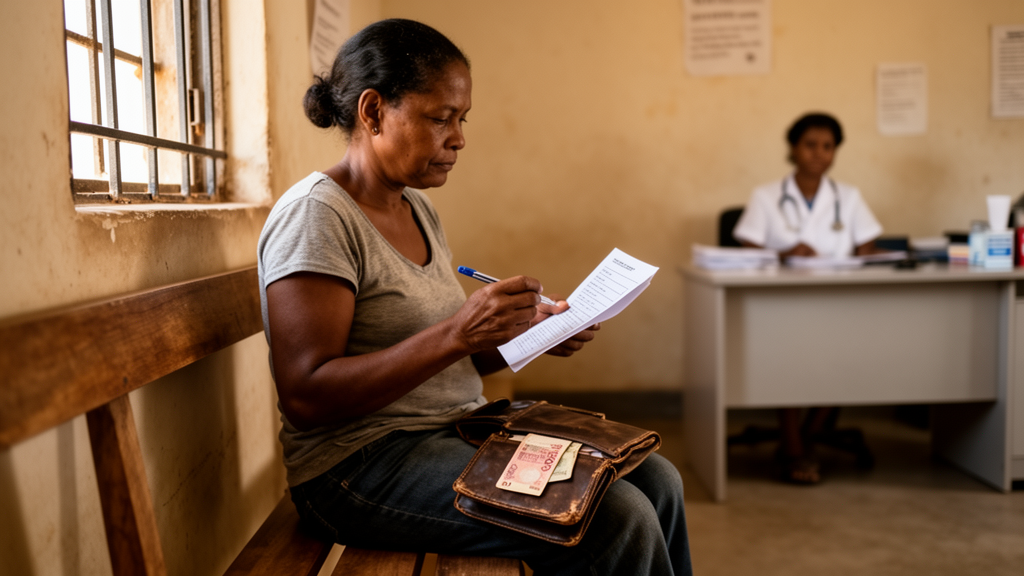
Cancer does not only attack the body. In hospitals across the developing world, it frequently attacks household finances with a force that can be as destructive as the disease itself, forcing families to sell land, pull children out of school, or abandon treatment altogether. Researchers have a name for this collateral damage: financial toxicity, a term borrowed deliberately from oncology’s own vocabulary of side effects. Yet while the concept has been measured, scored and validated extensively in wealthy nations, patients in low- and middle-income countries have largely been assessed with instruments never designed for their economic realities. A new study from Nepal, published in Supportive Care in Cancer, sets out to close that gap with a purpose-built measurement tool.
The research, led by Shweta Baral of Bhaktapur Cancer Hospital and Kathmandu University School of Education, together with Prakash C. Bhattarai and Bal Chandra Luitel, produced an 18-item instrument called the Financial Toxicity scale for Low- and Middle-income countries, abbreviated FT-LM. Its construction relied on a modified Delphi method, a structured technique for distilling expert judgment into group consensus through successive rounds of anonymous questionnaires. The result is not merely another questionnaire. It is an attempt to define, in statistically defensible terms, what financial distress actually looks like for a cancer patient whose safety net is thin or nonexistent.
The rationale for the work rests on a stubborn asymmetry in the global health literature. Lower socioeconomic status is consistently associated with higher cancer incidence and poorer treatment outcomes, and studies of financial toxicity have multiplied in high-income settings, where instruments such as the COST measure and the Financial Index of Toxicity were developed and validated. Those tools, however, encode assumptions about insurance coverage, employment protection, and credit access that simply do not transfer to contexts where most patients pay out of pocket. A survey of acute leukaemia patients in Nepal published in The Lancet Haematology in 2020 made the point starkly, and subsequent work has documented catastrophic health expenditure among cancer households in India, China, Malaysia, Ethiopia, Nigeria, Rwanda and Bangladesh.
To build the new scale, the team drew on multiple cancer hospitals across Nepal and combined qualitative and quantitative methods. The process began with extensive literature reviews and expert consultation to generate a candidate pool of items describing the financial consequences of cancer treatment. These candidate statements were then subjected to a series of Delphi rounds, in which a panel of experts rated each item independently. The modified Delphi approach preserves the anonymity and iteration of the classic technique while allowing researchers to set explicit statistical thresholds for retention, a feature that gives the final instrument a transparent, auditable pedigree.
The statistical machinery behind the item selection was rigorous. An item survived only if it met three simultaneous criteria: an interquartile range of one or less, indicating that expert ratings were tightly clustered; a level of agreement of at least 75 percent; and an item-level content validity index of at least 0.78, a standard benchmark in psychometrics for confirming that an item genuinely measures the construct it claims to capture. Kendall’s coefficient of concordance was used to track whether the panel as a whole was converging toward consensus across rounds. All analyses were performed with SPSS version 27.
Three rounds of surveys were sufficient. Agreement rose substantially from the first round to the third, and the final concordance statistic was emphatic: with 17 degrees of freedom and 42 experts, Kendall’s W reached 0.612 with a chi-square of 436.859 and a p-value below 0.01, indicating strong and statistically significant consensus. Only items clearing every threshold were retained, yielding a compact scale of 18 items. The authors report that the tightening of agreement across rounds suggests the panel moved from dispersed initial opinions to a genuinely shared understanding of what financial toxicity means in their setting.
Perhaps the most revealing output of the exercise is conceptual rather than statistical. The 18 surviving items organized themselves into five thematic domains: affordability of treatment, compromising on family needs, compromising on treatment, mental stress, and leaving treatment due to financial issues. Read together, these domains sketch a distinctly low- and middle-income country profile of financial harm. In wealthy health systems, financial toxicity is often framed around copayments, prescription costs and employment discrimination. In the Nepali context that shaped FT-LM, the domains extend to families sacrificing basic needs and to patients discontinuing therapy entirely because the money has run out, outcomes that are less about hardship at the margins and more about treatment abandonment as a direct financial event.
The inclusion of mental stress as a standalone domain also reflects a growing recognition that financial distress is not purely economic. Earlier studies, including work on breast cancer survivors in the United States and analyses of Italian clinical trial data, have linked financial difficulties to diminished quality of life and worse clinical outcomes. Recent research from low- and middle-income settings has extended this picture to informal caregivers, whose own mental well-being erodes under the weight of prolonged financial strain. By embedding psychological distress directly into the scale, the Nepali team has built an instrument that treats financial toxicity as a biopsychosocial phenomenon rather than a ledger entry.
Methodologically, the study demonstrates the continued utility of the Delphi technique, which has been applied in health research since the 1990s and refined in fields ranging from telemedicine training to disaster resilience. The modified Delphi design is particularly well suited to scale construction in contexts where no validated predecessor exists, because it allows local experts, oncologists, and hospital administrators to define the construct from the ground up rather than importing a framework built elsewhere. The Nepal Health Research Council approved the study, and participants provided consent under national guidelines, underscoring the ethical scaffolding that accompanies instrument development involving vulnerable patient populations.
The practical implications reach well beyond Nepal’s borders. For cancer treatment centers, FT-LM offers a way to identify patients at risk of treatment abandonment before it happens, opening a window for counseling, fee adjustment, or referral to financial support schemes. For policymakers in low- and middle-income countries, a validated, context-appropriate scale provides the evidence base needed to quantify the scale of the problem, compare populations, and evaluate whether financial protection policies actually reduce distress. As global health advocates push to close the cancer care gap, tools like FT-LM supply something the field has lacked: a common yardstick, calibrated locally, for measuring one of cancer’s most corrosive and least visible side effects.
Subject of Research: Development of a financial toxicity measurement scale for cancer patients in low- and middle-income countries
Article Title: Constructing the scale to measure financial toxicity in cancer patients for Low-middle income countries (FT-LM) by using the modified Delphi method
Article References: Baral, S., Bhattarai, P. C., & Luitel, B. C. (2026). Constructing the scale to measure financial toxicity in cancer patients for Low-middle income countries (FT-LM) by using the modified Delphi method. Supportive Care in Cancer, 34(11), Article 1077. https://doi.org/10.1007/s00520-026-11311-8
Image Credits: AI Generated
DOI: 10.1007/s00520-026-11311-8
Keywords: financial toxicity, cancer, Nepal, modified Delphi method, scale development, low- and middle-income countries, psychometrics, catastrophic health expenditure, patient-reported outcomes, health economics, treatment abandonment, supportive care
News Source: Nathaniel Bowman. (October 9, 2026). New 18-Item Scale Brings Financial Toxicity of Cancer Into Focus for Low- and Middle-Income Countries. Scienmag.