• HOME
  • NEWS
  • EXPLORE
    • CAREER
      • Companies
      • Jobs
    • EVENTS
    • iGEM
      • News
      • Team
    • PHOTOS
    • VIDEO
    • WIKI
  • BLOG
  • COMMUNITY
    • FACEBOOK
    • INSTAGRAM
    • TWITTER
Saturday, May 23, 2026
BIOENGINEER.ORG
No Result
View All Result
  • Login
  • HOME
  • NEWS
  • EXPLORE
    • CAREER
      • Companies
      • Jobs
        • Lecturer
        • PhD Studentship
        • Postdoc
        • Research Assistant
    • EVENTS
    • iGEM
      • News
      • Team
    • PHOTOS
    • VIDEO
    • WIKI
  • BLOG
  • COMMUNITY
    • FACEBOOK
    • INSTAGRAM
    • TWITTER
  • HOME
  • NEWS
  • EXPLORE
    • CAREER
      • Companies
      • Jobs
        • Lecturer
        • PhD Studentship
        • Postdoc
        • Research Assistant
    • EVENTS
    • iGEM
      • News
      • Team
    • PHOTOS
    • VIDEO
    • WIKI
  • BLOG
  • COMMUNITY
    • FACEBOOK
    • INSTAGRAM
    • TWITTER
No Result
View All Result
Bioengineer.org
No Result
View All Result
Home NEWS Science News Chemistry

Neutron research: Magnetic monopoles detected in Kagome spin ice systems

Bioengineer by Bioengineer
April 7, 2020
in Chemistry
Reading Time: 3 mins read
0
IMAGE
Share on FacebookShare on TwitterShare on LinkedinShare on RedditShare on Telegram

IMAGE

Credit: Uni Augsburg

Magnetic monopoles were detected for the first time worldwide at the Berlin Neutron Source BER II in 2008. At that time they in a one-dimensional spin system of a dysprosium compound. About 10 years ago, monopole quasi-particles could also be detected in two-dimensional spin-ice systems consisting of tetrahedral crystal units. However, these spin-ice materials were electrical insulators.

Now: Magnetic monopoles in a metal

Dr. Kan Zhao and Prof. Philipp Gegenwart from the University of Augsburg, together with teams from the Heinz Meier Leibnitz Centre, Forschungszentrum Jülich, the University of Colorado, the Academy of Sciences in Prague and the Helmholtz-Zentrum Berlin, have now shown for the first time that a metallic compound can also form such magnetic monopoles. The team in Augsburg prepared crystalline samples from the elements holmium, silver and germanium for this purpose.

Kagome spin-ice system means frustration

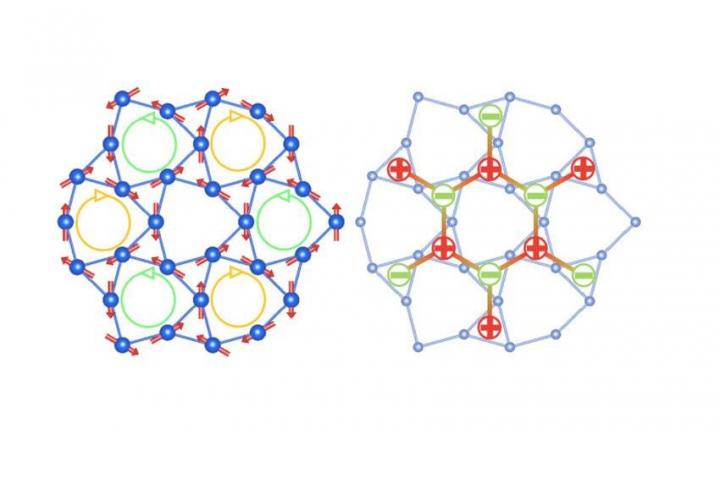
In the HoAgGe crystals, the magnetic moments (spins) of the holmium atoms form a so-called two-dimensional Kagome pattern. This name comes from the Japanese Kagome braiding art, in which the braiding bands are not woven at right angles to each other, but in such a way that triangular patterns are formed.

In the Kagome-pattern the spins of neighbouring atoms can not be aligned contrary to each other as usual. Instead, there are two permitted spin configurations: Either the spins of two of the three atoms point exactly towards the center of the triangle, while those of the third atom point out of the center. Or it is exactly the other way round: One spin points to the center, the other two out of it. This limits the possibilities of spin arrangements – hence the name “Kagome spin ice.” One consequence of this is that this system behaves as if magnetic monopoles were present in it.

This behaviour has now been experimentally demonstrated for the first time in HoAgGe crystals by the cooperation lead by the Augsburg researchers. They cooled the samples near absolute zero temperature and examined them under external magnetic fields of varying strength. Part of the experiments were carried out at the Heinz Maier-Leibnitz Centre in Garching near Munich. They were supported by the department of sample environment of the HZB, which provided a superconducting cryomagnet for the experiments at the FRM-II.

Data on the spin energy spectrum at NEAT

Thus they were able to generate different spin arrangements, which are expected in a Kagome spin ice system. Model calculations from the Augsburg research team showed what the energy spectrum of the spins should look like. This energy spectrum of the spins could then be measured using the method of inelastic neutron scattering at the NEAT instrument at the Berlin neutron source. “This was the final building block for detecting the magnetic monopoles in this system. The agreement with the theoretically predicted spectra is really excellent” says Dr. Margarita Russina, who is responsible for the NEAT instrument at HZB.

###

Media Contact
Antonia Roetger
[email protected]

Original Source

https://www.helmholtz-berlin.de/pubbin/news_seite?nid=21231;sprache=en;seitenid=1

Related Journal Article

http://dx.doi.org/10.1126/science.aaw1666

Tags: Atomic PhysicsAtomic/Molecular/Particle PhysicsChemistry/Physics/Materials SciencesMaterials
Share12Tweet8Share2ShareShareShare2

Related Posts

Study Reveals How Valproate Affects Early Brain Development: Insights into the Antiepileptic Drug’s Impact — Chemistry

Study Reveals How Valproate Affects Early Brain Development: Insights into the Antiepileptic Drug’s Impact

May 22, 2026
Sustainable Chemistry: Iron Replaces Noble Metals in Catalytic Reactions — Chemistry

Sustainable Chemistry: Iron Replaces Noble Metals in Catalytic Reactions

May 22, 2026

Advancing Thin-Film Device Manufacturing with Imaging Ellipsometry for Enhanced Process Control

May 22, 2026

Simple Adjustment in 3D Printing Enhances Fit of Dental Crowns

May 22, 2026
Please login to join discussion

POPULAR NEWS

  • blank

    New Study Reveals Plants Can Detect the Sound of Rain

    734 shares
    Share 293 Tweet 183
  • ESMO 2025: mRNA COVID Vaccines Enhance Efficacy of Cancer Immunotherapy

    312 shares
    Share 125 Tweet 78
  • Research Indicates Potential Connection Between Prenatal Medication Exposure and Elevated Autism Risk

    847 shares
    Share 339 Tweet 212
  • Common Food Preservatives Associated with Elevated Blood Pressure and Increased Heart Disease Risk

    55 shares
    Share 22 Tweet 14

About

We bring you the latest biotechnology news from best research centers and universities around the world. Check our website.

Follow us

Recent News

Fish Consumption and Mercury Exposure in Chicago Asians

Music and Motion Shape Emotion in Chinese Performance

N-acetylcysteine Trials for Preterm Birth Prevention

Subscribe to Blog via Email

Enter your email address to subscribe to this blog and receive notifications of new posts by email.

Join 83 other subscribers
  • Contact Us

Bioengineer.org © Copyright 2023 All Rights Reserved.

Welcome Back!

Login to your account below

Forgotten Password?

Retrieve your password

Please enter your username or email address to reset your password.

Log In
No Result
View All Result
  • Homepages
    • Home Page 1
    • Home Page 2
  • News
  • National
  • Business
  • Health
  • Lifestyle
  • Science

Bioengineer.org © Copyright 2023 All Rights Reserved.