Engineers studying how electrically conducting nanofluids behave between porous disks often face a computational bottleneck: every change in a magnetic field strength, porosity level, or reaction parameter means solving a coupled system of nonlinear equations all over again. A new study published in Discover Nano on 27 October 2026 proposes a way around that bottleneck by training artificial neural networks to mimic the outputs of a high-accuracy numerical solver, so that future predictions become nearly instantaneous once the networks have learned the underlying physics.
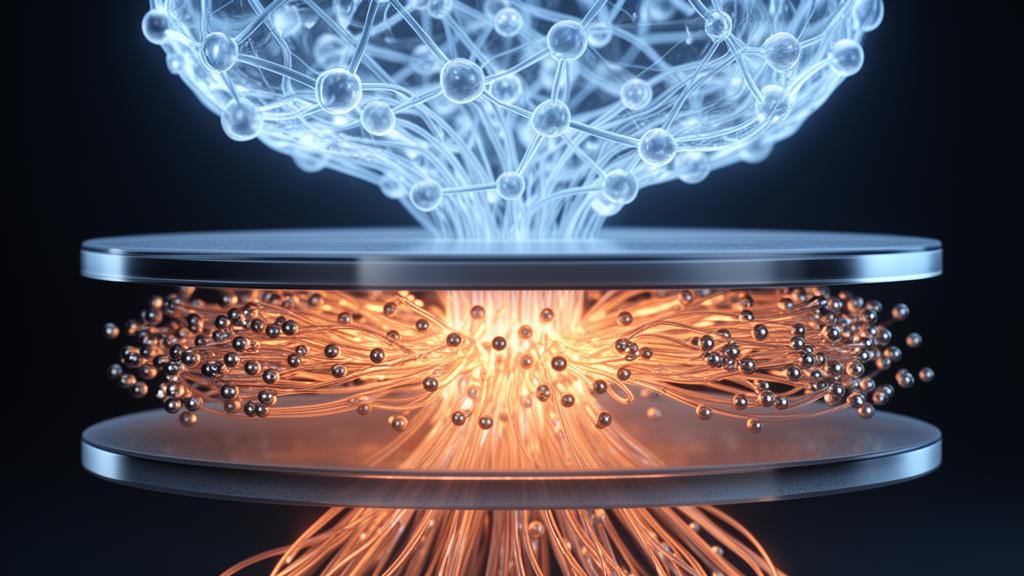
Fluid is injected through one porous disk and withdrawn through the other at a constant velocity, producing an axisymmetric flow. A uniform magnetic field is applied normal to the disk surfaces, and the model simultaneously incorporates Darcy–Brinkman porous-medium resistance, Arrhenius activation energy, a homogeneous chemical reaction, and the transport of gyrotactic microorganisms that drive bioconvection.
Bioconvection, one of the more intriguing mechanisms in the model, arises from the collective swimming of self-propelled microorganisms suspended in the fluid. Their coordinated motion creates density gradients that trigger large-scale convective movement, modifying the momentum, thermal, and concentration fields. Beyond enhancing mixing, bioconvection promotes heat and mass transfer and helps prevent sedimentation in nanoparticle suspensions, which is why it attracts interest in biotechnology, microbial fuel cells, biosensors, wastewater treatment, and pharmaceutical production. The concept dates back to Platt, who experimentally observed spontaneous convection cells in suspensions of freely swimming microorganisms, with Kuznetsov later laying the theoretical groundwork for oxytactic and gyrotactic microorganism suspensions in various thermal environments.
Mathematically, the team formulated conservation equations for mass, momentum, energy, nanoparticle concentration, and microorganism density in cylindrical coordinates, then applied similarity transformations that converted the governing partial differential equations into a coupled system of nonlinear ordinary differential equations. These were solved with MATLAB’s bvp4c boundary-value solver, which uses an adaptive collocation algorithm with fourth-order accuracy. The authors verified convergence by repeating the computations with different initial meshes and confirming that successive solutions differed only within the prescribed numerical tolerance. As an additional check, they compared their computed local Nusselt numbers against benchmark solutions from previously published studies under identical limiting conditions and found excellent agreement, with negligible deviations attributed to round-off and discretization errors.
The numerical solutions then served as training data for four independent Levenberg–Marquardt backpropagation neural networks, one each for velocity, temperature, concentration, and microorganism density. Each network has an input layer receiving the governing dimensionless parameters along with the similarity variable, two hidden layers of 64 neurons using hyperbolic tangent sigmoid activation, and a single-neuron linear output layer. The dataset was normalized with min–max scaling and randomly split into 70 percent training, 15 percent validation, and 15 percent testing subsets. The Levenberg–Marquardt algorithm was chosen for its fast convergence, numerical stability, and strong approximation accuracy on medium-sized nonlinear datasets.
The performance figures reported for the surrogate models are striking. The velocity network reached a minimum validation mean squared error of 1.5×10⁻¹⁵ at epoch 1000, while the temperature, concentration, and bioconvection networks achieved minimum validation errors of 3.6464×10⁻¹¹, 2.4719×10⁻⁹, and 4.3427×10⁻¹² respectively, with the bioconvection network converging at epoch 276. Absolute errors across most of the computational domain fell in the range of 10⁻⁹ to 10⁻⁶, with slightly larger errors confined to boundary-layer regions where gradients are steepest. Mean errors from the error histograms were 1.46×10⁻⁵ for velocity, 2.28×10⁻⁸ for temperature, 1.43×10⁻⁷ for concentration, and 3.47×10⁻⁶ for microorganism density. Regression coefficients for training, validation, test, and overall datasets were all very close to unity, and prediction errors stayed within narrow intervals around zero, which the authors interpret as evidence of good generalization without significant overfitting.
The parametric study itself yielded a detailed physical picture. The velocity field increases with increasing Hartmann number and porous-medium parameter, an effect the authors attribute to the Lorentz force modifying fluid momentum under the combined action of suction and porous-medium effects. Higher Reynolds numbers strengthen the flow by making inertial forces dominant over viscous ones, while increasing the heat-generation parameter suppresses the velocity profile indirectly, through coupling between the energy and momentum equations. On the thermal side, higher Prandtl numbers reduce the temperature field because thermal diffusivity declines relative to momentum diffusivity, thinning the thermal boundary layer, and the temperature distribution also decreases as the Reynolds number rises.
Concentration and bioconvection respond to their own parameter sets. Increasing the Schmidt number suppresses the nanoparticle concentration distribution because larger values mean weaker molecular diffusion, while increasing the activation energy raises concentration levels by lowering the effective reaction rate, and a stronger chemical reaction parameter consumes species and thins the concentration boundary layer. The motile microorganism density increases with the bioconvection Lewis number but is suppressed by larger Peclet numbers, where convective transport dominates over microorganism diffusion and produces a more localized distribution. At the wall, the Nusselt number improves by approximately 25 percent with increasing Hartmann number, the microorganism density number rises by nearly 35 percent with increasing Lewis and Peclet numbers, and the Sherwood number and skin-friction coefficient both decrease with increasing Hartmann number in the reported trends.
An entropy generation analysis rounds out the physical picture, quantifying thermodynamic irreversibility from heat transfer across finite temperature differences, Joule heating from the applied magnetic field, viscous dissipation, and porous-medium resistance. The results indicate that stronger magnetic fields and higher porous resistance increase entropy production, while an adequate balance between convection and conduction can improve thermodynamic performance. The authors also emphasize the practical payoff of the surrogate approach: although bvp4c solutions are highly accurate, repeated parametric analyses require repeated solutions of the nonlinear boundary-value problem, whereas the trained networks deliver instantaneous predictions at negligible computational cost, making the framework attractive for optimization, real-time prediction, and design work.
The study comes with clearly stated limitations. It is restricted to steady, laminar, axisymmetric flow between two infinite parallel porous disks, with unsteady, three-dimensional, and turbulent transport beyond its scope. The nanofluid is described with the Buongiorno model while nanoparticle aggregation, sedimentation, and particle shape effects are neglected, the porous medium uses the Darcy–Brinkman formulation without Forchheimer inertia or heterogeneous permeability, and, importantly, no experimental validation is included—the networks are trained entirely on numerically generated data. Future directions proposed by the team include three-dimensional configurations, variable thermophysical properties, non-uniform magnetic fields, and more advanced machine-learning architectures such as physics-informed neural networks and transformer-based models, along with integration of the surrogate framework with experimental measurements for the rapid prediction and intelligent design of complex multiphysics transport systems.
Subject of Research: Machine-learning surrogate modeling of magnetohydrodynamic bioconvective nanofluid flow between porous disks
Article Title: Levenberg–Marquardt-optimized multilayer neural network for data-driven modeling of coupled transport in MHD nanofluid flow between porous disks
Article References: Bashir, M. M., Fantaye, A. K., Zayani, H. M., Iqbal, N., Alshehery, S., Dammak, B., Dallak, A. M., & Ben Khedher, N. (2026). Levenberg–Marquardt-optimized multilayer neural network for data-driven modeling of coupled transport in MHD nanofluid flow between porous disks. Discover Nano, 21(1), Article 562. https://doi.org/10.1186/s11671-026-05007-5
Image Credits: AI Generated
DOI: 10.1186/s11671-026-05007-5
Keywords: nanofluid, magnetohydrodynamics, neural network, bioconvection, porous media, Levenberg-Marquardt, bvp4c, heat transfer, activation energy, surrogate modeling, entropy generation, Discover Nano
News Source: Blake Davidson. (October 27, 2026). Neural Network Surrogate Models MHD Nanofluid Flow Between Porous Disks. Scienmag.