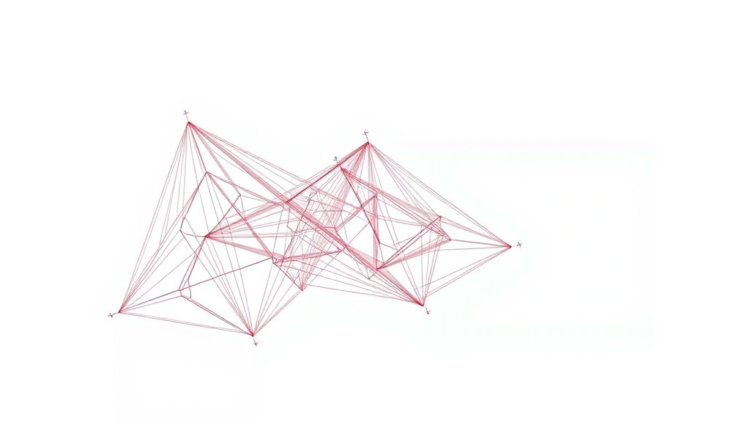
One of the most stubborn obstacles in applied machine learning rarely gets headlines: the quiet problem of imbalanced data. From fraud detection to rare disease diagnosis, the classes a classifier must separate are often wildly unequal, and algorithms trained on such data tend to ignore the rare but critical minority class. Now, a new study published in the International Journal of Data Science and Analytics proposes a strikingly different way to fix the problem, one that abandons the straight-line logic that has dominated the field for two decades in favor of a continuous, curvature-sensitive model of the data itself.
The technique, called MGOML-NGF, was developed by Touqeer Ahmad and Jie Yang of the School of Mathematical Sciences at Dalian University of Technology in China. It combines a neural geometry field with a meta-learning control mechanism to generate synthetic minority-class samples. Where classical oversampling methods draw new points along straight segments between existing neighbors, the new approach learns a continuous sampling density conditioned on three things: the local density of minority examples, the curvature of the manifold on which those examples lie, and the uncertainty of the classifier being trained.
The contrast with earlier methods is fundamental. Since the introduction of SMOTE, the synthetic minority oversampling technique, in 2002, most oversampling strategies have interpolated new points using fixed geometric primitives: line segments, simplices, or predefined polyhedra. These tools are fast and easy to implement, but they carry an implicit assumption that the minority class occupies a roughly flat, linear region of feature space. In high-dimensional data, that assumption often fails. Minority-class examples frequently trace curved, folded manifolds, and linear interpolation can place synthetic points in empty or ambiguous regions, creating artifacts that confuse rather than help the classifier.
MGOML-NGF replaces those rigid primitives with adaptive generation regimes tied directly to geometry. In regions of high curvature, the technique samples along geodesics, the shortest paths along the curved surface itself, rather than straight chords cutting through empty space. In regions of low curvature, where the manifold behaves more like a flat sheet, it applies elongated sampling that stretches new points along smooth directions. Intermediate regimes receive a hybrid strategy that blends the two. After generation, a density-adaptive perturbation step nudges synthetic points to improve coverage of the minority-class support, filling gaps where real examples are sparse.
The meta-learning component supplies the adaptivity that static schemes lack. Rather than fixing the generation parameters in advance, the system learns how to adjust them across tasks and datasets, tuning the balance between geodesic, elongated, and hybrid sampling according to what actually improves classification. This means the technique can flexibly respond to the wide variety of manifold shapes that real datasets present, instead of forcing every problem through the same geometric template.
What elevates the work beyond an empirical tweak is its theoretical grounding. The authors provide a consistency analysis under the Wasserstein distance, a rigorous metric for comparing probability distributions. Under standard assumptions about manifold regularity and density estimation, they show that the distribution of generated synthetic samples converges to the true minority-class distribution. In practical terms, this means the technique is not merely producing plausible-looking points; it is provably approaching the real thing as conditions improve, a guarantee that linear interpolation methods generally cannot offer.
The empirical evidence comes from a comprehensive evaluation across 16 benchmark imbalanced datasets, using 10-fold cross-validation to guard against overfitting the evaluation itself. The results, measured with accuracy, F1-score, G-mean, and AUC, the metrics most commonly used to judge performance on imbalanced problems, showed that MGOML-NGF achieved competitive or improved scores compared with both classical resampling techniques and newer geometry-based methods. The gains were most meaningful where they matter most: minority-class representation improved while the artifacts caused by linear interpolation in high-dimensional feature spaces diminished.
The significance of the result extends well beyond a single benchmark table. Imbalanced classification underpins some of the most consequential applications of machine learning today. Fraud detection systems must catch vanishingly rare malicious transactions. Medical diagnostic tools must identify uncommon but life-threatening conditions. Industrial fault detection, software defect prediction, and crop recommendation systems all confront the same asymmetry. When a classifier fails on the minority class, the failure is often catastrophic precisely because those cases matter most. A technique that represents rare classes more faithfully, and does so with theoretical guarantees, addresses a bottleneck that has constrained the field for years.
Curvature is the quiet star of this study. The idea that data lies on curved manifolds is well established in manifold learning, and geodesic methods have long been used for shape and surface processing in computer vision. What is new here is the fusion of that geometric insight with neural density estimation and meta-learning, creating a pipeline in which the geometry of the data dictates not just where synthetic samples go, but how they are generated. High-curvature regions, the hardest places for linear methods, are exactly where geodesic sampling earns its keep. Low-curvature expanses, meanwhile, are treated with the economical efficiency they deserve.
The work, received in June 2026 and published on 18 September 2026 as article 304 in volume 22 of the journal, was conducted without external funding at Dalian University of Technology, using only publicly available benchmark datasets. As machine learning systems continue to be deployed in domains where the rare case is the important case, the study suggests a broader lesson: when the shape of the data defies simple geometry, the answer may be to stop imposing simple geometry on it, and instead let a learned model of the manifold itself guide the way.
Subject of Research: Geometry-aware neural density field oversampling for imbalanced classification
Article Title: Geometry-aware neural density field for imbalanced classification via meta-learning-based oversampling
Article References: Geometry-aware neural density field for imbalanced classification via meta-learning-based oversampling. (n.d.). https://doi.org/10.1007/s41060-026-01284-6
Image Credits: AI Generated
DOI: 10.1007/s41060-026-01284-6
Keywords: class imbalance, oversampling, meta-learning, neural geometry fields, manifold learning, synthetic data generation, SMOTE, Wasserstein distance, geodesic sampling, classifier uncertainty, imbalanced classification, machine learning
Cite Scienmag News
APA MLA Chicago
Cassandra Pierce. (September 20, 2026). Neural Geometry Field Learns Curvature-Aware Oversampling for Imbalanced Data. Scienmag. https://scienmag.com/neural-geometry-field-learns-curvature-aware-oversampling-for-imbalanced-data/
Cassandra Pierce. “Neural Geometry Field Learns Curvature-Aware Oversampling for Imbalanced Data.” Scienmag, 20 September 2026, https://scienmag.com/neural-geometry-field-learns-curvature-aware-oversampling-for-imbalanced-data/. Accessed 20 September 2026.
Cassandra Pierce. “Neural Geometry Field Learns Curvature-Aware Oversampling for Imbalanced Data.” Scienmag. September 20, 2026. https://scienmag.com/neural-geometry-field-learns-curvature-aware-oversampling-for-imbalanced-data/
Copy citation Download RIS
Tags: class imbalanceclass imbalance in fraud detectionclassifier uncertaintycontinuous data sampling densitycurvature-aware oversamplingcurvature-sensitive data modelinggeodesic samplingimbalanced classificationImbalanced data classificationMachine learningmanifold curvature in machine learningmanifold learningmeta-learningmeta-learning control mechanismsMGOML-NGF methodologyneural geometry fieldsovercoming limitations of traditional oversampling techniquesoversamplingrare disease diagnosis data challengesSMOTEsynthetic data generationsynthetic minority class sample generationWasserstein distance