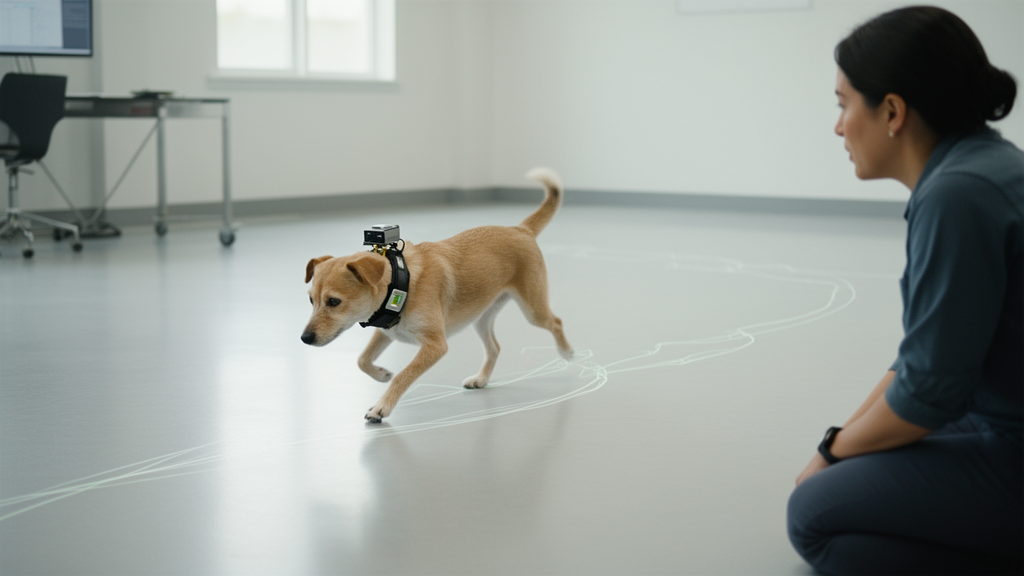
Two neural-aided dead-reckoning systems reduced trajectory error for walking dogs and a legged robot compared with a conventional step-length model, according to a study using body-mounted accelerometers and gyroscopes. The approach estimates velocity and heading from inertial data, then integrates those estimates into a two-dimensional path. On held-out biological-dog trajectories, the best neural configuration produced a mean position root mean square error of 2.91 metres, or 2.9% of the reference path length, compared with 25.03 metres, or 24.1%, for the model-based method. The leading configuration depended on the dataset: a ResNet-based heading estimator performed best for the dogs, while a hybrid ResNet and transformer system performed best for the robot.
The experiments were deliberately modest in scope, and the results should not be treated as a general-purpose solution for tracking animals over long distances. The canine dataset contained 13 minutes of synchronized recordings across 12 outdoor trajectories, involving one husky and one mixed-breed dog recorded on separate days at the same site. Walking took place on asphalt and grass, with the inertial unit fixed in one mounting position. The robot dataset was larger, providing 116 minutes of synchronized recordings across 49 trajectories, but the researchers used 17 of them, including three held-out test trajectories. The two canine sessions also confounded dog identity with recording day, so differences between the animals could not be attributed separately to breed or session. Generalization to additional animals, mounting positions, environments and motion patterns was not tested.
To collect the dog data, the team built DogMotion, a wearable unit based on a Raspberry Pi Zero and an OzzMaker SARA-R5 LTE-M GPS shield. Its inertial sensors recorded tri-axial acceleration and angular velocity at 125 hertz, while a GNSS receiver supplied position references at 1 hertz and had a specified horizontal accuracy of 2.5 metres. A real-time clock synchronized the high-frequency inertial stream with GNSS observations. Interpolating the GNSS coordinates to the inertial timestamps generated reference velocity and direction labels for supervised learning. The robot in the separate public dataset carried an ANYmal inertial measurement unit and CPT7 dual-antenna RTK-GNSS sensors. Its inertial data were sampled at 100 hertz and its GNSS reference at 10 hertz, with one-second input windows and a 0.1-second output stride.
All three proposed methods use inertial measurements for positioning, but they differ in how motion is represented. The model-based dog dead reckoning pipeline first smooths the accelerometer’s specific-force magnitude, detects steps by finding peaks above a threshold of 1.5 standard deviations, and estimates the distance between successive steps with the Weinberg method. That method relates step length to the fourth root of the difference between maximum and minimum specific force during a step. Walking direction is estimated with a quaternion-based Madgwick filter that propagates orientation from gyroscope measurements and corrects it using the direction of gravity from the accelerometer. Magnetometer corrections were deliberately omitted because the researchers considered them overly sensitive to environmental magnetic conditions.
The principal weakness of the model-based system is that its Weinberg gain must be calibrated, and the step length it produces is sensitive to an animal’s movement and physical characteristics. It also updates position only when a step is detected, rather than at every sampling instant. The underlying method was developed for human pedestrian dead reckoning, whereas the biological subjects here were four-legged dogs with different gait patterns, body dimensions and movement variability. In the experiments, the Weinberg gain was set to 0.45 for biological dogs and 0.42 for the robot after calibration on one trajectory from each dataset. The calibration trajectory was not included in the held-out tests, but the small number of subjects and routes still limits how broadly the results can be interpreted.
The first neural system, designated DL1-DDR, replaced explicit step detection with continuous motion estimates. A one-dimensional adaptation of ResNet-18 processed one-second windows containing six channels—three accelerometer axes and three gyroscope axes—with convolutional blocks and residual connections designed to learn temporal relationships in the signals. One network predicted the two components of velocity, while another regressed walking direction. The velocity model was trained with mean squared error; the direction model used cosine-distance loss to penalize disagreement between predicted and reference directions. Both networks were optimized with Adam for 200 epochs, using a learning rate of 0.009 and batch size of 2,048. Data were divided by complete trajectory so that no input window occurred in more than one training, validation or test partition.
The second neural configuration, DL2-DDR, retained the ResNet velocity estimator but replaced the direct direction regressor with a transformer encoder. A convolutional embedding layer mapped the six inertial channels to a 64-dimensional representation that was scaled to improve numerical stability during attention operations. Three transformer encoder layers followed, each using four-head self-attention, a feed-forward network with a hidden dimension of 128, residual connections and layer normalization. A fully connected head produced the heading estimate. This configuration represented heading as a change from the previous direction rather than as an absolute orientation, and it was trained for 200 epochs with mean squared error, a learning rate of 0.0025 and batch size of 1,024. Validation trajectories were used for learning-rate scheduling, checkpoint selection and hyperparameter tuning, while test data were not used for model selection.
Position was reconstructed by combining estimated speed with estimated direction and multiplying by the time interval. The evaluation used position root mean square error, which compares each estimated coordinate with its GNSS reference, and absolute distance error, which compares the total length of the estimated and reference trajectories. Absolute distance error depends on estimated speed magnitude rather than path direction, so it cannot distinguish two estimates that travel the same distance but follow different routes. This became evident when DL1-DDR and DL2-DDR produced identical absolute-distance errors in every test trajectory despite markedly different position errors: both configurations shared the same speed-regression network. The metric therefore describes the accuracy of integrated speed but provides no evidence about the relative geometric accuracy of the two heading approaches.
For the three held-out biological-dog trajectories, DL1-DDR achieved the lowest mean position error at 2.91 metres. The model-based method averaged 25.03 metres, and DL2-DDR averaged 19.40 metres. The neural advantage was not uniform across every route. On trajectory 4, DL2-DDR produced 30.54 metres of position error, slightly more than the model-based method’s 28.38 metres, while on trajectory 8 it reduced the error from 30.52 metres to 6.52 metres. DL1-DDR outperformed the model-based method on all three dog test trajectories by this metric, although the study does not establish that this ordering would persist for more dogs, terrains or mounting configurations. The trajectories were also relatively short, averaging 63.7 seconds in the canine dataset, limiting assessment of long-duration drift.
The ordering reversed on the legged robot’s three test trajectories. DL2-DDR achieved a mean position error of 5.25 metres, or 2.7%, compared with 12.92 metres, or 6.7%, for DL1-DDR and 25.93 metres, or 12.1%, for model-based dead reckoning. DL2-DDR performed better than DL1-DDR on each robot test trajectory. Neither neural system beat the model-based approach on every route: on trajectories 7 and 17, model-based positioning was more accurate than DL1-DDR, and its largest position error, 57.40 metres on trajectory 16, exceeded DL1-DDR’s 19.24 metres there. Pure inertial navigation, used as a baseline, performed far worse, with an average error of 2,400 metres on the dog data and more than 10 kilometres on the robot data.
The authors interpret the results as evidence that neural networks can learn movement features from raw inertial signals that are difficult to represent with a fixed biomechanical model, including relationships among gait impacts, acceleration, rotation, speed and direction. A validation experiment that randomly reassigned trajectories between training and test sets reportedly left the neural models’ mean errors largely unchanged, suggesting that performance did not depend entirely on one particular partition. That experiment was conducted within the study and is not independent confirmation. The methods remain open-loop systems, meaning heading and speed-scale biases can accumulate without bound, and the reported relative errors apply only to the trajectory durations tested. The researchers identify larger datasets, additional animals and environments, and magnetometer fusion as future priorities; they also released the code and canine dataset as a public benchmark.
Subject of Research: Neural-aided inertial dead reckoning for positioning biological dogs and a legged robot
Article Title: Model-based and neural-aided approaches for dog dead reckoning
Article References: Versano, G., Savin, I., & Klein, I. (2026). Model-based and neural-aided approaches for dog dead reckoning. Results in Engineering, 32, Article 113555. https://doi.org/10.1016/j.rineng.2026.113555
Image Credits: AI Generated
DOI: 10.1016/j.rineng.2026.113555
Keywords: dog navigation, inertial dead reckoning, deep learning, ResNet, transformer encoder, legged robot, trajectory reconstruction, accelerometer, gyroscope, GNSS reference, Model-based, neural-aided
News Source: Cassandra Pierce. (October 22, 2026). Neural-aided inertial tracking cuts dog trajectory error in small study. Scienmag.