The quantum systems employed in quantum technologies, for example single atoms, are also very sensitive: any interaction with the environment can induce changes in the quantum system, leading to errors. However, this remarkable sensitivity of quantum systems to environmental factors actually represents a unique advantage. This sensitivity enables quantum sensors to surpass conventional sensors in precision, for example when measuring magnetic or gravitational fields.
Credit: Helene Hainzer
The quantum systems employed in quantum technologies, for example single atoms, are also very sensitive: any interaction with the environment can induce changes in the quantum system, leading to errors. However, this remarkable sensitivity of quantum systems to environmental factors actually represents a unique advantage. This sensitivity enables quantum sensors to surpass conventional sensors in precision, for example when measuring magnetic or gravitational fields.
Noise cancellation using correlation spectroscopy
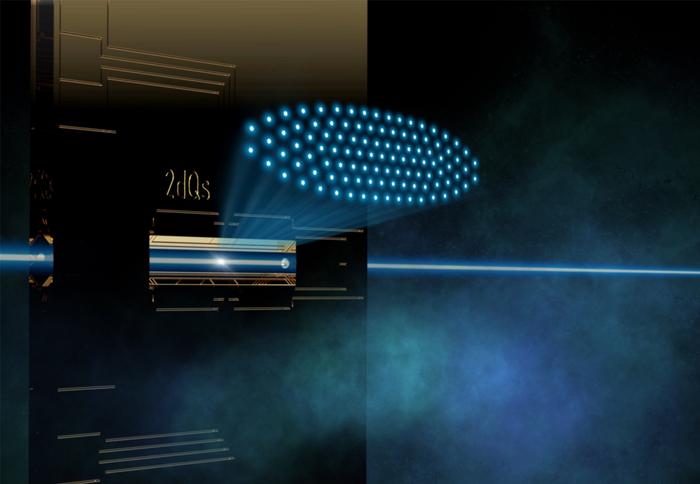
The delicate quantum properties needed for sensing can be covered up by noise—rapid interactions between the sensor and the environment that disrupt the information within the sensor, rendering the quantum signal unreadable. In a new paper, physicists led by Christian Roos from the Department of Experimental Physics at the University of Innsbruck, together with partners in Israel and the USA, present a method for making this information accessible again using “correlation spectroscopy”. “Here, the key idea is that we do not just use a single sensor, but a network of up to 91 sensors, each consisting of a single atom,” explains Helene Hainzer, the first author of the paper. “Since noise affects all sensors equally, analyzing simultaneous changes in the states of all sensors allows us to effectively subtract the environmental noise and reconstruct the desired information. This allows us to precisely measure magnetic field variations in the environment, as well as determine the distance between the quantum sensors.” Beyond that, the method is applicable for various other sensing tasks and within diverse experimental platforms, reflecting its versatility.
Precision increases with the number of sensors
While correlation spectroscopy has been demonstrated previously with two atomic clocks, allowing for a superior precision in measuring time, “our work marks the first application of this method on such a large number of atoms,” emphasizes ERC award winner Christian Roos. “In order to establish experimental control over so many atoms, we built an entirely new experimental setup over several years.” In their publication, the Innsbruck scientists show that the precision of the sensor measurements increases with the number of particles in the sensor network. Notably, entanglement— conventionally used to enhance quantum sensor precision but hard to create in the laboratory—fails to provide an advantage compared to the multi-sensor network.
The work has been published in the journal Physical Review X and was financially supported by the Austrian Science Fund FWF, the Austrian Federal Ministry of Education, Science and Research, the European Union and the Federation of Austrian Industries Tyrol, among others.
Publication: Correlation spectroscopy with multiqubit-enhanced phase estimation. Phys. Rev. X. H. Hainzer, D. Kiesenhofer, T. Ollikainen, M. Bock, F. Kranzl, M. K. Joshi, G. Yoeli, R. Blatt, T. Gefen, and C. F. Roos. Phys. Rev. X 2024 DOI: 10.1103/PhysRevX.14.011033
Journal
Physical Review X
DOI
10.1103/PhysRevX.14.011033
Method of Research
Experimental study
Article Title
Correlation spectroscopy with multiqubit-enhanced phase estimation
Article Publication Date
1-Mar-2024