Credit: M. Arndt
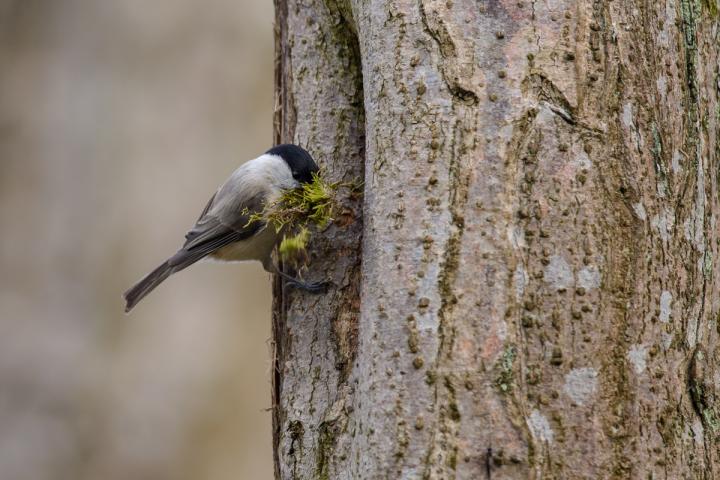
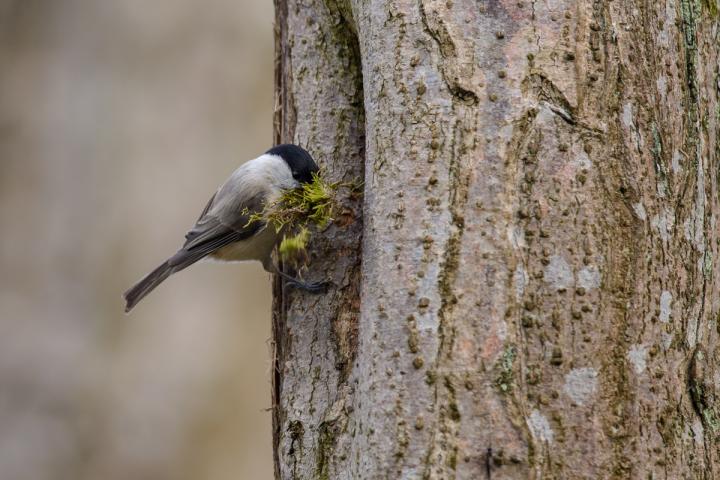
Nesting in cavities provides birds with some protection from predators — but it isn't foolproof. A new study from The Auk: Ornithological Advances explores how Poland's cavity-nesting Marsh Tits deal with predator attacks and finds that while tactics such as small entrances and solid walls do help, adaptations like this can only take the birds so far.
Wroc?aw University's Tomasz Weso?owski has spent nearly thirty years monitoring Marsh Tit nest cavities in Poland's Bia?owie?a Forest, comparing nests that are destroyed with nests that are attacked but survive. He has found that a nest's chance of survival depends on the predator's technique–broods are least likely to survive (10%) when the predator manages to get into the cavity through the existing entrance, more likely (29%) when the predator uses its paws or beak to pluck out the nest contents, and most likely to survive (39%) when the predator tries to enlarge the opening or make a new one. Tits' antipredator tactics vary in their effectiveness depending on the predator; attacks by Great Spotted Woodpeckers were successful only 60% of the time, while forest dormice were 100% successful.
The results show that despite the constant pressure of natural selection, Marsh Tits can only improve their antipredator tactics so much–there are limits to adaptation. Small, narrow entrances don't work against small predators and are only effective when combined with cavity walls made of solid (not decomposing) wood; nests that were deep in a cavity, out of reach of the entrance, are safest, but birds seldom place their nests that way, suggesting that cavities that are too deep may cause other problems for Marsh Tit parents.
The Bia?owie?a Forest, one of the last remaining tracts of old-growth forest in Europe, is an ideal place to study cavity-nesting birds, full of cavities of every size and shape for Marsh Tits to choose from. However, the fieldwork was not without its difficulties. "The Bia?owie?a Forest still contains fragments of primeval origin," says Weso?owski. "The work is challenging, as the old-growth stands are very tall. Marsh Tits breed at very low densities, and on average one has to search five to seven hectares of this forest to find a single breeding cavity. It requires much patience and determination."
"To understand the evolution of nesting behaviors, many ornithologists attempt to quantify the trade-offs that birds face in warding off nest predators. Usually we do this by comparing nests that fail versus nests that succeed, but that approach is limited because we can't tease apart the multiple factors, including chance, that contributed to making a nest successful," according to Kristina Cockle of the National Scientific and Technical Research Council of Argentina (CONICET), an ornithologist not involved with the study who has worked extensively on nest cavities. "The new study by Weso?owski compares, instead, nests that were depredated to nests that were attacked but survived. With this approach, the author was able to identify the physical attributes of tree cavities that foiled a suite of nest attackers from woodpeckers to dormice."
###
"Failed predator attacks: A study of tree cavities used by nesting Marsh Tits (Poecile palustris) for security" will be available July 12, 2017, at http://www.bioone.org/doi/full/10.1642/AUK-17-51.1 (issue URL http://www.bioone.org/toc/tauk/134/4).
Media Contact
Rebecca Heisman
[email protected]
http://americanornithologypubs.org/