• HOME
  • NEWS
  • EXPLORE
    • CAREER
      • Companies
      • Jobs
    • EVENTS
    • iGEM
      • News
      • Team
    • PHOTOS
    • VIDEO
    • WIKI
  • BLOG
  • COMMUNITY
    • FACEBOOK
    • INSTAGRAM
    • TWITTER
Monday, May 18, 2026
BIOENGINEER.ORG
No Result
View All Result
  • Login
  • HOME
  • NEWS
  • EXPLORE
    • CAREER
      • Companies
      • Jobs
        • Lecturer
        • PhD Studentship
        • Postdoc
        • Research Assistant
    • EVENTS
    • iGEM
      • News
      • Team
    • PHOTOS
    • VIDEO
    • WIKI
  • BLOG
  • COMMUNITY
    • FACEBOOK
    • INSTAGRAM
    • TWITTER
  • HOME
  • NEWS
  • EXPLORE
    • CAREER
      • Companies
      • Jobs
        • Lecturer
        • PhD Studentship
        • Postdoc
        • Research Assistant
    • EVENTS
    • iGEM
      • News
      • Team
    • PHOTOS
    • VIDEO
    • WIKI
  • BLOG
  • COMMUNITY
    • FACEBOOK
    • INSTAGRAM
    • TWITTER
No Result
View All Result
Bioengineer.org
No Result
View All Result
Home NEWS Science News Chemistry

Near-infrared electrochromism of a new multilayered complex

Bioengineer by Bioengineer
November 15, 2019
in Chemistry
Reading Time: 3 mins read
0
IMAGE
Share on FacebookShare on TwitterShare on LinkedinShare on RedditShare on Telegram

IMAGE

Credit: ©Science China Press


Electrochromic films that display reversible spectral and color changes in response to electric or electrochemical stimulus are highly useful in a wide range of applications, such as smart windows, electronic displays, dynamic camouflage, and information storage. For practical applications, electrochromism with low operation voltage, high contrast ratio (in general no less than 30%), short response time (a few seconds or less), and excellent cyclic stability (at least over 1000 cycles) is required.

Compared to common materials and films showing electrochromism in the visible region, one challenging topic in this field is the realization of high-performance electrochromism in the near-infrared (NIR) region.

In recent years, Professor Yu-Wu Zhong’s group at the Institute of Chemistry, Chinese Academy of Sciences, have prepared thin films of organometallic ruthenium complexes by electropolymerization or self-assembly (1-3). These films displayed NIR electrochromism with moderate contrast ratios at different NIR wavelength. In addition, the film preparation and cyclic stability of these films need to be further improved.

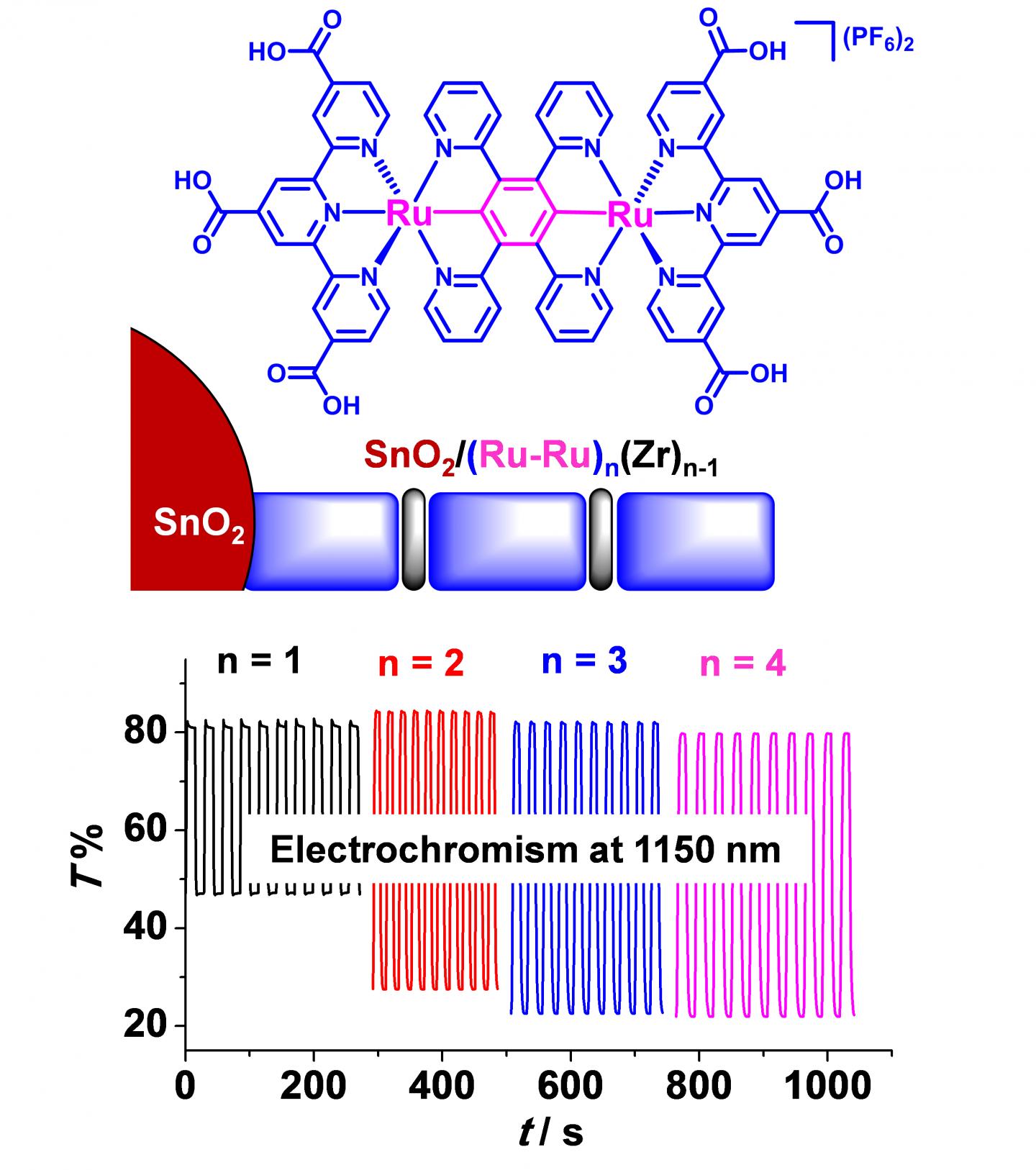
Currently (4), stimulated by the dye adsorption method commonly used in the fabrication of dye-sensitized solar cells, they prepared multilayer films of bridged diruthenium complexes by layer-by-layer (LBL) coordination assembly on metal oxide substrate and realized high-performance NIR electrochromism at 1150 nm (Figure 1).
A cyclometalated diruthenium complex with carboxylic acid groups on both terminal ligands has been prepared. The multilayer films of complex were prepared by the LBL coordinative deposition with Zr(IV)

ions on TiO2 or SnO2 substrates. The dye adsorption method is rather simple and high dye loading could be easily achieved by one-pot adsorption on metal oxides with high surface area, which is important for the efficient modulation of the contrast ratio of electrochromism.

These films display two reversible redox waves and electrochromism in the NIR region. In particular, the double-layered film on SnO2:Sb shows appealing electrochromic performance with a contrast ratio of 56% at 1150 nm, response time of a few seconds, and good cyclic stability being achieved. The higher electron conductivity and lower conduction band of SnO2:Sb with respect to TiO2 is believed beneficial to improve the electrochromic performance of the LBL films.

This work also demonstrates the capability of LBL films in realizing high-performance electrochromism and that the electrochromic performance could be regulated by the deposition cycles and the coordination LBL films on suitable substrates.

###

This work is supported by the National Natural Science Foundation of China (grant 21872154), Beijing National Science Foundation (grant 2191003), and the Strategic Priority Research Program of the Chinese Academy of Sciences (grant XDB12010400).

Reference

(1) J. Am. Chem. Soc. 2011, 133, 20720

(2) J. Am. Chem. Soc. 2015, 137, 4058

(3) J. Am. Chem. Soc. 2018, 140, 12337

(4) Sci. China Chem., 2019, DOI: 10.1007/s11426-019-9640-1

See the article: Li ZJ, Yao CJ, Zhong YW. Near-infrared electrochromism of multilayer films of a cyclometalated diruthenium complex prepared by layer-by-layer deposition on metal oxide substrates. Sci. China Chem., 2019, DOI: 10.1007/s11426-019-9640-1.

http://engine.scichina.com/publisher/scp/journal/SCC/doi/10.1007/s11426-019-9640-1?slug=fulltext

Media Contact
Yu-Wu Zhong
[email protected]

Related Journal Article

http://dx.doi.org/10.1007/s11426-019-9640-1

Tags: Chemistry/Physics/Materials Sciences
Share12Tweet8Share2ShareShareShare2

Related Posts

Optimizing Water Use with Physics-Guided Networks: Advancing Canal Flow Forecasting for Reduced Waste — Chemistry

Optimizing Water Use with Physics-Guided Networks: Advancing Canal Flow Forecasting for Reduced Waste

May 18, 2026
Experts Advocate Ending Routine Reporting of “Corrected” Calcium, Say International Authorities — Chemistry

Experts Advocate Ending Routine Reporting of “Corrected” Calcium, Say International Authorities

May 18, 2026

New SwRI Research Challenges Evidence for Europa’s Vapor Plumes

May 18, 2026

Supramolecular Dye Polymers Boost Aggregation Photocatalysis

May 18, 2026
Please login to join discussion

POPULAR NEWS

  • Research Indicates Potential Connection Between Prenatal Medication Exposure and Elevated Autism Risk

    845 shares
    Share 338 Tweet 211
  • New Study Reveals Plants Can Detect the Sound of Rain

    731 shares
    Share 292 Tweet 182
  • Salmonella Haem Blocks Macrophages, Boosts Infection

    62 shares
    Share 25 Tweet 16
  • Breastmilk Balances E. coli and Beneficial Bacteria in Infant Gut Microbiomes

    58 shares
    Share 23 Tweet 15

About

We bring you the latest biotechnology news from best research centers and universities around the world. Check our website.

Follow us

Recent News

Reversible Optical Data Storage via Phase-Change Hydrogel

Female Body Mass in Impressionism vs. Modern Ideals

Future Physicians Unite in Support of Children with Cancer and Their Families at PBSTA Day

Subscribe to Blog via Email

Enter your email address to subscribe to this blog and receive notifications of new posts by email.

Join 82 other subscribers
  • Contact Us

Bioengineer.org © Copyright 2023 All Rights Reserved.

Welcome Back!

Login to your account below

Forgotten Password?

Retrieve your password

Please enter your username or email address to reset your password.

Log In
No Result
View All Result
  • Homepages
    • Home Page 1
    • Home Page 2
  • News
  • National
  • Business
  • Health
  • Lifestyle
  • Science

Bioengineer.org © Copyright 2023 All Rights Reserved.