• HOME
  • NEWS
  • EXPLORE
    • CAREER
      • Companies
      • Jobs
    • EVENTS
    • iGEM
      • News
      • Team
    • PHOTOS
    • VIDEO
    • WIKI
  • BLOG
  • COMMUNITY
    • FACEBOOK
    • INSTAGRAM
    • TWITTER
Wednesday, July 8, 2026
BIOENGINEER.ORG
No Result
View All Result
  • Login
  • HOME
  • NEWS
  • EXPLORE
    • CAREER
      • Companies
      • Jobs
        • Lecturer
        • PhD Studentship
        • Postdoc
        • Research Assistant
    • EVENTS
    • iGEM
      • News
      • Team
    • PHOTOS
    • VIDEO
    • WIKI
  • BLOG
  • COMMUNITY
    • FACEBOOK
    • INSTAGRAM
    • TWITTER
  • HOME
  • NEWS
  • EXPLORE
    • CAREER
      • Companies
      • Jobs
        • Lecturer
        • PhD Studentship
        • Postdoc
        • Research Assistant
    • EVENTS
    • iGEM
      • News
      • Team
    • PHOTOS
    • VIDEO
    • WIKI
  • BLOG
  • COMMUNITY
    • FACEBOOK
    • INSTAGRAM
    • TWITTER
No Result
View All Result
Bioengineer.org
No Result
View All Result
Home NEWS Science News Biology

Nature: Don’t hope mature forests to soak up carbon dioxide emissions

Bioengineer by Bioengineer
April 15, 2020
in Biology
Reading Time: 3 mins read
0
IMAGE
Share on FacebookShare on TwitterShare on LinkedinShare on RedditShare on Telegram

IMAGE

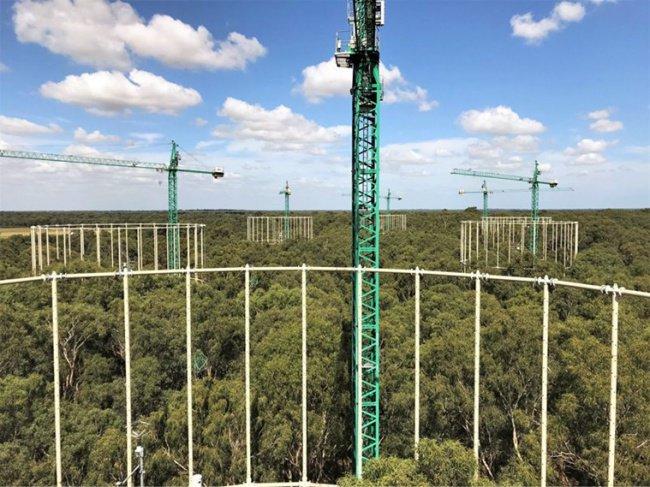
Credit: Western Sydney University

Globally, forests act as a large carbon sink, absorbing a substantial portion of the anthropogenic CO2 emissions. Whether mature forests will remain carbon sinks into the future is of critical importance for aspirations to limit climate warming to no more than 1.5 °C above pre-industrial levels? Researchers at Western Sydney University’s EucFACE (Eucalyptus Free Air CO2 Enrichment, see the photo) experiment have found new evidence of limitations in the capacity of mature forests to translate rising atmospheric CO2 concentrations into additional plant growth and carbon storage. The unique experiment was carried out in collaboration with many scientist over the world. The Head of the Centre of Excellence EcolChange Professor Ülo Niinemets and senior researcher Astrid Kännaste from the Estonian University of Life Sciences have contributed to data collection and data analysis of this study.

Carbon dioxide (CO2) is sometimes described as “food for plants” as it is the key ingredient in plant photosynthesis. Experiments in which single trees and young, rapidly growing forests have been exposed to elevated CO2 concentrations have shown that plants use the extra carbon acquired through photosynthesis to grow faster.

However, scientists have long wondered whether mature native forests would be able to take advantage of the extra photosynthesis, given that the trees also need nutrients from the soil to grow. This question is particularly relevant for Australia. In the first experiment of its kind applied to a mature native forest, Western Sydney University researchers exposed a 90-year old eucalypt woodland to elevated CO2-levels. “Just as we expected, the trees took in about 12% more carbon under the enriched CO2 conditions,” said Distinguished Professor Belinda Medlyn. “However, the trees did not grow any faster, prompting the question ‘where did the carbon go?'”.

The researchers combined their measurements into a carbon budget that accounts for all the pathways of carbon into and out of the EucFACE forest ecosystem, through the trees, grasses, insects, soils and leaf litter. This carbon-tracking analysis showed that the extra carbon absorbed by the trees was quickly cycled through the soil and returned to the atmosphere, with around half the carbon being returned by the trees themselves, and half by fungi and bacteria in the soil. “The trees convert the absorbed carbon into sugars, but they can’t use those sugars to grow more, because they don’t have access to additional nutrients from the soil. Instead, they send the sugars below-ground where they ‘feed’ soil microbes”, explained Professor Medlyn.

These findings have global implications: models used to project future climate change, and impacts of climate change on plants and ecosystems, currently assume that mature forests will continue to absorb carbon over and above their current levels, acting as carbon sinks. Professor Niinemets said: “What did we find? Increased uptake by the forest in elevated CO2, but not increased retention of this extra C. Instead, the extra C that was taken up was released back to the atmosphere. The future emissions could mean worse outcomes than we thought in terms of future climate, given this lack of response by nutrient-limited mature forests.”

###

The research is published in Nature: https://www.nature.com/articles/s41586-020-2128-9

Media Contact
Ülo Niinemets
[email protected]

Related Journal Article

http://dx.doi.org/10.1038/s41586-020-2128-9

Tags: Biology
Share12Tweet8Share2ShareShareShare2

Related Posts

Here are a few rewritten headlines for a science magazine post, each with a slightly different tone: Intriguing & poetic: How do organs sculpt themselves? Sea stars hold the secret Direct & research-focused: Sea stars reveal the hidden rules of organ formation Metaphorical & inviting: Tiny architects beneath the waves: What sea stars teach us about building organs Short & punchy: Star-shaped clues to how our organs take shape Question-led: Could a sea star show us how organs form? Elegant & feature-style: The body’s blueprint, glimpsed in a sea star’s arm

July 6, 2026
Bacteria evolve faster with unconventional gene copies — Biology

Bacteria evolve faster with unconventional gene copies

July 6, 2026

Neighbours rewire soil feedback via root microbiome shifts

July 6, 2026

Evolution-Inspired Biosensors Revolutionize Lipid Tracking in Real Time

July 2, 2026
Please login to join discussion

POPULAR NEWS

  • Detection of EDCs in Breast Milk and Infant Urine Up to Six Months Highlights Early Exposure Risks

    77 shares
    Share 31 Tweet 19
  • New Drug Candidate Developed at McMaster Shows Potential for Treating Brain Cancer

    58 shares
    Share 23 Tweet 15
  • Saying Goodbye to PGY-6: Pediatric Fellowship Realities

    103 shares
    Share 41 Tweet 26
  • KTU Researchers Explore Ultrasound’s Role in Enhancing Blood Flow Beyond Diagnostics

    53 shares
    Share 21 Tweet 13

About

We bring you the latest biotechnology news from best research centers and universities around the world. Check our website.

Follow us

Recent News

Flame retardant BDE-209 targets molecularly linked to ulcerative colitis

Ultra-high frequency particle impacts mimic rockbursts to shatter hard rock

Kidney transplant outcomes in older adults studied by German researchers

Subscribe to Blog via Email

Success! An email was just sent to confirm your subscription. Please find the email now and click 'Confirm' to start subscribing.

Join 83 other subscribers
  • Contact Us

Bioengineer.org © Copyright 2023 All Rights Reserved.

Welcome Back!

Login to your account below

Forgotten Password?

Retrieve your password

Please enter your username or email address to reset your password.

Log In
No Result
View All Result
  • Homepages
    • Home Page 1
    • Home Page 2
  • News
  • National
  • Business
  • Health
  • Lifestyle
  • Science

Bioengineer.org © Copyright 2023 All Rights Reserved.