• HOME
  • NEWS
  • EXPLORE
    • CAREER
      • Companies
      • Jobs
    • EVENTS
    • iGEM
      • News
      • Team
    • PHOTOS
    • VIDEO
    • WIKI
  • BLOG
  • COMMUNITY
    • FACEBOOK
    • INSTAGRAM
    • TWITTER
Saturday, July 4, 2026
BIOENGINEER.ORG
No Result
View All Result
  • Login
  • HOME
  • NEWS
  • EXPLORE
    • CAREER
      • Companies
      • Jobs
        • Lecturer
        • PhD Studentship
        • Postdoc
        • Research Assistant
    • EVENTS
    • iGEM
      • News
      • Team
    • PHOTOS
    • VIDEO
    • WIKI
  • BLOG
  • COMMUNITY
    • FACEBOOK
    • INSTAGRAM
    • TWITTER
  • HOME
  • NEWS
  • EXPLORE
    • CAREER
      • Companies
      • Jobs
        • Lecturer
        • PhD Studentship
        • Postdoc
        • Research Assistant
    • EVENTS
    • iGEM
      • News
      • Team
    • PHOTOS
    • VIDEO
    • WIKI
  • BLOG
  • COMMUNITY
    • FACEBOOK
    • INSTAGRAM
    • TWITTER
No Result
View All Result
Bioengineer.org
No Result
View All Result
Home NEWS Science News Biology

Natural light flicker can help prevent detection

Bioengineer by Bioengineer
April 1, 2020
in Biology
Reading Time: 2 mins read
0
IMAGE
Share on FacebookShare on TwitterShare on LinkedinShare on RedditShare on Telegram

IMAGE

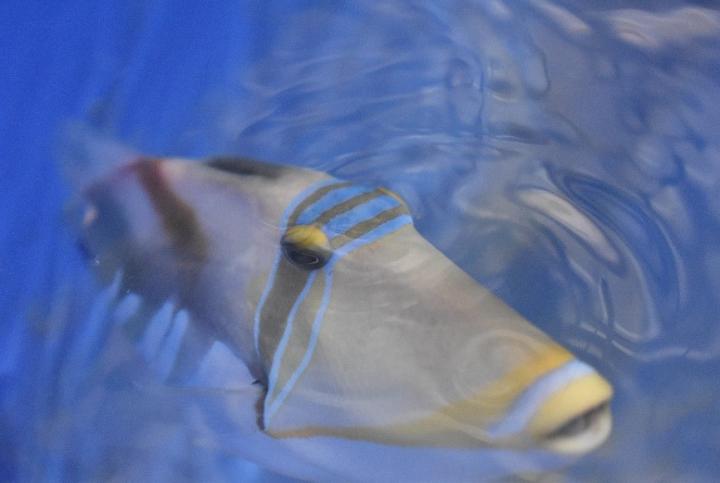
Credit: University of Bristol

Movement breaks camouflage, making it risky for anything trying to hide. New research, published in the Proceedings of the Royal Society B today [1 April] has shown that dynamic features common in many natural habitats, such as moving light patterns, can reduce being located when moving.
Dynamic illumination is particularly common in coral reefs, where patterns known as ‘water caustics’ play chaotically in the shallows. Researchers from the University of Bristol and the University of Queensland carried out behavioural experiments on the Great Barrier Reef, Australia.

Wild Picasso triggerfish (Rhinecanthus aculeatus), a common reef fish, were trained to locate and attack moving prey items within computer-simulated scenes on a Waterproofed iPad. Each scene contained ‘water caustics’ that varied in terms of motion (static or moving), scale (fine or coarse) and sharpness (sharp or diffuse), to illustrate the diversity of water caustics seen in natural habitats.

The presence of water caustics significantly increased the time for triggerfish to attack moving prey items compared to static caustic controls. Moreover, manipulating the sharpness and scale of water caustics implies that this delay should be maximised in shallow water: scenes with fine scale and sharp water caustics induced the longest attack latencies.

Dr Sam Matchette, a former PhD student in the University of Bristol’s School of Biological Sciences and lead author, said: “Our research is the first to address the impacts of dynamic underwater illumination upon fish behaviour and directly assesses how visual features of water caustics can affect visually guided behaviour.”

While being stationary remains the optimal strategy for the concealment of cryptic organisms, the findings here highlight conditions under which the disadvantage of moving can be reduced to some degree.

Dr Matchette added: “Due to the direct impact upon foraging efficiency, we predict that the presence of dynamic water caustics will have important consequences for decision-making regarding habitat choice and foraging by both wild prey and predators.”

###

The research was supported by a CASE studentship and research grant from the Engineering and Physical Sciences Research Council (EPSRC) and QinetiQ.

Media Contact
Joanne Fryer, University of Bristol
[email protected]

Related Journal Article

http://dx.doi.org/10.1098/rspb.2019.2453

Tags: BiologyMarine/Freshwater Biology
Share12Tweet8Share2ShareShareShare2

Related Posts

Evolution-Inspired Biosensors Revolutionize Lipid Tracking in Real Time — Biology

Evolution-Inspired Biosensors Revolutionize Lipid Tracking in Real Time

July 2, 2026
New Study Reveals How to Reduce Risk of Dangerous Wildlife Encounters This Summer — Biology

New Study Reveals How to Reduce Risk of Dangerous Wildlife Encounters This Summer

July 2, 2026

Hepatic IFRD1 Alleviates Metabolic Dysfunction-Linked Steatohepatitis Through the GLUD1/α-KG Pathway

July 2, 2026

Intricate Food Webs Support Ecosystem Health and Stability

July 2, 2026
Please login to join discussion

POPULAR NEWS

  • Detection of EDCs in Breast Milk and Infant Urine Up to Six Months Highlights Early Exposure Risks

    77 shares
    Share 31 Tweet 19
  • Saying Goodbye to PGY-6: Pediatric Fellowship Realities

    103 shares
    Share 41 Tweet 26
  • New Drug Candidate Developed at McMaster Shows Potential for Treating Brain Cancer

    58 shares
    Share 23 Tweet 15
  • KTU Researchers Explore Ultrasound’s Role in Enhancing Blood Flow Beyond Diagnostics

    53 shares
    Share 21 Tweet 13

About

We bring you the latest biotechnology news from best research centers and universities around the world. Check our website.

Follow us

Recent News

Quasi-Bound States Boost Quantum Well Photoresponse

Lysine Pyruvylation Links Glycolysis to Epigenetics

Multiphysics Coupling: Single vs. Multiple DeepONet Branches

Subscribe to Blog via Email

Success! An email was just sent to confirm your subscription. Please find the email now and click 'Confirm' to start subscribing.

Join 83 other subscribers
  • Contact Us

Bioengineer.org © Copyright 2023 All Rights Reserved.

Welcome Back!

Login to your account below

Forgotten Password?

Retrieve your password

Please enter your username or email address to reset your password.

Log In
No Result
View All Result
  • Homepages
    • Home Page 1
    • Home Page 2
  • News
  • National
  • Business
  • Health
  • Lifestyle
  • Science

Bioengineer.org © Copyright 2023 All Rights Reserved.