


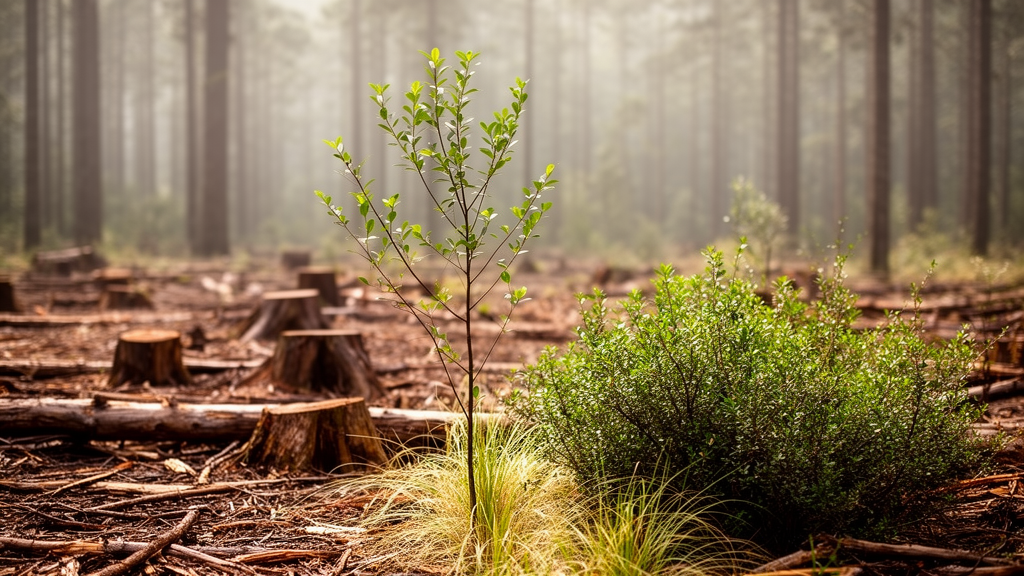
In the cold, wind-scoured forests at the southern tip of South America, the fate of newly regenerating trees can hinge on the plants growing right beside them. A two-year field experiment in harvested Nothofagus pumilio forests of Tierra del Fuego, Argentina, has shown that the identity of the understory vegetation strongly shapes how transplanted lenga seedlings cope physiologically and whether they survive at all. Native broad-leaved herbs such as Osmorhiza depauperata and Acaena ovalifolia improved seedling water status, chlorophyll content and survival, while the exotic grass Poa pratensis and bare ground dragged performance down to some of the lowest values recorded. The study, published in Ecological Processes, also found that these differences only fully emerged during a wetter growing season, suggesting that climate sets the stage on which plant–plant interactions play out.
The research team, led by Lucia Bottan and María Vanessa Lencinas, established experimental plots in two harvested stands managed by the forestry company Lenga Patagonia S.A., where shelterwood cuts carried out between 2019 and 2021 had retained roughly 30 square meters of basal area per hectare. Into each one-square-meter plot they transplanted 100 two- and three-year-old lenga seedlings collected from a nearby primary forest. Plots were dominated either by O. depauperata, a native erect herb reaching up to 70 centimeters, by A. ovalifolia, a native creeping herb, or by P. pratensis, an exotic rhizomatous grass. Non-target understory species were removed by hand to reinforce treatment identity, and vegetation-free control plots completed the design. Reference plots in an unharvested primary forest, without accompanying understory vegetation, provided a baseline for seedlings growing under a closed canopy.
The experiment was repeated across two consecutive growing seasons, 2023–2024 and 2024–2025, which turned out to be climatically contrasting. Regional reanalysis data showed that the first season had temperatures close to the long-term mean of about 7.3 degrees Celsius but cumulative precipitation of only 150 millimeters during October through January, well below the 219-millimeter historical average, and January soil moisture 41 percent below the long-term norm. The second season was warmer than average at 8.4 degrees Celsius, received near-normal precipitation, and showed January soil moisture matching the historical mean. In the harvested stands, plot-level volumetric soil water content measured in January roughly doubled between the two seasons, from about 8 percent to about 17 percent, while the unharvested forest remained stable across both years.
Each January, at mid-summer, the researchers measured a suite of ecophysiological traits on the seedlings: stomatal conductance with a porometer, leaf area by digital image analysis, dawn leaf water potential with a pressure chamber, chlorophyll content via the SPAD index, and relative water content from fresh, turgid and dry leaf masses. Survival was scored as the percentage of seedlings still bearing green leaves in January relative to the 100 originally planted. From these traits the team computed an ecophysiological performance index, averaging standardized values, and analyzed the data with linear mixed-effects models, treating plots as experimental units and retaining stand as a random effect.
Growing season emerged as the dominant filter. Sequential partitioning of marginal R-squared values showed that season explained between 13 and 51 percent of the variance in seedling responses in harvested forests, peaking at 51 percent for predawn leaf water potential, 38 percent for leaf area and 34 percent for stomatal conductance. Every measured variable and survival rate were significantly higher during the wetter 2024–2025 season. Survival overall was 17.5 percent higher in the second season than in the first. By contrast, seedlings in the unharvested forest showed no significant differences between seasons in any response variable, underscoring how the closed canopy buffers seedlings from interannual climatic swings that harvested stands, with their opened canopies, transmit directly to the forest floor.
Understory identity mattered too, though its effects were trait-dependent. Treatment significantly affected chlorophyll content, relative water content and survival, but not stomatal conductance, leaf area or predawn leaf water potential. Survival was significantly greater beneath O. depauperata and A. ovalifolia than beneath P. pratensis, and seedlings under O. depauperata also outperformed those in vegetation-free control microsites. The SPAD chlorophyll index was highest under O. depauperata across both years, coinciding with the lowest photosynthetically active radiation measured beneath any treatment, which the authors interpret as protection from photo-oxidative stress and pigment degradation in more exposed plots. Relative water content was higher under O. depauperata than under P. pratensis. Multivariate analyses confirmed these patterns: a permutational analysis of variance detected significant differences among treatments, particularly in the second season, and a dispersion test showed that responses under the grass were more variable while those under the native herb and in controls were more homogeneous.
Soil moisture tied the whole story together. All response variables correlated positively with volumetric soil water content, and nonlinear Michaelis–Menten models fitted to this variable explained 57 percent of the variation in the performance index and 42 percent of the variation in survival. Plots dominated by the two native herbs maintained higher soil water content than grass-dominated plots, while P. pratensis plots showed the lowest soil moisture and the greatest herbaceous root density. The authors suggest that the grass’s dense superficial roots and erect leaf architecture, which lets more light reach the soil surface, promote drying through rapid water uptake and evaporation, whereas the broader, horizontally oriented foliage of the native dicots shades the ground and reduces evaporative demand. Notably, seedlings under the grass and in controls kept low survival even during the wetter second season, indicating that survival integrates cumulative stress rather than reflecting only current physiological status.
The study’s authors frame these findings through the lens of the so-called disturbance paradox: canopy opening creates recruitment opportunities but simultaneously exposes seedlings to greater environmental stress, including frost, drought and intense competition. During the drier first season, severe water stress acted as an overriding filter that forced physiological convergence across microsites, muting the differences among understory treatments. Only under the more favourable conditions of the wetter season did a gradient of facilitation become visible, with O. depauperata functioning as a kind of micro-refugium and A. ovalifolia offering intermediate protection. The team is careful to note limitations: only two growing seasons and a small number of stands were evaluated, so the work does not constitute a formal test of climate-driven ecological filtering, and the study cannot fully decouple whether the observed moisture patterns arise from initial species placement on naturally wetter microsites or from active environmental modification by the plants themselves.
For forest managers in the Patagonian ecotone, where soil water availability is naturally more limiting than in the region’s mountain forests, the practical message is that not all understory cover is beneficial. Native broad-leaved species appear to stabilize the microenvironment and facilitate lenga regeneration during the critical transition from closed-canopy shade to open harvested conditions, whereas dominance by the invasive grass P. pratensis, or complete absence of vegetation, creates conditions associated with poorer seedling performance and lower survival. The researchers argue that site-specific restoration strategies should account for understory composition and interannual climatic variability, and they call for future work spanning more seasons, more stands, and the longer-term shift from early facilitation to potential competition as seedlings grow. Whether these facilitative effects persist as climate variability intensifies remains an open question, but for now the humble herbs of the Tierra del Fuego understory have been shown to matter as much to young lenga as the weather above them.
Subject of Research: How understory plant species identity affects the ecophysiology and survival of Nothofagus pumilio seedlings in harvested Patagonian forests across two climatically contrasting growing seasons.
Article Title: Effect of plant–plant interactions on Nothofagus pumilio regeneration ecophysiology in harvested forests during two years of contrasting climate
Article References: Bottan, L., Chaves, J. E., Rodríguez-Souilla, J., Benitez, J., Favoretti, S., Barrera, M. D., Pastur, G. M., & Lencinas, M. V. (2026). Effect of plant–plant interactions on Nothofagus pumilio regeneration ecophysiology in harvested forests during two years of contrasting climate. Ecological Processes, 15(1), Article 85. https://doi.org/10.1186/s13717-026-00742-0
Image Credits: AI Generated
DOI: 10.1186/s13717-026-00742-0
Keywords: Nothofagus pumilio, lenga, forest regeneration, Tierra del Fuego, understory interactions, facilitation, competition, Poa pratensis, Osmorhiza depauperata, soil moisture, ecophysiology, shelterwood harvesting
News Source: Drew Townsend. (October 30, 2026). Native Understory Plants Help Lenga Seedlings Survive in Harvested Patagonian Forests. Scienmag.



