


Researchers surveying apple orchards in the northern districts of the Kashmir valley have isolated five native strains of the entomopathogenic nematode Heterorhabditis bacteriophora and, in laboratory bioassays, shown that all five can kill larvae of the city longhorn beetle, Aeolesthes sarta, a serious wood-boring pest of apple trees in the region. The study, published in the Egyptian Journal of Biological Pest Control, is reported by its authors as the first isolation of native H. bacteriophora strains from northern Kashmir and the first evaluation of native entomopathogenic nematodes against A. sarta in the valley.
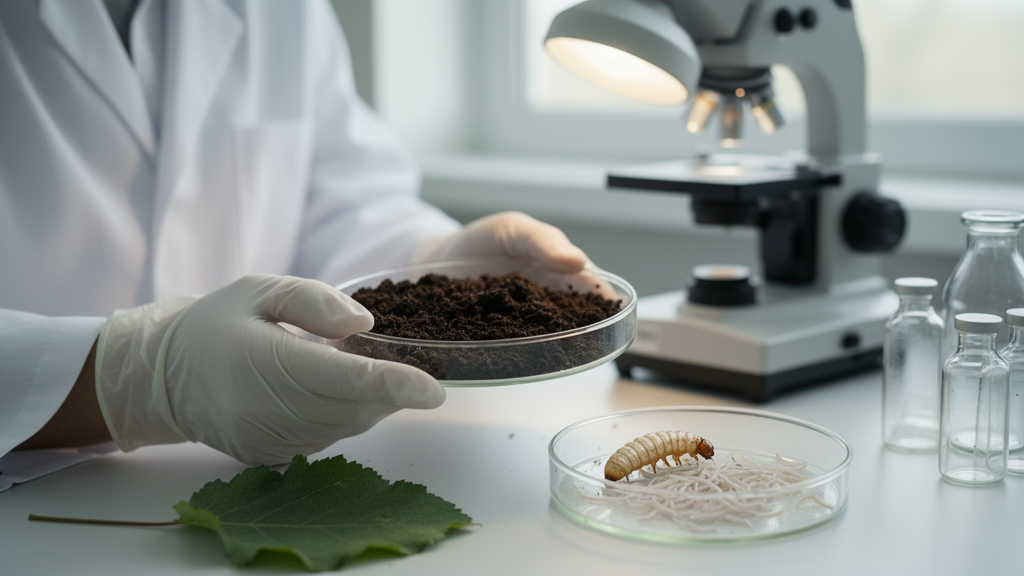
Samples were taken from the rhizosphere of apple trees at a depth of 15 to 20 centimetres, with 150 samples per district drawn from 15 locations each during June and July. Only five samples, 1.11 percent of the total, proved positive for entomopathogenic nematodes, a low recovery rate the authors attribute to the tendency of these organisms to occupy discrete ecological niches within agroecosystems. Four positive samples came from Kupwara and one from Bandipora; no positives were found in Baramulla. The soils at positive sites were mostly loam or silt loam.
Isolation followed the live bait method, using laboratory-reared late-instar larvae of the greater wax moth, Galleria mellonella. Each soil sample was placed in a container with six surface-sterilized wax moth larvae, incubated at 18 degrees Celsius, and monitored for up to 14 days. Cadavers that turned flaccid and orange-red, without rotting or odour, were treated as evidence of nematode infection and transferred to White traps to allow infective juveniles to emerge. The recovered nematodes were then propagated on fresh larvae for further study.
The five strains, designated PW2, N1, N1S3, WK2 and R1, received GenBank accession numbers PP549986 through PP549990 for their internal transcribed spacer (ITS) rDNA sequences. Molecular comparison showed greater than 99.8 percent identity with several known H. bacteriophora isolates, confirming the strains as conspecific with that species. Phylogenetic reconstruction using maximum likelihood analysis placed all five isolates in a well-supported clade with the reference sequence MK421460 of H. bacteriophora, within the so-called bacteriophora lineage alongside H. georgiana and H. beicherriana, which in turn formed a sister group to H. zealandica, H. downesi and H. atacamensis. The out-group taxa used to root the tree were Caenorhabditis elegans and Oscheius tipulae.
Sequence detail revealed minor nucleotide variation in the terminal regions of the ITS amplicons relative to the topotype population. A single nucleotide deletion at position 538 appeared in isolates R1, N1, N1S3 and WK2, while PW2 carried a substitution from C to A at the same position, and further differences occurred between positions 539 and 547. These terminal regions were excluded during sequence trimming to remove ambiguous positions. After trimming, the five Kashmir strains showed zero total character differences with each other and with the MK421460 reference, but were separated from other described Heterorhabditis species by 13 to 24 base pairs. Morphological and morphometric examination of the spicules, gubernaculum, pharynx and stoma found no differences from the original description of H. bacteriophora published by Poinar in 1976.
The virulence testing focused on the target pest itself. Aeolesthes sarta, known as the city longhorn beetle or stem borer, attacks both healthy and stressed trees in the Kashmir valley; in apple trees its grubs drill large holes into the trunk and branches, and heavily infested trees dry up. Growers currently rely heavily on chemical insecticides, whose cost and environmental effects have prompted the search for eco-friendly alternatives. The researchers collected first, second and third instar larvae of the beetle from untreated apple trees and exposed them, one grub per well or dish, to four concentrations of infective juveniles: 1000, 2000, 3000 and 4000 per grub, suspended in 350 microlitres of distilled water and sprayed onto filter paper. First and second instars were tested in six-well plates, while the larger third instars required 10-centimetre Petri dishes. Twelve replications were maintained per treatment, a distilled-water control was included, and mortality was recorded every 24 hours for up to 120 hours at 20 degrees Celsius. Dead grubs were transferred to White traps to confirm emergence of infective juveniles, and the entire experiment was repeated twice.
Probit analysis of the pooled bioassay data produced median lethal concentration (LC50) and median lethal time (LT50) values with 95 percent confidence intervals, and these varied substantially among strains. The most virulent strain was H. bacteriophora PP549990, isolate R1. Against first instar larvae, its LC50 fell from 3628.68 infective juveniles per grub at 24 hours to 471.25 IJs per grub at 120 hours, with the 96-hour value of 612.72 IJs per grub statistically at par with the 120-hour estimate but significantly different from the 72-hour and 48-hour values. At shorter exposure periods of 24 to 48 hours, several LC50 estimates for second and third instars exceeded the highest concentration tested, 4000 IJs per grub, meaning those figures were extrapolated beyond the experimental range and reflect both lower susceptibility of later instars and limited precision of the estimates.
Median lethal time showed the complementary pattern. H. bacteriophora PP549990 killed 50 percent of first instar larvae within 66, 58, 44 and 26 hours at inoculum levels of 1000, 2000, 3000 and 4000 IJs per larva respectively, while third instars required 98, 82, 67 and 62 hours at the same doses. Across all five strains, the time to kill half the grubs decreased as nematode dose increased and rose with grub size, but the ranking among strains persisted. PP549990 consistently needed the least time, followed by PP549987, PP549986, PP549988 and PP549989, making it the most lethal strain against every larval instar tested. The authors note that differences in bioassay arena size among instars may have influenced nematode density per unit area and host encounter rates, so comparisons between instars should be interpreted cautiously, and the relatively small sample size may have affected the precision of some estimates.
The mechanism behind these kills lies in the nematode’s bacterial partner. Heterorhabditis bacteriophora carries mutualistic Photorhabdus luminescens bacteria in its gut. Once inside an insect host, the bacteria are released, multiply rapidly, generate toxins and decompose the host’s tissues into a nutrient-rich substrate for nematode feeding and reproduction. Toxins and tissue breakdown together overwhelm the insect’s immune system, and host death typically follows within one to three days. In Photorhabdus-Heterorhabditis combinations the bacteria play the primary role in inducing mortality, whereas in Steinernema-Xenorhabdus pairs the nematode contributes more actively to virulence. Because of this, the authors argue that the high virulence associated with strain PP549990 warrants further investigation of its bacterial symbiont, including toxins and proteases, and note that H. bacteriophora exists as a holobiont associated with more than ten bacterial species across different geographic origins.
The authors position the recorded LC50 and LT50 values as a basis for matching nematode strains to this host and for developing a novel, safe and effective management strategy for A. sarta. They stress, however, that the work so far is entirely laboratory-based: field efficacy has not been demonstrated, and the conclusions call for multilocational field evaluations across the agro-ecological zones of Kashmir, studies of the strains’ adaptation to local soil and climate, formulation and integration with conventional pest management, and development of sustainable mass-production protocols tailored to the region. They also suggest that the detected isolates be tested against other native and key pests, and that nematode fitness and quality traits such as viability, infectivity, reproductive yield and virulence be measured in grubs of A. sarta. If those steps succeed, the native strains isolated from Kashmir’s own orchard soils could eventually complement or reduce reliance on chemical insecticides against one of the valley’s most damaging apple pests.
Subject of Research: Isolation and laboratory virulence testing of native Heterorhabditis bacteriophora nematodes against apple stem borer larvae in Kashmir
Article Title: Isolation and efficacy of native Heterorhabditis bacteriophora against Aeolesthes sarta (Coleoptera: Cerambycidae) in North Kashmir apple orchards
Article References: Fatimah, N., Askary, T. H., Somvanshi, V. S., Johnson, L. W., Abd-Elgawad, M., Mansoor, T., War, W. A., Ashraf, S., & Ahad, I. (2026). Isolation and efficacy of native Heterorhabditis bacteriophora against Aeolesthes sarta (Coleoptera: Cerambycidae) in North Kashmir apple orchards. Egyptian Journal of Biological Pest Control, 36(1), Article 29. https://doi.org/10.1186/s41938-026-00902-6
Image Credits: AI Generated
DOI: 10.1186/s41938-026-00902-6
Keywords: entomopathogenic nematodes, Heterorhabditis bacteriophora, Aeolesthes sarta, apple orchards, Kashmir, biological control, LC50, LT50, Photorhabdus luminescens, ITS rDNA, phylogenetics, stem borer
News Source: Alan Morgan. (October 29, 2026). Native Nematodes from Kashmir Apple Orchards Show Potent Kill Rates Against Longhorn Beetle Grubs in Lab Tests. Scienmag.



