• HOME
  • NEWS
  • EXPLORE
    • CAREER
      • Companies
      • Jobs
    • EVENTS
    • iGEM
      • News
      • Team
    • PHOTOS
    • VIDEO
    • WIKI
  • BLOG
  • COMMUNITY
    • FACEBOOK
    • INSTAGRAM
    • TWITTER
Friday, June 26, 2026
BIOENGINEER.ORG
No Result
View All Result
  • Login
  • HOME
  • NEWS
  • EXPLORE
    • CAREER
      • Companies
      • Jobs
        • Lecturer
        • PhD Studentship
        • Postdoc
        • Research Assistant
    • EVENTS
    • iGEM
      • News
      • Team
    • PHOTOS
    • VIDEO
    • WIKI
  • BLOG
  • COMMUNITY
    • FACEBOOK
    • INSTAGRAM
    • TWITTER
  • HOME
  • NEWS
  • EXPLORE
    • CAREER
      • Companies
      • Jobs
        • Lecturer
        • PhD Studentship
        • Postdoc
        • Research Assistant
    • EVENTS
    • iGEM
      • News
      • Team
    • PHOTOS
    • VIDEO
    • WIKI
  • BLOG
  • COMMUNITY
    • FACEBOOK
    • INSTAGRAM
    • TWITTER
No Result
View All Result
Bioengineer.org
No Result
View All Result
Home NEWS Science News Biology

Native Hawaiian tiger cowries eat alien invasive species

Bioengineer by Bioengineer
August 18, 2020
in Biology
Reading Time: 3 mins read
0
IMAGE
Share on FacebookShare on TwitterShare on LinkedinShare on RedditShare on Telegram

IMAGE

Credit: Leon Weaver

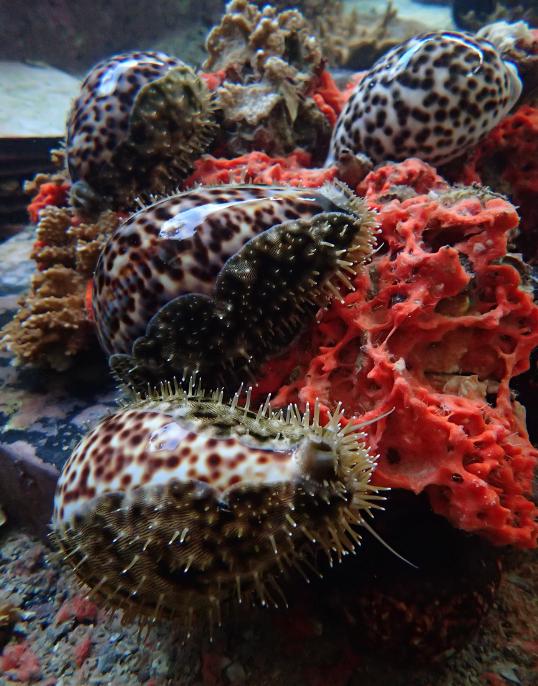
Researchers at the University of Hawai’i (UH) at Mānoa’s Hawai?i Institute of Marine Biology (HIMB) have just discovered that the Hawaiian tiger cowrie (Leho-kiko in Hawaiian) is a voracious predator of alien sponges such as the Orange Keyhole sponge, which can overgrow native corals and has become a concern as it spread across reefs within Kāne?ohe Bay. In the study published recently, researchers found that each cowrie eats more than half their body weight in sponges each week.

“We found that cowries ate most species of alien sponges that we offered them, and that a single snail can consume an entire sponge the size of your fist in roughly a week,” said Jan Vicente, lead author of the study and postdoctoral researcher at HIMB in the UH Mānoa School of Ocean and Earth Science and Technology (SOEST).

Alien invasive species, such as killer algae in the Mediterranean or lionfish in the Caribbean, can devastate native ecosystems. Hawai?i ranks among the highest in the world for both the number of marine alien invasive species and the success of those invaders in taking over space from native species. Prevention, early detection, and rapid removal are the best tools to prevent impacts from alien species, because once invaders become established, efforts to eradicate them are expensive and often unsuccessful.

One relatively cheap option for management of alien species is known as biocontrol, in which a natural predator of the alien species is also introduced to control the invader. Hawai?i is also home to some spectacular failures of past biocontrol efforts, such as the mongoose and wolf snail that created new problems rather than solving existing ones. However, not all biocontrol efforts need to use one alien species to control another, because in some cases a native species can serve that critical role to control an alien invader.

Cowries have been overharvested throughout the Pacific and have experienced a precipitous decline in most populated locations. The Hawaiian tiger cowrie is more valuable than most, because it is not found anywhere else and reaches a much larger size. Tiger cowries, like most cowrie shells, have been in high demand for over 1000 years in Indo-Pacific trade, but harvest of the Hawaiian cowrie is unreported and unregulated by the state of Hawai’i.

“Our study shows that cowries may be able to control alien sponges if they were common enough, but we hear from the Native Hawaiian community that they are far less common today than in the past. We need to protect these culturally and ecologically important animals from overharvest. This study shows that Hawaiian tiger cowries could help control invasive species, so maybe we should stop people from killing them to sell as ornaments in the shell trade.” said Vicente.

Co-author and HIMB professor Rob Toonen was quick to add, “If these snails can do the work of controlling alien invasive species for us, it will save the state both time and money to keep them in the ocean rather than on display for someone’s shelf.”

###

Media Contact
Marcie Grabowski
[email protected]

Original Source

https://www.soest.hawaii.edu/soestwp/announce/news/native-hawaiian-tiger-cowries-eat-alien-invasive-species/

Related Journal Article

http://dx.doi.org/10.3354/meps13418

Tags: BiodiversityBiologyDevelopmental/Reproductive BiologyEcology/EnvironmentMarine/Freshwater BiologyOceanographyPollution/RemediationPopulation Biology
Share12Tweet8Share2ShareShareShare2

Related Posts

Natural Hallucinogens: Evolution’s Ecological Tools, Not Mere Chemical Byproducts

June 25, 2026

This Famous Butterfly Revealed: Three Distinct Species Hidden in One

June 25, 2026

Scientists Attack Soybean Cyst Nematode by Starving Its Food Source

June 25, 2026

Decoding the Secret Code of a Crucial Immune Sensor

June 24, 2026
Please login to join discussion

POPULAR NEWS

  • Saying Goodbye to PGY-6: Pediatric Fellowship Realities

    103 shares
    Share 41 Tweet 26
  • Multi-Hospital Study Reveals Long Covid Burden Is Twice as High as Current Estimates

    92 shares
    Share 36 Tweet 23
  • Detection of EDCs in Breast Milk and Infant Urine Up to Six Months Highlights Early Exposure Risks

    77 shares
    Share 31 Tweet 19
  • New Drug Candidate Developed at McMaster Shows Potential for Treating Brain Cancer

    58 shares
    Share 23 Tweet 15

About

We bring you the latest biotechnology news from best research centers and universities around the world. Check our website.

Follow us

Recent News

Tracking Lanthanide-Labeled Microplastics in Plants

POSTECH Researchers Slash Cost of Reconstituted Cell-Free Systems by 95%

AI and Physics Collaborate to Design Advanced Hydrogen Storage Materials

Subscribe to Blog via Email

Success! An email was just sent to confirm your subscription. Please find the email now and click 'Confirm' to start subscribing.

Join 82 other subscribers
  • Contact Us

Bioengineer.org © Copyright 2023 All Rights Reserved.

Welcome Back!

Login to your account below

Forgotten Password?

Retrieve your password

Please enter your username or email address to reset your password.

Log In
No Result
View All Result
  • Homepages
    • Home Page 1
    • Home Page 2
  • News
  • National
  • Business
  • Health
  • Lifestyle
  • Science

Bioengineer.org © Copyright 2023 All Rights Reserved.