


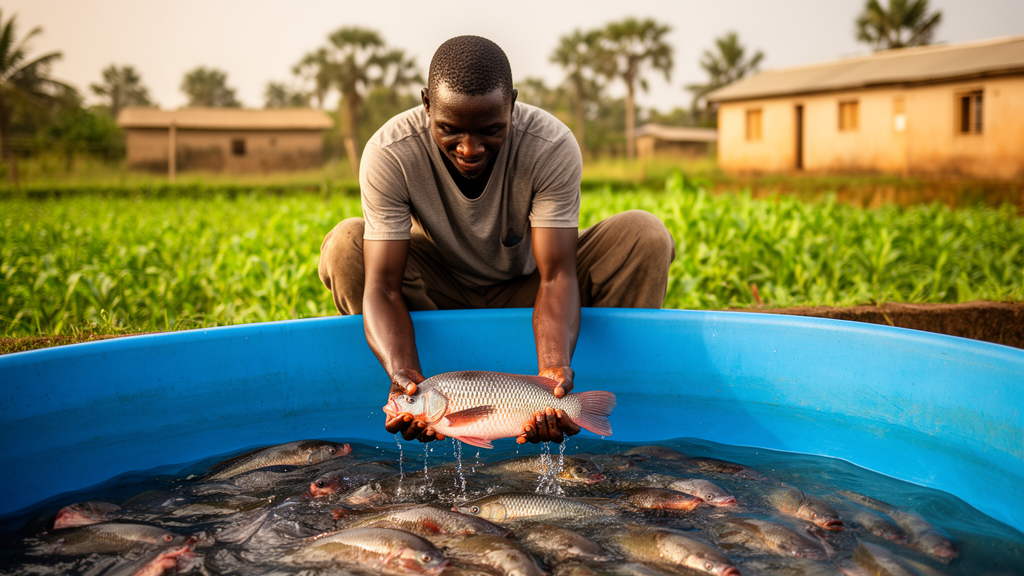
Researchers in Ivory Coast report that two lactic acid bacteria strains isolated from the intestine of Nile tilapia (Oreochromis niloticus) improved growth performance, feed efficiency and flesh quality when sprayed onto commercial fish feed. In a controlled feeding trial spanning the larval, pre-growth and growth stages of rearing, fish fed a diet enriched with Pediococcus acidilactici LB 137 consistently outperformed fish given Pediococcus pentosaceus LB 195, a mixture of both strains, or an unenriched control feed. The study, published in the journal Discover Bacteria, was conducted by Wahauwouélé Hermann Coulibaly and colleagues affiliated with the University Nangui Abrogoua and partner institutions in the District of Abidjan.
The motivation behind the work lies in the structure of Ivory Coast’s fish economy. Fish is the second source of animal protein in the country after cow and chicken meat, yet domestic aquaculture production, dominated by Nile tilapia, remains insufficient to meet a national demand estimated at between 250,000 and 300,000 tonnes per year, leaving the country strongly dependent on imports. In West African fish farming, low-cost agro-industrial by-products such as wheat bran, corn bran and rice bran are widely used as feed, but these plant materials contain anti-nutritional substances that can disrupt appetite, digestion, nutrient absorption and metabolism. At the same time, inappropriate antibiotic use in aquaculture can cause imbalances in the intestinal microbiota, poisoning, reduced immunity and greater susceptibility to disease, prompting intense interest in probiotics as an alternative.
The two bacterial strains at the centre of the trial, Pediococcus acidilactici LB 137 (deposited as ON141902) and Pediococcus pentosaceus LB 195 (ON141903), had previously been isolated and identified from the intestine of Nile tilapia, and their probiotic potential had already been demonstrated in vitro by the same research group. The authors note that probiotic bacteria isolated from other hosts often fail to colonize the fish gut as effectively as indigenous strains, which is why isolating candidate probiotics from the target species itself is considered a promising strategy. The strains were grown in MRS medium for 48 hours, harvested by centrifugation, washed and resuspended, then sprayed onto an industrial commercial feed branded Koudijs to reach a concentration of between 1 × 10^7 and 1 × 10^8 CFU per gram of feed. The enriched pellets were dried at room temperature for four to five hours to allow the bacteria to adhere.
The experimental design compared four feeding groups: commercial feed plus P. acidilactici LB 137, commercial feed plus P. pentosaceus LB 195, commercial feed with both strains mixed, and an untreated control. Larvae with an initial mean weight of 1.6 milligrams were reared for 56 days in eight 30-litre plastic tanks at a stocking density of 1,000 individuals per cubic metre, fed at 100 percent of biomass per day for the first four weeks. The pre-growth stage lasted 90 days and the growth stage 180 days, both conducted in eight rectangular concrete ponds of 0.8 cubic metres stocked at 100 individuals per cubic metre, with fish fed a daily ration of 5 percent of their live weight in three meals. Water quality was monitored weekly before feeding between 6 and 7 am using multi-parameter meters, and all zootechnical measurements were taken in triplicate.
Water conditions remained within the ranges recommended for tropical fish farming throughout the experiment, with pH between 6 and 9, dissolved oxygen at or above 3 mg/L, temperature at or above 25 °C and salinity below 30 g/L, and no significant differences were detected between feeding treatments for any water parameter. The commercial feed itself was analysed because the manufacturer did not provide its composition: it contained 47.82 percent protein, 36.96 percent carbohydrate, 7.25 percent fat, 2.65 percent crude fibre and 5.32 percent ash, with an energy value of 404.35 Kcal per 100 g of dry matter, plus calcium, phosphorus and magnesium at measured levels.
The clearest growth advantages appeared at the larval and growth stages. At the larval stage, specific growth rate did not differ significantly between treatments, but protein efficiency rate and feed conversion rate did: PER ranged from 1.71 percent for LB 195 to 1.91 percent for LB 137, while FCR ranged from 1.11 for LB 137 to 1.33 for LB 195. Fish fed the LB 137-enriched feed achieved weight gains of 5.22 ± 0.82 g at the larval stage, 54.93 ± 5.5 g at the pre-growth stage and 177.23 ± 5.5 g at the growth stage. At the pre-growth stage, no statistically significant differences were observed among treatments for any zootechnical parameter, although LB 137 still produced the highest numerical values for final average weight, weight gain, daily weight gain, PER and specific growth rate, and the lowest FCR at 1.04.
At the growth stage, the highest values of specific growth rate, protein efficiency rate and final average weight, together with the lowest feed conversion rate, were observed with LB 137 and the mixed formulation, and significant differences were recorded between these treatments and the others for all zootechnical parameters except survival rate. Fish fed the LB 137 diet reached a final average weight of 229.99 ± 13.7 g, with a specific growth rate of 0.82 ± 0.01 percent per day, a protein efficiency rate of 3.29 ± 0.2 percent and a feed conversion rate of 0.87 ± 0.1. The authors suggest that the improved feed utilization may reflect a better balance of the intestinal microbial flora, higher digestive enzyme activity and improved absorption quality, mechanisms consistent with earlier reports that lactic acid bacteria probiotics can secrete lipase, protease and amylase and enhance protein digestibility, while stressing that the processes by which probiotic bacteria promote growth remain unclear.
Flesh composition also shifted in favour of the probiotic-fed fish. All enriched formulations improved macronutrient content and energy value relative to the control, and the flesh of fish fed LB 137 showed the highest values for most parameters: fat content was 7.82 percent compared with 4.66 percent in control fish, protein content reached 19.02 percent against 18.43 percent in controls, and gross energy was 150.26 Kcal per 100 g of dry matter versus 137.90 Kcal in the control, with LB 195 and the mixed formulation falling in between. The only exception was carbohydrate, which was lowest in the LB 137 group at 0.93 percent. All formulations showed significant variation in macronutrients and energy value compared with the control, and the reported fat and protein levels exceeded values previously recorded for Nile tilapia flesh in France, the Netherlands and China, a difference the authors attribute to factors such as daily ration, water quality and feed nutritional quality.
Economic analysis reinforced the case for the LB 137 strain. Feed enriched with P. acidilactici LB 137 showed the lowest feed cost per kilogram at 748.2 FCFA and the highest reduction rate of feed cost at 13 percent, followed by the mixed formulation at 799.8 FCFA and a 7 percent reduction, calculated against a reference feed cost of 860 FCFA per kilogram. By contrast, the LB 195-enriched feed appeared unprofitable, with economic values higher than the reference feed. Based on the protein efficiency rate, feed conversion rate, flesh macronutrient contents and economic values taken together, the authors conclude that the P. acidilactici LB 137 strain seems suitable for probiotic applications in tilapia, and they propose testing it in other fish species.
The authors are explicit about the limitations of their study. Only two replicate tanks per treatment were used rather than three, the viability of the bacteria after spraying onto the feed and during storage was not assessed, and no immune parameters such as lysozyme activity, respiratory burst or haematology were measured, so health benefits beyond growth cannot be claimed from these data. Gut colonization by the two strains was not verified, and the authors recommend 16S rRNA microbiome profiling to demonstrate shifts in the intestinal community. Statistical comparisons relied on one-factor analysis of variance with Tukey’s test at a 0.05 threshold. Before any definitive conclusion, the team calls for repeat experiments with three replicate tanks, viability assessments, immune biomarker analyses and colonization studies, positioning the current results as a promising but preliminary step toward probiotic-enriched feeds for Ivory Coast’s tilapia farms.
Subject of Research: Probiotic lactic acid bacteria isolated from Nile tilapia tested as feed supplements to improve fish growth performance in Ivory Coast
Article Title: Pediococcus acidilactici LB 137 and Pediococcus pentosaceus LB 195 strains as potential probiotics for enhancing the growth performance of nile tilapia (Oreochromis niloticus) in Ivory Coast
Article References: Coulibaly, W. H., Kouadio, N. R., Koffi, G. Y., Camara, F., Oussou, K. R., Coulibaly, I., & Kane, A. F. F. (2026). Pediococcus acidilactici LB 137 and Pediococcus pentosaceus LB 195 strains as potential probiotics for enhancing the growth performance of nile tilapia (Oreochromis niloticus) in Ivory Coast. Discover Bacteria, 3(1), Article 7. https://doi.org/10.1007/s44351-026-00042-0
Image Credits: AI Generated
DOI: 10.1007/s44351-026-00042-0
Keywords: Nile tilapia, probiotics, Pediococcus acidilactici, Pediococcus pentosaceus, aquaculture, Ivory Coast, lactic acid bacteria, feed conversion rate, fish nutrition, growth performance, gut microbiota, sustainable fish farming
News Source: Morgan Morrow. (October 30, 2026). Native gut bacteria boost Nile tilapia growth in Ivory Coast feeding trial. Scienmag.



