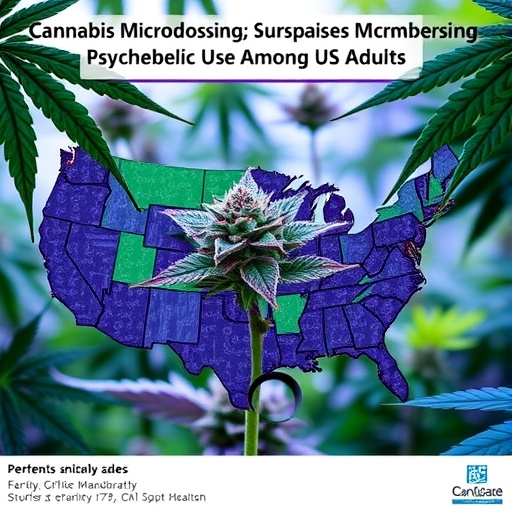
In a groundbreaking study published in the American Journal of Preventive Medicine, researchers from the University of California, San Diego, have revealed that microdosing—consuming minute quantities of psychoactive substances—is far more prevalent among U.S. adults than previously understood. Contrary to popular perception, which often frames microdosing as chiefly a psychedelic phenomenon, cannabis emerges as the dominant substance in this practice, outranking traditional psychedelics like psilocybin, LSD, and MDMA.
Microdosing has typically been associated with precise regimens involving psychedelics such as LSD and psilocybin, prescribed in low doses to explore potential therapeutic benefits. However, this comprehensive study challenges that narrative, indicating that the majority of microdosers use cannabis, often for recreational purposes, aiming to temper their psychoactive experience rather than eliminate it. This nuanced approach to reduced dosing suggests an intentional modulation of substance effects, with users seeking subtler psychological or physiological impacts without inducing strong intoxication.
The investigation leveraged a nationally representative survey conducted in late 2023 utilizing Ipsos KnowledgePanel, encompassing responses from 1,525 U.S. adults. Participants were queried about their history of intentionally microdosing cannabis, psilocybin mushrooms, LSD, and MDMA. The findings indicate that approximately 9.4% of American adults—equating to roughly 24 million people—have microdosed cannabis at least once, a figure nearly twice that of those who have microdosed psilocybin or LSD. Engagement with MDMA via microdosing was less frequent but nonetheless notable.
Current microdosing patterns further underscore cannabis’s dominance, with an estimated 3.3% actively microdosing cannabis compared to just 1.0% for psilocybin, 0.6% for LSD, and a minimal 0.3% for MDMA. This demographic data not only recalibrates our understanding of microdosing trends but also expands the dialogue around how different substances are integrated into everyday wellness or recreational routines.
Divergences in the motivations driving microdosing practices emerged distinctly by substance. Cannabis was predominantly microdosed for medical reasons—users sought symptom relief from anxiety, depression, or chronic pain through small, controlled doses. Conversely, psychedelics like psilocybin, LSD, and MDMA were more commonly microdosed to achieve mild psychoactive effects, indicating an orientation towards recreational use rather than explicit therapeutic intent.
The study further explored correlations between microdosing behavior and mental health status, revealing a compelling association wherein individuals reporting poorer mental health were significantly more likely to engage in microdosing. For example, cannabis microdosing was reported by over one-fifth of adults who rated their mental health as “poor,” more than twice the rate among those with self-assessed “excellent” mental health. This pattern raises important questions about the self-medicative potential of microdosing amid mental health challenges.
Regulatory environments also appeared influential; microdosing of psychedelics such as psilocybin and LSD was notably more prevalent in jurisdictions where possession has been decriminalized. These findings suggest that shifts in public policy not only affect legal access but may also reduce stigma, encouraging more candid reporting of microdosing behaviors.
Despite burgeoning public enthusiasm around microdosing, the scientific community remains cautious. The study’s authors emphasize that empirical evidence substantiating microdosing’s health benefits is still scant. Few randomized placebo-controlled clinical trials have been executed, and extant research often yields inconsistent results regarding efficacy. Moreover, substantial risks persist, particularly due to the unregulated status of many substances. Variability in potency and potential for contamination or dosing errors pose tangible hazards.
Kevin Yang, MD, the study’s first author, notes that while microdosing conversations frequently concentrate on psychedelics, the prominence of cannabis microdosing invites a reevaluation of how the practice is framed. Instead of exclusively medical or strictly recreational, microdosing may serve as a harm reduction technique, allowing users to derive benefits or pleasure while minimizing adverse effects traditionally linked to higher doses.
Eric Leas, PhD, MPH, the senior author, stresses the importance of rigorous scientific inquiry to disentangle anecdotal enthusiasm from measurable outcomes. His team calls for longitudinal studies and controlled trials to elucidate the mechanisms through which microdosing may influence mental and physical health, identify who stands to benefit most, and delineate potential risks.
Given progressive legalization of cannabis and evolving psychedelic policies across the United States, public health monitoring of microdosing trends will become increasingly critical. Understanding the multifaceted motivations, patterns, and contexts of microdosing behaviors can guide evidence-based prevention strategies, inform clinical guidelines, and shape sound regulatory frameworks.
This study fundamentally broadens the scope of microdosing beyond psychedelics, recognizing cannabis as a central player in this emerging behavioral landscape. As more individuals turn to microdosing to calibrate their psychological states or physical symptoms, comprehensive research is essential to safeguard public health while harnessing any genuine therapeutic potential.
Looking ahead, interdisciplinary collaborations spanning psychiatry, pharmacology, public health, and policy analysis will be vital in constructing a robust scientific foundation for microdosing. Only through methodical investigation can the medical and social implications of these practices be fully understood and responsibly managed.
Ultimately, this research underscores microdosing as a complex, nuanced phenomenon that transcends simplistic categorizations. Its ubiquity and diversity reflect a broader cultural and pharmacological shift, one in which users are actively experimenting with dosage to fine-tune experiences in hope of achieving balance—whether for health, creativity, or recreation.
Subject of Research: Microdosing of psychoactive substances among U.S. adults, including cannabis, psilocybin, LSD, and MDMA, with a focus on prevalence, motivations, mental health correlations, and implications of drug policy.
Article Title: Not explicitly provided in the source content.
News Publication Date: May 4, 2026
Web References: http://dx.doi.org/10.1016/j.amepre.2026.108381
References:
Yang, K., Leas, E., Friedman, J., Ping, S., Satybaldiyeva, N., & Kepner, W. (2026). Patterns and motivations for microdosing cannabis and psychedelics among U.S. adults. American Journal of Preventive Medicine. DOI: 10.1016/j.amepre.2026.108381
Image Credits: No specific image credits provided.
Keywords: Cannabis, Microdosing, Psychedelics, Psilocybin, LSD, MDMA, Mental Health, Psychoactive Substances, Drug Policy, Public Health
Tags: cannabis microdosing trends in the UScomparison of cannabis and psychedelic microdosingdemographic patterns in cannabis microdosingIpsos KnowledgePanel microdosing studymicrodosing cannabismicrodosing cannabis for subtle psychoactive effectsmicrodosing cannabis vs psychedelicsnational survey on microdosing substancesprevalence of cannabis microdosing among adultspsychological impacts of cannabis microdosingrecreational cannabis microdosing effectstherapeutic potential of cannabis microdosing