In a groundbreaking leap for microfabrication and soft materials engineering, researchers have unveiled an innovative approach to constructing highly detailed two-dimensional and three-dimensional microarchitectures using aerosol jet printing technology. This pioneering study, led by Kushagr S., Hu C., Yuan B., and colleagues, shines a transformative light on the potential of polydimethylsiloxane (PDMS) as a versatile material for intricate microconstructs. The work, published in npj Advanced Manufacturing, demonstrates a fabrication technique that transcends traditional limitations, delivering unprecedented spatial resolution and structural complexity within polymer-based microdevices.
Aerosol jet printing, an additive manufacturing method known for its precision and flexibility, serves as the cornerstone of this research. Historically used for depositing functional inks onto various substrates, this technology is utilized here in an unprecedented manner to pattern PDMS with microscale accuracy. By converting PDMS into aerosolized droplets and directing them in finely controlled jets, the team has succeeded in forming microarchitectures that range from simple linear patterns to complex three-dimensional lattice structures. This technique not only challenges the norm of PDMS fabrication but also potentially redefines it.
The engineering feats showcased in this study address some of the long-standing challenges in PDMS microfabrication. Traditional molding or lithography processes, while effective to a degree, often face restrictions in resolution, scalability, and layer-by-layer customization. Aerosol jet printing sidesteps these hurdles by leveraging a non-contact, digitally controlled deposition mechanism. Such freedom enables the direct writing of microarchitectures without the need for molds or masks, significantly enhancing design flexibility and reducing material waste.
A critical achievement within the study is the fabrication of microarchitectures with dimensions firmly within the micron scale, maintaining fidelity to design specifications that typically escape conventional PDMS processing methods. The researchers meticulously optimized various parameters, such as aerosol droplet size, substrate temperature, and jet velocity, ensuring the printed patterns display crisp edges and uniform thickness. This level of precision is instrumental in tailoring mechanical, optical, or fluidic properties in devices destined for wide-ranging applications.
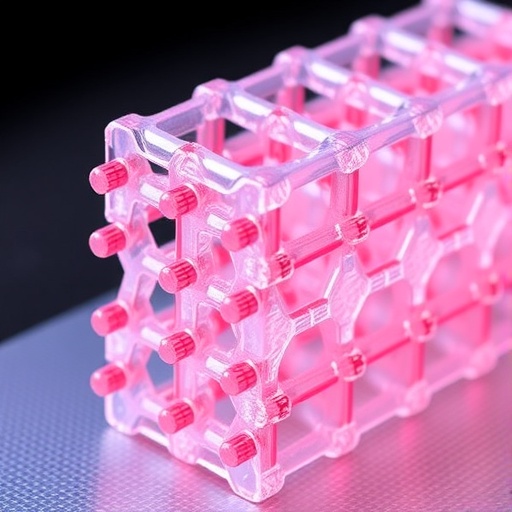
Of particular note is the capacity of the aerosol jet printing process to create multi-layered, three-dimensional constructs through the sequential stacking of PDMS layers. Each layer is accurately aligned and cured, enabling the construction of complex lattices and networks reminiscent of natural or engineered microarchitectures. This 3D capability embodies a significant step toward the integration of soft microstructures in areas such as microfluidics, flexible electronics, and biomedical scaffolds.
The material focus of the research, PDMS, is itself a pivotal choice due to its biocompatibility, optical transparency, and mechanical flexibility. These attributes make it a preferred substrate in bioengineering and microelectromechanical systems (MEMS). However, conventional PDMS fabrication methodologies often compromise these qualities when striving for fine-scale patterning. By employing aerosol jet printing, the researchers preserve PDMS’s intrinsic properties while extending its structural versatility.
Underlying this method is a nuanced understanding of the aerosolization and deposition dynamics specific to PDMS. The team tackled challenges like droplet coalescence and curing kinetics, orchestrating a precise interplay between the printing environment and material behavior. Advanced process control ensures the droplets solidify into stable microarchitectures without compromising resolution or mechanical integrity, effectively bridging the gap between raw material and finished micro-scale device.
In addition to the technical prowess demonstrated, the versatility of the fabricated microarchitectures is integral to their anticipated impact. The ability to produce both planar and volumetric structures opens avenues for customized device fabrication across an array of sectors. For instance, microfluidic devices requiring intricate channel networks could benefit from this method, as could flexible sensors and actuators that demand both fine detail and three-dimensionality.
The research also hints at the potential scalability of aerosol jet printed PDMS architectures, a crucial factor for industrial adoption. The digital, maskless nature of the process promotes rapid iteration and mass customization, potentially shortening manufacturing cycles and lowering costs. As the printing methodology matures, it could offer a sustainable alternative to traditional PDMS manufacturing workflows, aligning with the growing demand for environmentally considerate production methods.
Beyond manufacturing benefits, this innovation could catalyze new scientific inquiries and product designs. By enabling precise spatial control over micro-scale features, researchers and engineers can better model biological tissues, create bespoke optical devices, or engineer microenvironments for cell culture with unparalleled control. This fusion of material science and additive manufacturing could foster a new generation of soft microstructures finely tuned for their functional end-uses.
The implications extend to education and research labs, where the rapid prototyping of sophisticated PDMS devices often faces resource constraints. The aerosol jet printing approach offers a relatively accessible platform for producing high-resolution microarchitectures without relying on costly lithography tools. This democratization of design and fabrication technology promises to accelerate innovation at various levels of scientific inquiry.
Despite these advancements, the authors acknowledge areas ripe for further exploration. These include enhancing the print speed and investigating the long-term stability of aerosol jet printed PDMS structures under various environmental conditions. In addition, expanding material compatibility to incorporate PDMS composites or hybrid materials could unlock even broader functionalities. Interdisciplinary collaboration will likely be pivotal in translating these advances into commercial technologies.
Another fascinating dimension explored in the study is the nuanced control of microarchitecture mechanics through geometric design and layering strategies. By varying parameters such as strut thickness, lattice patterning, and interconnectivity, the researchers showcased how printed structures could be programmed for tunable mechanical responses—from stiffness modulation to impact absorption. This design-to-function paradigm underscores the transformative potential of combining advanced printing methods with material science.
The visual evidence of the work, as presented through scanning electron microscopy images, reveals the remarkable resolution and uniformity achieved. These images vividly display the transition from simple linear printed features to intricate 3D lattice frameworks, underscoring the precision and reliability of the adopted methodology. Such high-fidelity microstructures affirm the feasibility of translating complex digital designs into tangible PDMS constructs.
On a broader scale, aerosol jet printing of PDMS microarchitectures resonates with the ongoing quest to merge additive manufacturing with functional soft materials. The convergence of these fields heralds a new era in microdevice engineering, where rapid, customizable, and high-resolution fabrication can meet the burgeoning demands of applications ranging from wearable health monitors to soft robotics components.
This research not only marks a significant technical milestone but also charts a clear path toward the practical deployment of PDMS-based microdevices fabricated through aerosol jet printing. The work embodies the spirit of innovation and interdisciplinarity, blending insights from materials science, mechanical engineering, and manufacturing technology to redefine what is possible in micro-scale PDMS structuring.
As industries and academia continue to pursue miniaturization, flexibility, and adaptability in device development, the methods elucidated in this paper stand as a powerful testament to the role of additive manufacturing in shaping the future landscape. The ability to seamlessly progress from lines to lattices epitomizes the sophistication and promise of this new frontier in microarchitecture fabrication.
In sum, the study led by Kushagr and colleagues illuminates an exciting horizon for PDMS fabrication, where aerosol jet printing emerges as a versatile, high-resolution, and scalable technique. This innovation holds promise not only for advancing the functional integration of PDMS in sophisticated devices but also for inspiring further interdisciplinary exploration in the evolving realm of advanced manufacturing technologies.
Subject of Research: Fabrication and characterization of high-resolution two-dimensional and three-dimensional polydimethylsiloxane (PDMS) microarchitectures using aerosol jet printing technology.
Article Title: From lines to lattices—high-resolution 2D and 3D PDMS microarchitectures via aerosol jet printing.
Article References:
Kushagr, S., Hu, C., Yuan, B. et al. From lines to lattices—high-resolution 2D and 3D PDMS microarchitectures via aerosol jet printing. npj Adv. Manuf. 3, 19 (2026). https://doi.org/10.1038/s44334-026-00080-1
Image Credits: AI Generated
DOI: https://doi.org/10.1038/s44334-026-00080-1
Tags: 3D microarchitecturesadditive manufacturing for soft materialsadvanced soft materials engineeringaerosol jet printing technologyaerosolized PDMS droplet depositioncomplex lattice microstructureshigh-resolution PDMS printingmicrofabrication challenges in PDMSmicrofabrication of polymersmicroscale patterning techniquespolydimethylsiloxane microstructurespolymer-based microdevices fabrication