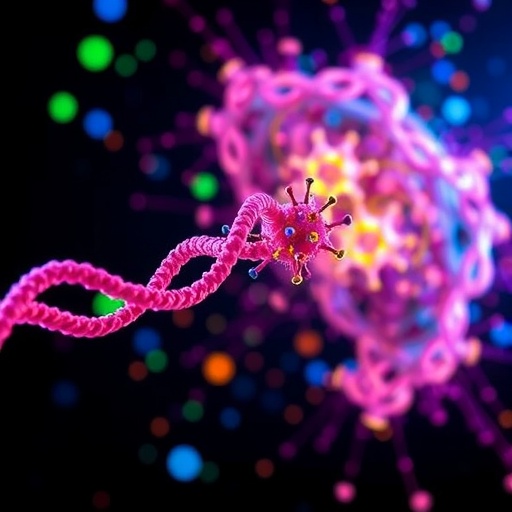
In a groundbreaking study led by researchers at the Massachusetts Institute of Technology (MIT), the intricate dynamics of chromatin within the nucleus of living cells have been elucidated with unprecedented precision. Chromatin, the complex consisting of DNA and associated proteins, is essential for regulating gene expression and facilitating vital cellular processes like DNA repair. This new research leveraged state-of-the-art microscopy techniques to capture and analyze chromatin movements across an extensive timescale, revealing two fundamentally distinct classes of chromatin dynamics that vary significantly among cell types.
Traditionally, chromatin has often been portrayed as a relatively static entity within the nucleus, but it is, in fact, highly dynamic, engaging in constant motion critical for interactions between gene loci and regulatory elements. Enhancers, which can reside up to a million base pairs away from their target genes, rely on the mobility of chromatin to establish contact necessary for gene activation. Similarly, efficient DNA repair depends on the ability of chromatin to bring broken DNA ends into proximity. These dynamic behaviors, previously difficult to quantify, are now better understood thanks to advances in super-resolution microscopy.
The MIT team broke new ground by utilizing MINFLUX, a cutting-edge nanoscopy technique that surpasses the spatial and temporal resolution limits of conventional fluorescence microscopy. Developed recently by Nobel laureate Stefan Hell, MINFLUX enables tracking single molecules with nanometer precision over extended periods. By applying this technology, the research group achieved measurements of chromatin motion spanning four orders of magnitude in time—from mere hundreds of microseconds up to ten seconds—exceeding prior observational capabilities.
Moreover, by integrating MINFLUX data with additional imaging methods, the investigators extended their observational window further, covering seven orders of magnitude over time, from sub-millisecond intervals to several hours. Such breadth allowed for a comprehensive analysis of chromatin dynamics that was statistically robust and revealing. The study reported that, within short to intermediate timescales (approximately up to 200 seconds), chromatin loci exhibited constrained motion confined to a spatial domain of roughly 200 nanometers. This “region of influence” represents a neighborhood within which genomic elements frequently interact without needing active facilitation.
This constrained movement arises from the polymeric nature of DNA. Each locus is tethered by adjacent DNA strands, akin to a runner tethered by linked hands to others in a chain; efforts to move freely lead to pulls back toward equilibrium positions. This kind of constrained diffusion, known as subdiffusion, had been observed before but lacked consistent quantification across such diverse timescales. The new data suggest the subdiffusive behavior is stronger than previously estimated, likely because earlier studies could not simultaneously capture the rapid and long-duration movements that MINFLUX now reveals.
Interestingly, beyond the short-to-moderate timescales, the researchers identified a second distinct class of chromatin dynamics present in certain cell types but absent in others. This class demonstrates more extensive chromatin movement over longer durations—from minutes to hours. The biological underpinnings of this variability remain unclear but might reflect different chromatin states or nuclear environments influencing DNA mobility. Notably, these findings challenge long-standing theoretical models like the Rouse and fractal globule models, which inadequately account for such diverse dynamic behavior.
The implications of this study extend broadly across molecular biology and genetics, providing mechanistic insight into how chromatin organization regulates gene activity and genome maintenance. The discovery of spatially and temporally partitioned modes of chromatin motion adds a new dimension to understanding nuclear function, potentially influencing how researchers approach genome organization, epigenetic regulation, and the cellular response to DNA damage. Awareness of the “region of influence” could inform new models of gene regulation that incorporate realistic physical constraints and mobility patterns of genomic loci.
Further, because enhancer-promoter interactions generally occur within 100,000 base pairs, the limited chromatin movement at short timescales suggests these regulatory sequences rely on passive, rapid encounters within a confined spatial radius rather than active searching. This passive model coheres with observed transcriptional timescales and negates the necessity for additional molecular machinery to ensure regulatory sequence proximity for many genes. Conversely, for more distal interactions or chromatin regions exhibiting the freer, long-timescale movement, other factors might mediate gene regulation and chromatin remodeling.
The application of MINFLUX microscopy to live-cell studies represents a significant methodological advancement, opening new frontiers in cell biology by enabling real-time, nanoscale tracking of molecules and chromatin segments. By overcoming the temporal and spatial resolution limits of prior approaches, MINFLUX offers a powerful tool to dissect nuclear architecture and dynamics in health and disease. The MIT group’s pioneering work lays the foundation for future research seeking to link chromatin motion to functional outcomes such as transcriptional regulation, DNA repair fidelity, and chromatin remodeling mechanisms.
Notably, the study’s findings demonstrate pronounced variability in chromatin dynamics across different mammalian cell types, contradicting assumptions that chromatin behaves uniformly in all cells. This heterogeneity indicates that nuclear organization and biophysical constraints on DNA may be finely tuned according to cellular context, developmental stage, or epigenetic status. Understanding such differences may be crucial for unraveling mechanisms underlying cell-specific gene expression programs and genome stability.
Overall, this research sets a new standard for the quantitative study of chromatin behavior, emphasizing the importance of combining cutting-edge imaging technologies with rigorous statistical methods to obtain a complete picture of genome dynamics. The insights gained promise to deepen our comprehension of fundamental nuclear processes and propel the field toward more integrated models of genome function that fully acknowledge the multidimensional nature of chromatin movement.
This study underscores the intricate balance cells maintain between constrained and free movement of chromatin, orchestrated over multiple timescales, to support essential biological functions. By elucidating the mechanistic basis of chromatin dynamics and revealing cell type-specific patterns, the work paves the way for novel therapeutic approaches targeting chromatin behavior in diseases linked to genome instability or misregulated gene expression.
The research was funded by major scientific bodies, including the National Institutes of Health, the National Science Foundation CAREER Award, the Pew-Stewart Scholar for Cancer Research Award, and the collaborative Bridge Project linking MIT’s Koch Institute and the Dana-Farber/Harvard Cancer Center. This extensive support highlights the importance and translational potential of unraveling chromatin dynamics in molecular genetics.
For readers and researchers alike, this remarkable study exemplifies the power of innovative technologies to unravel complex biological systems at previously inaccessible resolutions and durations, ushering in a new era of precision biophysics and molecular cell biology.
Subject of Research: Chromatin dynamics in living cells and its role in gene expression regulation and DNA repair.
Article Title: Integrated MINFLUX tracking reveals two distinct chromatin dynamics classes across cell types
News Publication Date: 4-May-2026
Web References: https://doi.org/10.1038/s41594-026-01807-6
Image Credits: MIT
Keywords
Life sciences, Genetic material, DNA, Molecular genetics, Cells, Genetics, Engineering, Bioengineering
Tags: advances in chromatin visualization technologychromatin and DNA repair mechanismschromatin dynamics in gene expressionchromatin dynamics variability across cell typeschromatin movement microscopy techniqueschromatin structure and gene activationenhancer-promoter interactionsgene regulation by chromatin mobilitylive cell chromatin imagingMINFLUX nanoscopy applicationsMIT chromatin researchsuper-resolution microscopy in cell biology