• HOME
  • NEWS
  • EXPLORE
    • CAREER
      • Companies
      • Jobs
    • EVENTS
    • iGEM
      • News
      • Team
    • PHOTOS
    • VIDEO
    • WIKI
  • BLOG
  • COMMUNITY
    • FACEBOOK
    • INSTAGRAM
    • TWITTER
Sunday, May 10, 2026
BIOENGINEER.ORG
No Result
View All Result
  • Login
  • HOME
  • NEWS
  • EXPLORE
    • CAREER
      • Companies
      • Jobs
        • Lecturer
        • PhD Studentship
        • Postdoc
        • Research Assistant
    • EVENTS
    • iGEM
      • News
      • Team
    • PHOTOS
    • VIDEO
    • WIKI
  • BLOG
  • COMMUNITY
    • FACEBOOK
    • INSTAGRAM
    • TWITTER
  • HOME
  • NEWS
  • EXPLORE
    • CAREER
      • Companies
      • Jobs
        • Lecturer
        • PhD Studentship
        • Postdoc
        • Research Assistant
    • EVENTS
    • iGEM
      • News
      • Team
    • PHOTOS
    • VIDEO
    • WIKI
  • BLOG
  • COMMUNITY
    • FACEBOOK
    • INSTAGRAM
    • TWITTER
No Result
View All Result
Bioengineer.org
No Result
View All Result
Home NEWS Science News Chemistry

NASA’s Webb Sunshield undergoes rocket fitting, more testing

Bioengineer by Bioengineer
June 17, 2019
in Chemistry
Reading Time: 2 mins read
0
IMAGE
Share on FacebookShare on TwitterShare on LinkedinShare on RedditShare on Telegram

IMAGE

Credit: NASA/Chris Gunn

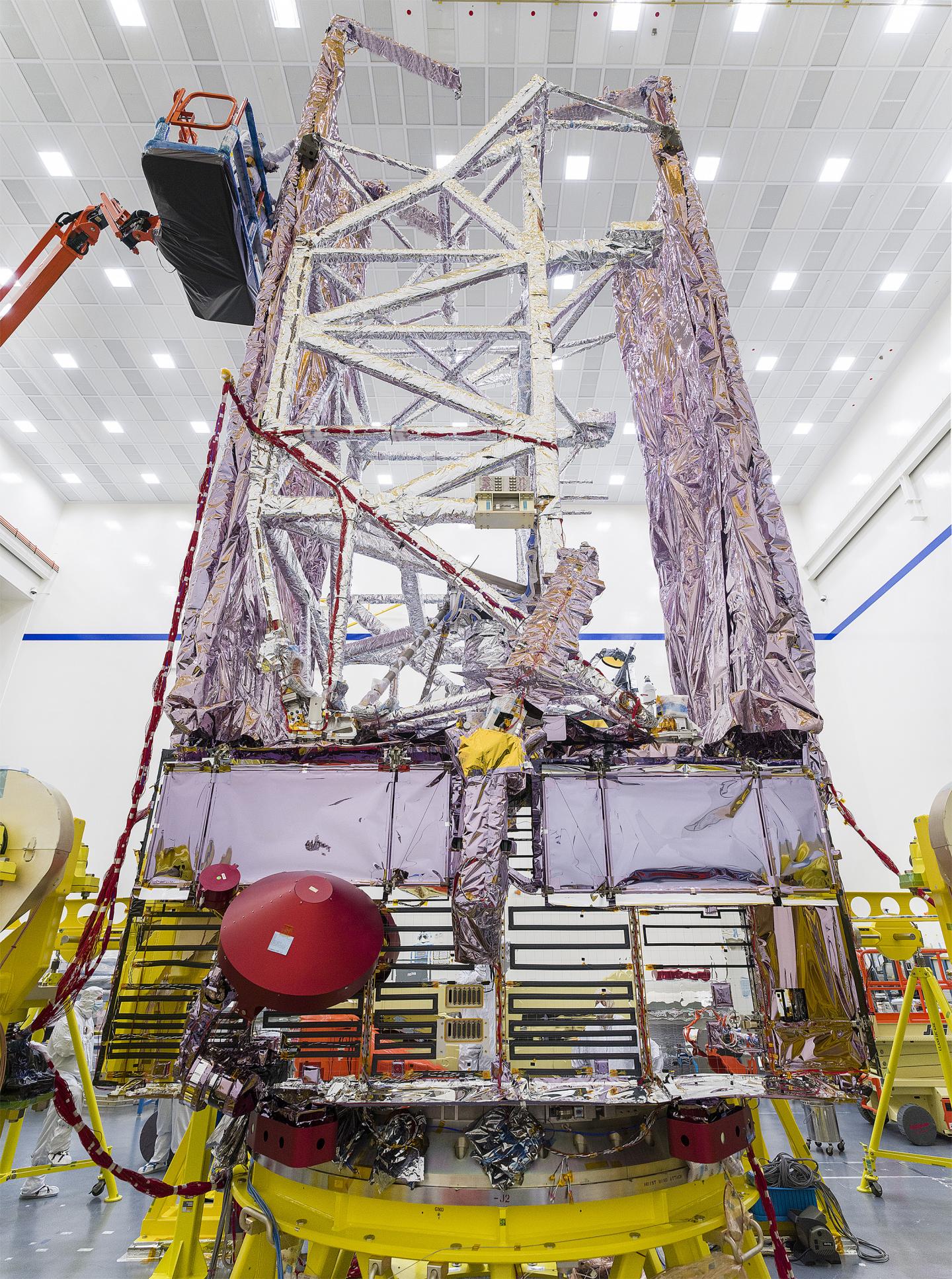
NASA’s James Webb Space Telescope’s spacecraft element, which consists of the observatory’s spacecraft bus and the sunshield, was put in the same folded-up configuration that it will be in when mounted on atop a rocket for launch in 2021.

Since Webb is too large to fit inside a rocket in its “deployed,” or operational, form, it will be tested in its folded-up, or “stowed,” launch configuration that takes up less space. Webb’s enormous sunshield has to be elaborately folded and secured to both fit in the rocket’s nose cone and be strong enough to survive the ride into space.

In the two weeks after launch, the entire observatory will undergo a highly choreographed transformation–unfurling, extending and expanding to a configuration that is very different to how it looks when stored inside the rocket for liftoff.

In a photo taken in the clean room at Northrop Grumman Corporation in Redondo Beach, the last sunshield stowing step for the spacecraft element was completed, after engineers rotated the aft Unitized Pallet Structure (UPS) in a full upward position and locked it. There are two UPSs–a forward and an aft one; the aft UPS is the longer one. All five expansive sunshield membranes are folded up and pinned flat to the UPSs. A big silver truss-like structure in between the two UPSs is a structural substitute for the flight telescope element, which has already been tested separately.

In the stowed configuration, the spacecraft element was transported on a giant dolly from the clean room to test facilities in other buildings at Northrop Grumman where it was subjected to environmental testing. Now that it has passed those tests, the next big thing is to return the spacecraft element to the clean room and deploy, inspect and verify that it got through those flight environment tests successfully.

Once operational, the James Webb Space Telescope will be the world’s premier space science observatory. Webb will solve mysteries of our solar system, look beyond to distant worlds around other stars, and probe the mysterious structures and origins of our universe and our place in it. Webb is an international project led by NASA with its partners, ESA (European Space Agency) and the Canadian Space Agency.

For more information about NASA’s Webb observatory, visit: http://www.nasa.gov/webb

###

Media Contact
Laura Betz
[email protected]

Original Source

https://www.nasa.gov/image-feature/goddard/2019/nasas-webb-sunshield-undergoes-rocket-fitting-more-testing

Tags: AstronomyAstrophysicsExperiments in SpaceMechanical EngineeringPlanets/MoonsResearch/DevelopmentSatellite Missions/ShuttlesSpace/Planetary ScienceTechnology/Engineering/Computer ScienceVehicles
Share12Tweet8Share2ShareShareShare2

Related Posts

Miniature Sensor Uses Light to Detect Touch — Chemistry

Miniature Sensor Uses Light to Detect Touch

May 8, 2026
Iron Minerals Determine Whether Dissolved Organic Matter Fuels Microbes or Becomes Long-Term Carbon Storage — Chemistry

Iron Minerals Determine Whether Dissolved Organic Matter Fuels Microbes or Becomes Long-Term Carbon Storage

May 8, 2026

Kate Evans Appointed Associate Lab Director for Biological and Environmental Systems Science at ORNL

May 8, 2026

Advancing Multiscale Modeling and Overcoming Operational Challenges in Autothermal COâ‚‚-to-Methanol Reactors

May 8, 2026
Please login to join discussion

POPULAR NEWS

  • Research Indicates Potential Connection Between Prenatal Medication Exposure and Elevated Autism Risk

    840 shares
    Share 336 Tweet 210
  • New Study Reveals Plants Can Detect the Sound of Rain

    727 shares
    Share 290 Tweet 181
  • Scientists Investigate Possible Connection Between COVID-19 and Increased Lung Cancer Risk

    68 shares
    Share 27 Tweet 17
  • Salmonella Haem Blocks Macrophages, Boosts Infection

    61 shares
    Share 24 Tweet 15

About

We bring you the latest biotechnology news from best research centers and universities around the world. Check our website.

Follow us

Recent News

Evaluating Digoxin Use in Patients with Symptomatic Rheumatic Heart Disease

Evaluating the Effectiveness and Safety of Digitalis Glycosides in Treating Heart Failure

Urdu Fall Risk Questionnaire Adapted for Elderly

Subscribe to Blog via Email

Enter your email address to subscribe to this blog and receive notifications of new posts by email.

Join 82 other subscribers
  • Contact Us

Bioengineer.org © Copyright 2023 All Rights Reserved.

Welcome Back!

Login to your account below

Forgotten Password?

Retrieve your password

Please enter your username or email address to reset your password.

Log In
No Result
View All Result
  • Homepages
    • Home Page 1
    • Home Page 2
  • News
  • National
  • Business
  • Health
  • Lifestyle
  • Science

Bioengineer.org © Copyright 2023 All Rights Reserved.