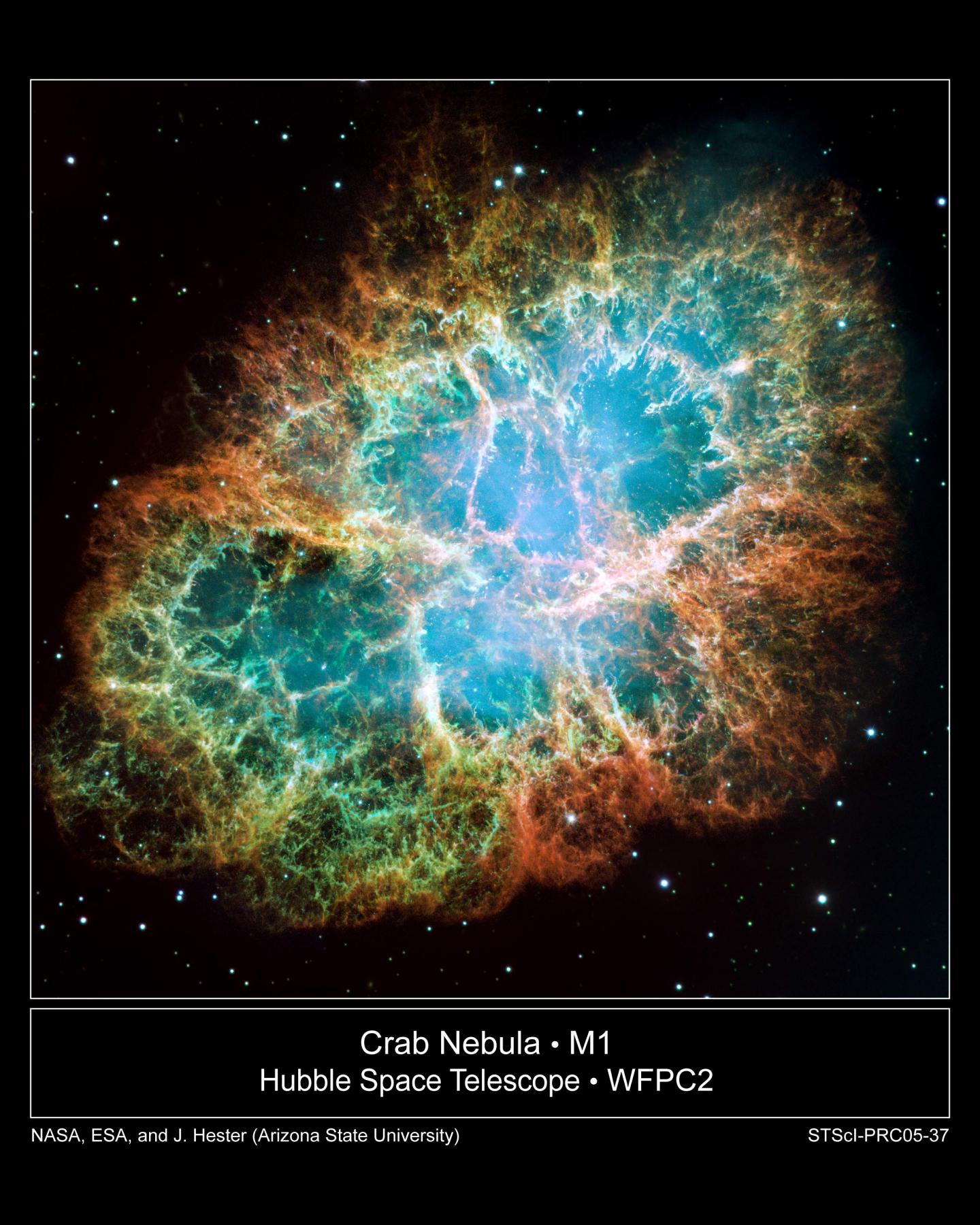
Credit: Credit: NASA, ESA, J. Hester and A. Loll (Arizona State University)
A global science collaboration using data from NASA’s Neutron star Interior Composition Explorer (NICER) telescope on the International Space Station has discovered X-ray surges accompanying radio bursts from the pulsar in the Crab Nebula. The finding shows that these bursts, called giant radio pulses, release far more energy than previously suspected.
A pulsar is a type of rapidly spinning neutron star, the crushed, city-sized core of a star that exploded as a supernova. A young, isolated neutron star can spin dozens of times each second, and its whirling magnetic field powers beams of radio waves, visible light, X-rays, and gamma rays. If these beams sweep past Earth, astronomers observe clock-like pulses of emission and classify the object as a pulsar.
“Out of more than 2,800 pulsars cataloged, the Crab pulsar is one of only a few that emit giant radio pulses, which occur sporadically and can be hundreds to thousands of times brighter than the regular pulses,” said lead scientist Teruaki Enoto at the RIKEN Cluster for Pioneering Research in Wako, Saitama prefecture, Japan. “After decades of observations, only the Crab has been shown to enhance its giant radio pulses with emission from other parts of the spectrum.”
The new study, which will appear in the April 9 edition of Science and is now available online, analyzed the largest amount of simultaneous X-ray and radio data ever collected from a pulsar. It extends the observed energy range associated with this enhancement phenomenon by thousands of times.
Located about 6,500 light-years away in the constellation Taurus, the Crab Nebula and its pulsar formed in a supernova whose light reached Earth in July 1054. The neutron star spins 30 times each second, and at X-ray and radio wavelengths it is among the brightest pulsars in the sky.
Between August 2017 and August 2019, Enoto and his colleagues used NICER to repeatedly observe the Crab pulsar in X-rays with energies up to 10,000 electron volts, or thousands of times that of visible light. While NICER was watching, the team also studied the object using at least one of two ground-based radio telescopes in Japan – the 34-meter dish at the Kashima Space Technology Center and the 64-meter dish at the Japan Aerospace Exploration Agency’s Usuda Deep Space Center, both operating at a frequency of 2 gigahertz.
he combined dataset effectively gave the researchers nearly a day and a half of simultaneous X-ray and radio coverage. All told, they captured activity across 3.7 million pulsar rotations and netted some 26,000 giant radio pulses.
Giant pulses erupt quickly, spiking in millionths of a second, and occur unpredictably. However, when they occur, they coincide with the regular clockwork pulsations.
NICER records the arrival time of every X-ray it detects to within 100 nanoseconds, but the telescope’s timing precision isn’t its only advantage for this study.
“NICER’s capacity for observing bright X-ray sources is nearly four times greater than the combined brightness of both the pulsar and its nebula,” said Zaven Arzoumanian, the project’s science lead at NASA’s Goddard Space Flight Center in Greenbelt, Maryland. “So these observations were largely unaffected by pileup – where a detector counts two or more X-rays as a single event – and other issues that have complicated earlier analyses.”
Enoto’s team combined all of the X-ray data that coincided with giant radio pulses, revealing an X-ray boost of about 4% that occurred in synch with them. It’s remarkably similar to the 3% rise in visible light also associated with the phenomenon, discovered in 2003. Compared to the brightness difference between the Crab’s regular and giant pulses, these changes are remarkably small and provide a challenge for theoretical models to explain.
The enhancements suggest that giant pulses are a manifestation of underlying processes that produce emission spanning the electromagnetic spectrum, from radio to X-rays. And because X-rays pack millions of times the punch of radio waves, even a modest increase represents a large energy contribution. The researchers conclude that the total emitted energy associated with a giant pulse is dozens to hundreds of times higher than previously estimated from the radio and optical data alone.
“We still don’t understand how or where pulsars produce their complex and wide-ranging emission, and it’s gratifying to have contributed another piece to the multiwavelength puzzle of these fascinating objects,” Enoto said.
###
NICER is an Astrophysics Mission of Opportunity within NASA’s Explorers program, which provides frequent flight opportunities for world-class scientific investigations from space utilizing innovative, streamlined and efficient management approaches within the heliophysics and astrophysics science areas. NASA’s Space Technology Mission Directorate supports the SEXTANT component of the mission, demonstrating pulsar-based spacecraft navigation.
Banner: The Crab Nebula, the six-light-year-wide expanding cloud of debris from a supernova explosion, hosts a neutron star spinning 30 times a second that is among the brightest pulsars in the sky at X-ray and radio wavelengths. This composite of Hubble Space Telescope images reveals different gases expelled in the explosion: blue reveals neutral oxygen, green shows singly ionized sulfur, and red indicates doubly ionized oxygen. Credit: NASA, ESA, J. Hester and A. Loll (Arizona State University)
By Francis Reddy
NASA’s Goddard Space Flight Center, Greenbelt, Md.
Media contact:
Claire Andreoli
NASA’s Goddard Space Flight Center, Greenbelt, Md.
(301) 286-1940
Media Contact
Frank Reddy
[email protected]
Original Source
https:/