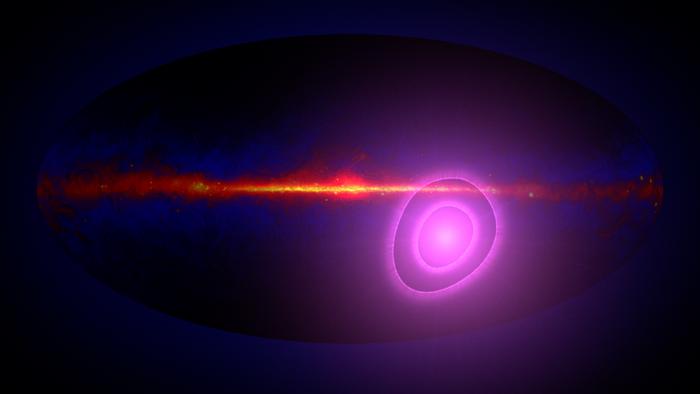
Astronomers analyzing 13 years of data from NASA’s Fermi Gamma-ray Space Telescope have found an unexpected and as yet unexplained feature outside of our galaxy.
Credit: NASA’s Goddard Space Flight Center
Astronomers analyzing 13 years of data from NASA’s Fermi Gamma-ray Space Telescope have found an unexpected and as yet unexplained feature outside of our galaxy.
“It is a completely serendipitous discovery,” said Alexander Kashlinsky, a cosmologist at the University of Maryland and NASA’s Goddard Space Flight Center in Greenbelt, who presented the research at the 243rd meeting of the American Astronomical Society in New Orleans. “We found a much stronger signal, and in a different part of the sky, than the one we were looking for.”
Intriguingly, the gamma-ray signal is found in a similar direction and with a nearly identical magnitude as another unexplained feature, one produced by some of the most energetic cosmic particles ever detected.
A paper describing the findings was published Wednesday, Jan. 10, in The Astrophysical Journal Letters.
The team was searching for a gamma-ray feature related to the CMB (cosmic microwave background), the oldest light in the universe. Scientists say the CMB originated when the hot, expanding universe had cooled enough to form the first atoms, an event that released a burst of light that, for the first time, could permeate the cosmos. Stretched by the subsequent expansion of space over the past 13 billion years, this light was first detected in the form of faint microwaves all over the sky in 1965.
In the 1970s, astronomers realized that the CMB had a so-called dipole structure, which was later measured at high precision by NASA’s COBE (Cosmic Background Explorer) mission. The CMB is about 0.12% hotter, with more microwaves than average, toward the constellation Leo, and colder by the same amount, with fewer microwaves than average, in the opposite direction. In order to study the tiny temperature variations within the CMB, this signal must be removed. Astronomers generally regard the pattern as a result of the motion of our own solar system relative to the CMB at about 230 miles (370 kilometers) per second.
This motion will give rise to a dipole signal in the light coming from any astrophysical source, but so far the CMB is the only one that has been precisely measured. By looking for the pattern in other forms of light, astronomers could confirm or challenge the idea that the dipole is due entirely to our solar system’s motion.
“Such a measurement is important because a disagreement with the size and direction of the CMB dipole could provide us with a glimpse into physical processes operating in the very early universe, potentially back to when it was less than a trillionth of a second old,” said co-author Fernando Atrio-Barandela, a professor of theoretical physics at the University of Salamanca in Spain.
The team reasoned that by adding together many years of data from Fermi’s LAT (Large Area Telescope), which scans the entire sky many times a day, a related dipole emission pattern could be detected in gamma rays. Thanks to the effects of relativity, the gamma-ray dipole should be amplified by as much as five times over the currently detected CMB’s.
The scientists combined 13 years of Fermi LAT observations of gamma rays above about 3 billion electron volts (GeV); for comparison, visible light has energies between about 2 and 3 electron volts. They removed all resolved and identified sources and stripped out the central plane of our Milky Way galaxy in order to analyze the extragalactic gamma-ray background.
“We found a gamma-ray dipole, but its peak is located in the southern sky, far from the CMB’s, and its magnitude is 10 times greater than what we would expect from our motion,” said co-author Chris Shrader, an astrophysicist at the Catholic University of America in Washington and Goddard. “While it is not what we were looking for, we suspect it may be related to a similar feature reported for the highest-energy cosmic rays.”
Cosmic rays are accelerated charged particles – mostly protons and atomic nuclei. The rarest and most energetic particles, called UHECRs (ultrahigh-energy cosmic rays), carry more than a billion times the energy of 3 GeV gamma rays, and their origins remain one of the biggest mysteries in astrophysics.
Since 2017, the Pierre Auger Observatory in Argentina has reported a dipole in the arrival direction of UHECRs. Being electrically charged, cosmic rays are diverted by the galaxy’s magnetic field by different amounts depending on their energies, but the UHECR dipole peaks in a sky location similar to what Kashlinsky’s team finds in gamma rays. And both have strikingly similar magnitudes – about 7% more gamma rays or particles than average coming from one direction and correspondingly smaller amounts arriving from the opposite direction.
The scientists think it’s likely the two phenomena are linked – that as yet unidentified sources are producing both the gamma rays and the ultrahigh-energy particles. To solve this cosmic conundrum, astronomers must either locate these mysterious sources or propose alternative explanations for both features.
The Fermi Gamma-ray Space Telescope is an astrophysics and particle physics partnership managed by Goddard. Fermi was developed in collaboration with the U.S. Department of Energy, with important contributions from academic institutions and partners in France, Germany, Italy, Japan, Sweden, and the United States.
Journal
The Astrophysical Journal Letters
DOI
10.3847/2041-8213/acfedd
Article Title
Probing the Dipole of the Diffuse Gamma-Ray Background
Article Publication Date
10-Jan-2024