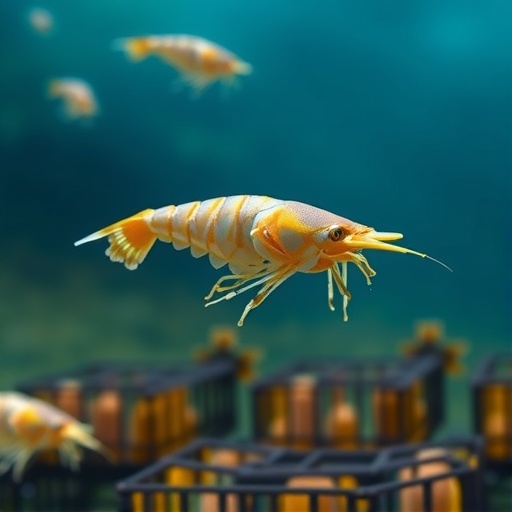
On any given day inside a modern land-based shrimp farm, the same water may pass through a filtration membrane dozens of times before a single drop is discharged — and with every pass, an invisible film of organic debris inches its way across the membrane’s surface. A new study published in Case Studies in Chemical and Environmental Engineering argues that this film is anything but generic. Led by Candra Wijaya and Putu Doddy Sutrisna, a research team set out to determine whether two of the most abundant organic players in recirculating aquaculture — shrimp feed and humic acid — leave chemically and structurally distinct fingerprints on commercial polysulfone ultrafiltration membranes. Their conclusion, encoded in the study’s very title, is that membrane fouling is a foulant-specific phenomenon: the membrane that emerges from an encounter with protein-rich feed particles is not the same material that emerges from an encounter with humic substances. The distinction matters because the world’s shrimp farms are betting their future on closed-loop water recycling, and the membranes at the heart of those systems are only as reliable as our understanding of what blinds them.
The stakes are high. Aquaculture is among the fastest-growing food production sectors on the planet, and its expansion has triggered an urgent demand for sustainable wastewater management. Recirculating Aquaculture Systems, or RAS, have emerged as one of the most attractive answers: water is cycled through a series of integrated treatment processes designed to strip out unwanted substances and pathogens so the same water can be reused again and again, slashing consumption relative to conventional flow-through farming. The biological logic of such systems is unforgiving. Uneaten feed and animal excretions must be minimized, because both are major contributors of ammonia, a compound that is harmful to the fish and shrimp living in the system even at modest concentrations. Every treatment stage that underperforms pushes its burden onto the next, and ultimately onto the animals themselves. A well-run RAS is therefore a continuous balancing act between intense animal production and relentless water purification — and filtration membranes sit squarely at the center of that balance.
The contaminants these membranes must capture are notoriously awkward customers. Organic matter in aquaculture systems arrives in a wide range of sizes and chemical characters, distributed more or less at random, which is why conventional processes such as classification or centrifugation struggle to cope. Proteins in the water complicate matters further by promoting the formation of colloids — particles fine enough to remain suspended indefinitely. Coagulation and flocculation can clump these colloids into removable flocs, but adding chemicals to water shared with living animals is a delicate proposition, and minimizing such additives is widely considered indispensable. Membrane filtration, which removes contaminants without any added reagents, has therefore arisen as the leading alternative. Among the available pore sizes, microfiltration — spanning roughly 0.1 to 10 micrometers — and ultrafiltration — spanning roughly 0.001 to 0.01 micrometers — have the potential to replace coagulation-flocculation outright. Nanofiltration and reverse osmosis can also be deployed in aquaculture systems, although both generally demand more energy than microfiltration or ultrafiltration, a trade-off that matters enormously in facilities that never stop pumping.
The technology’s ceiling is impressive. In one demonstration cited by the team, researchers led by Yong applied membrane distillation to aquaculture water and recovered ammonia at concentrations of up to 465 milligrams per liter — roughly 23 times the initial concentration of about 19.83 milligrams per liter. Almost all of the ammonia was rejected by the membrane, producing a high separation factor of 148: only 0.04 milligrams per liter managed to slip through. Yet despite such successes, the implementation of membrane processes in aquaculture remains limited by four persistent obstacles: low membrane selectivity, high operating costs, membrane fouling, and membrane degradation. Of these, fouling is widely regarded as the most difficult barrier to overcome. It is also maddeningly multifactorial, shaped by the characteristics of the wastewater itself, by the conditions under which the membrane is operated, and by the intrinsic properties of the membrane material. Change any one of those variables, and the fouling behavior can change with it.
Understanding why requires a brief tour of membrane science. A membrane’s separation behavior is governed by properties such as porosity, tortuosity, hydrophilicity, surface charge, and pore size. In water-based separations, hydrophilic — water-loving — membranes are almost always preferred, thanks to their high surface wettability and attendant anti-fouling ability. Highly wettable membranes can sustain high flux — the volume of water pushed through per unit area per unit time — without sacrificing selectivity. The game changes, however, the moment foulants arrive. The ratio between a contaminant’s size and the membrane’s pore size is decisive in determining which fouling mechanism dominates, whether particles lodge inside and seal the pores or accumulate into a compressible layer atop the surface. Chemistry compounds the geometry: the interplay between a membrane’s surface charge and the isoelectric points of its contaminants is governed by pH, and when electrostatic repulsion between membrane and contaminant prevails, fouling is reduced and flux climbs. Fouling, in other words, is not a single phenomenon but a family of them — and each member responds to different countermeasures.
This is precisely where the new study stakes its claim. Actual RAS water is a bewildering cocktail: feed- and fecal-derived organic matter, fine suspended solids and colloids, microbial-derived compounds, dissolved organic matter, nitrogen species, and assorted inorganic constituents, all coexisting at once. Feed input and feed-derived particles have been directly associated with increased membrane fouling in marine RAS, while the continuous recirculation of water promotes the accumulation and gradual transformation of dissolved organic matter, including humic- and fulvic-type compounds. Because of this complexity, the authors note, no single synthetic solution can reproduce the complete fouling environment of an operating RAS. But controlled model-foulant systems offer something field studies cannot: the ability to isolate how a membrane responds to chemically distinct classes of organic matter, one at a time. Previous aquaculture membrane research has employed shrimp-feed-derived organic matter and humic acid for exactly this purpose, making them natural candidates for a rigorous side-by-side mechanistic comparison.
In their investigation, Wijaya and colleagues subjected a commercial polysulfone ultrafiltration membrane — with a nominal molecular weight cut-off of 20,000 Daltons, supplied by RisingSun Membrane Technology — to two aquaculture-relevant model foulants. The first was shrimp feed, using the commercial product IRAWAN 681 V from Central Proteina Prima Indonesia, a formulation containing more than 30 percent protein and 5 percent crude fiber, chosen to represent the feed-derived organic matter that escapes into farm water. The second was humic acid from Sigma-Aldrich, standing in for the humic-type dissolved organic compounds that accumulate as RAS water is recycled over and over. The team systematically varied operating pressure, foulant concentration, and filtration configuration, then tracked how the membrane responded. Crucially, the researchers were explicit about scope: the objective was not to recreate the full composition of actual RAS wastewater, but to interrogate, under controlled laboratory conditions, the individual effects of each foulant class on filtration performance and on the membrane’s physicochemical properties.
The characterization strategy reads like a forensic protocol. Molecular weight cut-off measurements probe whether the membrane’s effective pore structure has shifted after fouling — evidence that deposits have narrowed or sealed channels once open to water. Scanning electron microscopy, or SEM, captures the morphology of the fouling layer, distinguishing dense surface cakes from sporadic pore plugging. Fourier-transform infrared spectroscopy, or FTIR, reads the chemistry, revealing which functional groups the foulants have imparted to the surface: proteinaceous feed residues and humic substances carry different chemical signatures, and each leaves its own record in the spectrum. Water contact angle measurements quantify wettability — the property that determines how eagerly water spreads across the surface and, by extension, how hospitably the fouled membrane greets the next wave of contaminants. Taken together, these techniques allowed the team to document transformations that were unmistakably foulant-specific. A polysulfone membrane after filtration of shrimp-feed organics and the same membrane after filtration of humic acid are, in a meaningful sense, two different materials: altered in surface chemistry, altered in morphology, and altered in how they will behave during the next filtration cycle. That single insight cascades directly into practice, because cleaning agents, cleaning frequencies, and flux-recovery expectations suited to a protein-fouled membrane may be poorly matched to one fouled by humic substances.
The implications ripple outward from the shrimp pond. As coastal aquaculture intensifies and freshwater resources tighten, closed-loop systems built around membrane filtration are poised to become the norm rather than the exception, and every percentage point of flux recovered or cleaning cycle avoided translates into real energy, chemical, and capital savings. Mechanistic studies of this kind are the raw material from which fouling-resistant membrane designs and smarter operating protocols will be built: surfaces engineered to repel specific foulant chemistries, filtration configurations matched to the dominant organic matter in a given farm’s water, and monitoring strategies that detect the chemical signatures of trouble before flux collapses. The authors position their work as a deliberate bridge — model foulants on one side, the churning complexity of a production-scale RAS on the other — and extending it to mixed foulant systems and real farm water is the natural next step. For now, the study delivers a deceptively simple message to an industry racing to recycle every drop: know thy foulant, because the membrane certainly does.
Subject of Research: Foulant-specific fouling mechanisms and physicochemical transformations of commercial polysulfone ultrafiltration membranes exposed to shrimp feed and humic acid, with implications for water treatment in Recirculating Aquaculture Systems (RAS)
Subject of Research: Chemistry
Article Title: Not All Fouling Is Equal: Shrimp Feed and Humic Acid Leave Different Fingerprints on Aquaculture’s Water-Recycling Membranes
Article References: Wijaya, C., Sutrisna, P. D., Mustika, P. C. B. W., Limahardja, M. W., & Handoyo, I. (2026). Foulant-specific transformations of polysulfone membrane: A mechanistic study of shrimp feed and humic acid fouling with implications for Recirculating Aquaculture Systems (RAS). Case Studies in Chemical and Environmental Engineering, 14, Article 101478. https://doi.org/10.1016/j.cscee.2026.101478
Image Credits: AI Generated
DOI: 10.1016/j.cscee.2026.101478
Keywords: Membrane fouling; Polysulfone ultrafiltration membrane; Recirculating Aquaculture System (RAS); Shrimp feed; Humic acid; Aquaculture wastewater treatment; Membrane characterization; Water reuse
Cite Scienmag News
APA MLA Chicago
Bethany Barker. (September 3, 2026). Shrimp feed and humic acid foul aquaculture membranes differently, study finds. Scienmag. https://scienmag.com/shrimp-feed-and-humic-acid-foul-aquaculture-membranes-differently-study-finds/
Bethany Barker. “Shrimp feed and humic acid foul aquaculture membranes differently, study finds.” Scienmag, 3 September 2026, https://scienmag.com/shrimp-feed-and-humic-acid-foul-aquaculture-membranes-differently-study-finds/. Accessed 3 September 2026.
Bethany Barker. “Shrimp feed and humic acid foul aquaculture membranes differently, study finds.” Scienmag. September 3, 2026. https://scienmag.com/shrimp-feed-and-humic-acid-foul-aquaculture-membranes-differently-study-finds/
Copy citation Download RIS
Tags: Aquaculture membrane foulingchemical and structural differences in foulingchemical fingerprints of organic fouling agentseffects of organic matter on membrane performancehumic acid effects on aquaculture membraneshumic acid membrane foulingimpact of shrimp feed on membrane performancemembrane cleaning and maintenance in shrimp farmingmembrane fouling fingerprintingorganic debris accumulation in aquacultureorganic debris buildup in aquacultureorganic fouling in aquaculture systemsorganic fouling mechanisms in aquaculture filtrationpolysulfone ultrafiltration membrane foulingpolysulfone ultrafiltration membranesrecirculating aquaculture system membrane contaminationrecirculating aquaculture water treatmentshrimp farm water filtrationshrimp feed impact on filtration membranessignificance of membrane-specific fouling in aquaculture sustainabilitysustainable aquaculture filtration technologieswater recycling challenges in shrimp aquaculturewater recycling in shrimp farms