• HOME
  • NEWS
  • EXPLORE
    • CAREER
      • Companies
      • Jobs
    • EVENTS
    • iGEM
      • News
      • Team
    • PHOTOS
    • VIDEO
    • WIKI
  • BLOG
  • COMMUNITY
    • FACEBOOK
    • INSTAGRAM
    • TWITTER
Monday, June 15, 2026
BIOENGINEER.ORG
No Result
View All Result
  • Login
  • HOME
  • NEWS
  • EXPLORE
    • CAREER
      • Companies
      • Jobs
        • Lecturer
        • PhD Studentship
        • Postdoc
        • Research Assistant
    • EVENTS
    • iGEM
      • News
      • Team
    • PHOTOS
    • VIDEO
    • WIKI
  • BLOG
  • COMMUNITY
    • FACEBOOK
    • INSTAGRAM
    • TWITTER
  • HOME
  • NEWS
  • EXPLORE
    • CAREER
      • Companies
      • Jobs
        • Lecturer
        • PhD Studentship
        • Postdoc
        • Research Assistant
    • EVENTS
    • iGEM
      • News
      • Team
    • PHOTOS
    • VIDEO
    • WIKI
  • BLOG
  • COMMUNITY
    • FACEBOOK
    • INSTAGRAM
    • TWITTER
No Result
View All Result
Bioengineer.org
No Result
View All Result
Home NEWS Science News

NASA spots short-lived Tropical Cyclone Alfred

Bioengineer by Bioengineer
February 21, 2017
in Science News
Reading Time: 2 mins read
0
Share on FacebookShare on TwitterShare on LinkedinShare on RedditShare on Telegram
IMAGE

Credit: Credits: NASA/NOAA

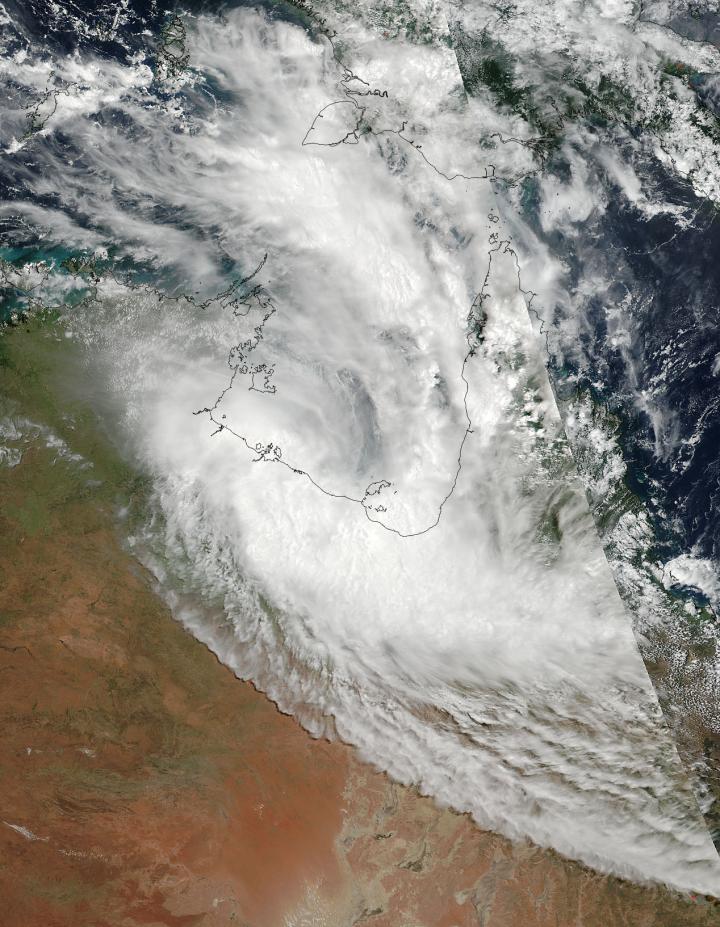
NASA-NOAA's Suomi NPP satellite captured a visible image of the Southern Pacific Ocean's newly formed tropical cyclone in the Gulf of Carpentaria. By the next day Alfred made landfall and weakened to a remnant low pressure area.

The Gulf of Carpentaria is a body of water between Australia's Northern Territory and Queensland. The Arafura Sea lies to the north of the Gulf.

On Feb. 20 the Visible Infrared Imaging Radiometer Suite (VIIRS) instrument aboard NASA-NOAA's Suomi NPP satellite provided a visible image of Alfred that showed half of the storm was over land, and half in the Gulf of Carpentaria.

Tropical Cyclone Alfred developed from a tropical low pressure area previously known as System 91P. As the low pressure area briefly moved off the coast of the Northern Territory and into the warm waters of the Gulf it consolidated and strengthened into a tropical cyclone.

When Alfred developed around 0300 UTC on Feb. 20 (10 p.m. EST on Feb. 19) the Joint Typhoon Warning Center noted Alfred's maximum sustained winds were near 46 mph (40 knots/74 kph. At that time, Alfred was centered near 15.3 degrees south latitude and 137.1 degrees east longitude in the southwestern Gulf of Carpentaria. Alfred was moving to the south-southeast 3.4 mph (3 knots/5.5 kph) and was crossing the Gulf of Carpentaria coast, between Borroloola and the Northern Territory/Queensland border.

By Feb. 21, Alfred had made landfall near the Queensland and Northern Territory border and weakened to a remnant low pressure area. At 8 p.m. AEST local time in Queensland, The Australian Bureau of Meteorology (ABM) noted that ex-tropical cyclone is expected to remain slow moving over land before shifting westward on Feb. 22.

###

There are currently no tropical cyclone warnings in effect for Alfred. For additional weather advisories, visit the ABM website: http://www.bom.gov.au/qld/warnings/.

Media Contact

Rob Gutro
[email protected]
@NASAGoddard

http://www.nasa.gov/goddard

############

Story Source: Materials provided by Scienmag
Share12Tweet8Share2ShareShareShare2

Related Posts

Neighborhoods Shape Health Inequities in Preterm Infants — Technology and Engineering

Neighborhoods Shape Health Inequities in Preterm Infants

June 15, 2026
Adaptive AGV Control via BP Neural Observer — Technology and Engineering

Adaptive AGV Control via BP Neural Observer

June 15, 2026

Five-Year Trend: Antibiotic Use in Northern Sri Lanka

June 15, 2026

Miniature Ingestible Sensor Enables Continuous Internal Temperature Monitoring

June 15, 2026
Please login to join discussion

POPULAR NEWS

  • ESMO 2025: mRNA COVID Vaccines Enhance Efficacy of Cancer Immunotherapy

    325 shares
    Share 130 Tweet 81
  • Saying Goodbye to PGY-6: Pediatric Fellowship Realities

    100 shares
    Share 40 Tweet 25
  • Multi-Hospital Study Reveals Long Covid Burden Is Twice as High as Current Estimates

    91 shares
    Share 36 Tweet 23
  • Detection of EDCs in Breast Milk and Infant Urine Up to Six Months Highlights Early Exposure Risks

    74 shares
    Share 30 Tweet 19

About

We bring you the latest biotechnology news from best research centers and universities around the world. Check our website.

Follow us

Recent News

Neighborhoods Shape Health Inequities in Preterm Infants

Adaptive AGV Control via BP Neural Observer

Five-Year Trend: Antibiotic Use in Northern Sri Lanka

Subscribe to Blog via Email

Enter your email address to subscribe to this blog and receive notifications of new posts by email.

Join 82 other subscribers
  • Contact Us

Bioengineer.org © Copyright 2023 All Rights Reserved.

Welcome Back!

Login to your account below

Forgotten Password?

Retrieve your password

Please enter your username or email address to reset your password.

Log In
No Result
View All Result
  • Homepages
    • Home Page 1
    • Home Page 2
  • News
  • National
  • Business
  • Health
  • Lifestyle
  • Science

Bioengineer.org © Copyright 2023 All Rights Reserved.