• HOME
  • NEWS
  • EXPLORE
    • CAREER
      • Companies
      • Jobs
    • EVENTS
    • iGEM
      • News
      • Team
    • PHOTOS
    • VIDEO
    • WIKI
  • BLOG
  • COMMUNITY
    • FACEBOOK
    • INSTAGRAM
    • TWITTER
Wednesday, June 24, 2026
BIOENGINEER.ORG
No Result
View All Result
  • Login
  • HOME
  • NEWS
  • EXPLORE
    • CAREER
      • Companies
      • Jobs
        • Lecturer
        • PhD Studentship
        • Postdoc
        • Research Assistant
    • EVENTS
    • iGEM
      • News
      • Team
    • PHOTOS
    • VIDEO
    • WIKI
  • BLOG
  • COMMUNITY
    • FACEBOOK
    • INSTAGRAM
    • TWITTER
  • HOME
  • NEWS
  • EXPLORE
    • CAREER
      • Companies
      • Jobs
        • Lecturer
        • PhD Studentship
        • Postdoc
        • Research Assistant
    • EVENTS
    • iGEM
      • News
      • Team
    • PHOTOS
    • VIDEO
    • WIKI
  • BLOG
  • COMMUNITY
    • FACEBOOK
    • INSTAGRAM
    • TWITTER
No Result
View All Result
Bioengineer.org
No Result
View All Result
Home NEWS Science News

NASA sees vertical wind shear affecting Tropical Storm Muifa

Bioengineer by Bioengineer
April 27, 2017
in Science News
Reading Time: 2 mins read
0
Share on FacebookShare on TwitterShare on LinkedinShare on RedditShare on Telegram
IMAGE

Credit: Credits: NASA/JAXA, Hal Pierce

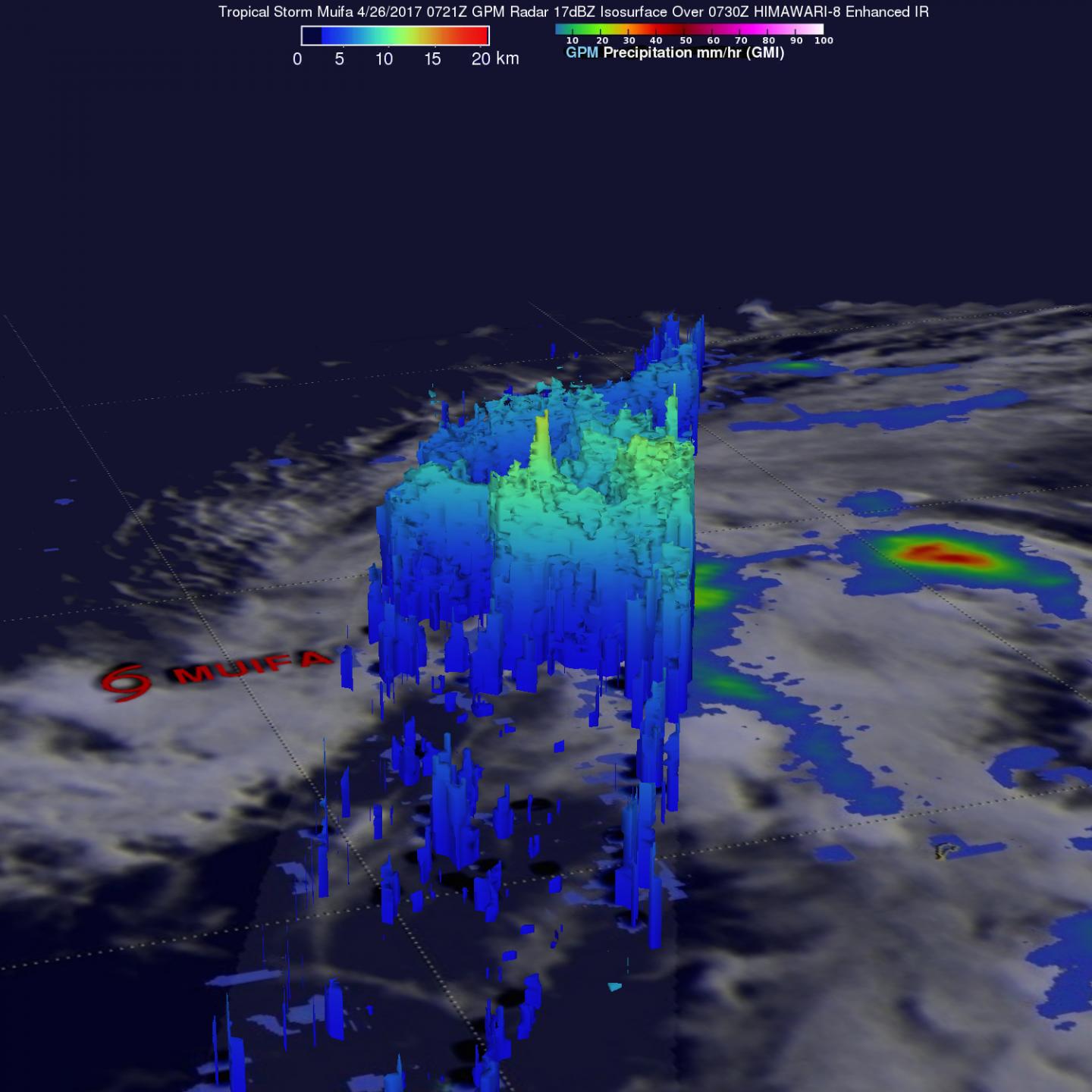
Vertical wind shear can weaken a tropical cyclone and that's what's happening to the now weaker Tropical Depression Muifa in the Northwestern Pacific Ocean. NASA gathered rainfall information about the storm as wind shear continued to weaken it.

The Global Precipitation Measurement mission or GPM core observatory satellite again passed over Tropical Storm Muifa in the western Pacific Ocean on April 26, 2017 at 0721 UTC (3:21 a.m. EDT). GPM data revealed that there was very little precipitation around Muifa's low level center of circulation. A red tropical storm symbol shows the approximate location of tropical storm Muifa's center. Rain was measured by GPM's Dual-Frequency Precipitation Radar (DPR) falling at a rate of over 193 mm (7.6 inches) per hour in storms located well to the east of the tropical cyclone's center.

GPM's Radar (DPR Ku Band) data were used to show the 3-D structure of precipitation in a cross section through the eastern side of the tropical storm. Storm tops in the DPR swath were shown to reach heights above 16 km (9.9 miles). Maximum sustained wind speeds in Muifa were estimated to be about 40 knots (46 mph) at the time of this GPM pass. The image was created at NASA's Goddard Space Flight Center in Greenbelt, Maryland. GPM is a joint mission between NASA and the Japanese space agency JAXA.

On April 27 at 1500 UTC (11 a.m. EDT) Muifa's maximum sustained winds were near 30 knots (34.5 mph/55.5 kph). Muifa has weakened to a depression and was centered near 17.3 degrees north latitude and 135.1 degrees east longitude, about 489 nautical miles north-northwest of Yap. Muifa has tracked northward at 11 knots (12.6 mph/20.3 kph).

The Joint Typhoon Warning Center (JTWC) noted "the lack of convection and the absence of an organized low level circulation indicates that the system is continuing to weaken." JTWC predicts Muifa will continue to weaken and dissipate in a day or two.

###

Media Contact

Rob Gutro
[email protected]
@NASAGoddard

http://www.nasa.gov/goddard

############

Story Source: Materials provided by Scienmag

Share12Tweet8Share2ShareShareShare2

Related Posts

Increase in Adolescent Suicidality Following State-Level Total Abortion Bans

June 24, 2026

Personalized Brain Imaging Offers New Hope for Treatment-Resistant Depression

June 24, 2026

How Intestinal Mucus Influences Klebsiella pneumoniae Colonization and Antibiotic Effectiveness

June 24, 2026

Can Bifidobacterium infantis M-63 Transform Weaning Gut?

June 24, 2026
Please login to join discussion

POPULAR NEWS

  • Saying Goodbye to PGY-6: Pediatric Fellowship Realities

    103 shares
    Share 41 Tweet 26
  • Multi-Hospital Study Reveals Long Covid Burden Is Twice as High as Current Estimates

    92 shares
    Share 36 Tweet 23
  • Detection of EDCs in Breast Milk and Infant Urine Up to Six Months Highlights Early Exposure Risks

    77 shares
    Share 31 Tweet 19
  • New Drug Candidate Developed at McMaster Shows Potential for Treating Brain Cancer

    58 shares
    Share 23 Tweet 15

About

We bring you the latest biotechnology news from best research centers and universities around the world. Check our website.

Follow us

Recent News

Increase in Adolescent Suicidality Following State-Level Total Abortion Bans

Personalized Brain Imaging Offers New Hope for Treatment-Resistant Depression

How Intestinal Mucus Influences Klebsiella pneumoniae Colonization and Antibiotic Effectiveness

Subscribe to Blog via Email

Enter your email address to subscribe to this blog and receive notifications of new posts by email.

Join 82 other subscribers
  • Contact Us

Bioengineer.org © Copyright 2023 All Rights Reserved.

Welcome Back!

Login to your account below

Forgotten Password?

Retrieve your password

Please enter your username or email address to reset your password.

Log In
No Result
View All Result
  • Homepages
    • Home Page 1
    • Home Page 2
  • News
  • National
  • Business
  • Health
  • Lifestyle
  • Science

Bioengineer.org © Copyright 2023 All Rights Reserved.