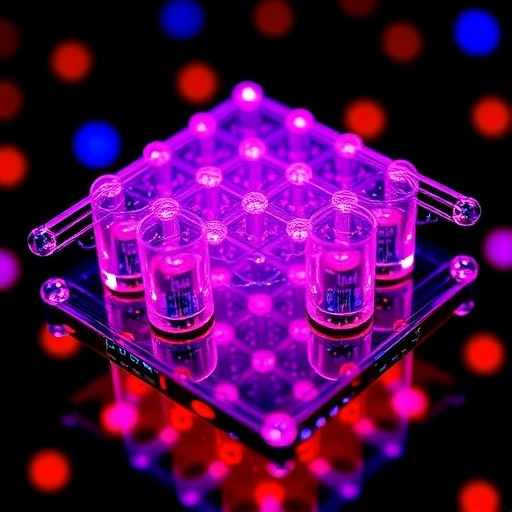
Sunlight-driven hydrogen production has long promised a way to store renewable energy in a clean, flexible form. Yet the materials designed to make hydrogen from water often waste much of the light they absorb. A new study reports that tiny carbon particles derived from cellulose can substantially improve the performance of cadmium sulfide, or CdS, a visible-light-responsive semiconductor widely investigated for photocatalytic hydrogen evolution.
The researchers created a composite material by attaching cellulose-derived carbon quantum dots, known as CQDs, to CdS nanoparticles. In laboratory tests, the optimized catalyst generated 7,812.5 micromoles of hydrogen per gram during five hours of visible-light irradiation. Under the same conditions, unmodified CdS produced 4,633.5 micromoles per gram. The results, published in Sustainable Carbon Materials, suggest that a renewable carbon material can help solve one of the central problems in solar photocatalysis: keeping light-generated electrical charges apart long enough to drive useful chemical reactions.
Hydrogen is often described as an energy carrier rather than a primary energy source. It can be produced using electricity or sunlight and later used in fuel cells, industrial processes, or energy-storage systems. When consumed in a fuel cell, hydrogen produces water rather than carbon dioxide at the point of use. Photocatalytic hydrogen production is especially attractive because it seeks to use sunlight directly to power the chemical conversion of protons into hydrogen gas. However, the efficiency and durability of photocatalytic materials remain significant obstacles to practical deployment.
CdS is a promising photocatalyst because its relatively narrow bandgap allows it to absorb a substantial portion of visible light. When CdS absorbs photons with sufficient energy, electrons are promoted from the valence band to the conduction band, leaving positively charged holes behind. The excited electrons can reduce protons to form hydrogen, while the holes participate in oxidation reactions. The difficulty is that electrons and holes can rapidly recombine, releasing their energy as heat or light before they reach the surface. CdS can also suffer from photocorrosion, a process that gradually damages the semiconductor during illumination.
To modify the material, the researchers produced CQDs from cellulose through a hydrothermal process. Cellulose, the structural polymer found in plant cell walls, can be converted under heat and pressure into nanoscale carbon particles with electronic and optical properties that differ from those of bulk carbon. Microscopy showed that the CQDs averaged approximately 3.5 nanometers in diameter and were distributed on the surface of CdS nanoparticles. The attachment process preserved the general structure of the CdS while creating an interface where charge transfer could occur.
The resulting composites absorbed visible light more effectively than pure CdS and displayed slightly narrower bandgaps. The best-performing formulation, designated 12CQDs/CdS, had a bandgap of approximately 2.01 electron volts, compared with 2.05 electron volts for unmodified CdS. Although the numerical shift appears small, changes in band structure and interfacial electronic states can influence how efficiently a photocatalyst uses incoming photons and how readily excited electrons move through the material.
The clearest evidence of improved charge management came from electrochemical measurements. The optimized CQDs/CdS composite reached an average photocurrent density of 49.9 microamperes per square centimeter, nearly 20 times higher than the 2.63 microamperes per square centimeter measured for pure CdS. A higher photocurrent indicates that more photogenerated charges are reaching the electrode and participating in external electrical processes rather than recombining inside the catalyst. The composite also showed lower charge-transfer resistance, suggesting that electrons could move more readily across the CQD–CdS interface.
The researchers propose that the carbon quantum dots perform two related functions. First, they act as photosensitizers, helping the material harvest visible light. Second, they serve as electron acceptors that capture excited electrons from CdS and help transport them away from locations where recombination is likely. By improving spatial separation between electrons and holes, the CQDs leave more electrons available to reduce protons into hydrogen. This interfacial process is central to the performance increase: the carbon dots do not simply add more surface area, but actively influence the movement and lifetime of charge carriers.
The study also reveals why adding more of the carbon material is not necessarily better. When the CQD loading becomes excessive, the particles can cover active sites on the CdS surface, block the arrival of light, or hinder the movement of reactants and products. The strongest performance therefore depended on carefully controlling the amount of CQDs rather than maximizing their concentration. Even at the optimized composition, however, hydrogen production declined during repeated photocatalytic cycles. This decrease indicates that photocorrosion of CdS remains unresolved and could limit the material’s long-term usefulness. Protective surface layers, cocatalysts, engineered heterostructures, and further tuning of CQD surface chemistry may help improve stability. By combining an abundant biomass-derived material with a visible-light semiconductor, the work offers a relatively simple route toward more efficient photocatalysts while reducing reliance on noble metals and elaborate architectures.
Subject of Research: Cellulose-derived carbon quantum dots combined with cadmium sulfide for visible-light photocatalytic hydrogen production.
Article Title: Cellulose carbon quantum dots decorated CdS nanocatalyst for enhanced visible-light photocatalytic hydrogen evolution
News Publication Date: 8-Jun-2026
Web References: Sustainable Carbon Materials: https://www.maxapress.com/scm; DOI: https://doi.org/10.48130/scm-0026-0020
References: Wang Z, Changotra R, Dong G, Yang J, He QS. 2026. Cellulose carbon quantum dots decorated CdS nanocatalyst for enhanced visible-light photocatalytic hydrogen evolution. Sustainable Carbon Materials 2: e025. DOI: 10.48130/scm-0026-0020
Image Credits: Zijing Wang, Rahil Changotra, Guofa Dong, Jie Yang, and Quan Sophia He
Keywords
Photocatalysis, hydrogen evolution, carbon quantum dots, cellulose, cadmium sulfide, visible-light catalysis, renewable energy, solar fuel, nanomaterials, photocorrosion
Tags: carbon quantum dots for hydrogen evolutionCdS semiconductor photocatalystscellulose-derived quantum dotsclean hydrogen fuel productionenhancement of photocatalytic efficiencynanomaterials for hydrogen generationphotocatalytic water splittingrenewable energy storagesolar energy conversionsolar-driven hydrogen productionsustainable carbon materialsvisible-light-responsive photocatalysts