• HOME
  • NEWS
  • EXPLORE
    • CAREER
      • Companies
      • Jobs
    • EVENTS
    • iGEM
      • News
      • Team
    • PHOTOS
    • VIDEO
    • WIKI
  • BLOG
  • COMMUNITY
    • FACEBOOK
    • INSTAGRAM
    • TWITTER
Monday, January 12, 2026
BIOENGINEER.ORG
No Result
View All Result
  • Login
  • HOME
  • NEWS
  • EXPLORE
    • CAREER
      • Companies
      • Jobs
        • Lecturer
        • PhD Studentship
        • Postdoc
        • Research Assistant
    • EVENTS
    • iGEM
      • News
      • Team
    • PHOTOS
    • VIDEO
    • WIKI
  • BLOG
  • COMMUNITY
    • FACEBOOK
    • INSTAGRAM
    • TWITTER
  • HOME
  • NEWS
  • EXPLORE
    • CAREER
      • Companies
      • Jobs
        • Lecturer
        • PhD Studentship
        • Postdoc
        • Research Assistant
    • EVENTS
    • iGEM
      • News
      • Team
    • PHOTOS
    • VIDEO
    • WIKI
  • BLOG
  • COMMUNITY
    • FACEBOOK
    • INSTAGRAM
    • TWITTER
No Result
View All Result
Bioengineer.org
No Result
View All Result
Home NEWS Science News

NASA sees Typhoon Phanfone landfall in the Philippines

Bioengineer by Bioengineer
December 24, 2019
in Science News
Reading Time: 2 mins read
0
IMAGE
Share on FacebookShare on TwitterShare on LinkedinShare on RedditShare on Telegram

IMAGE

Credit: Credit: NOAA/NASA Worldview


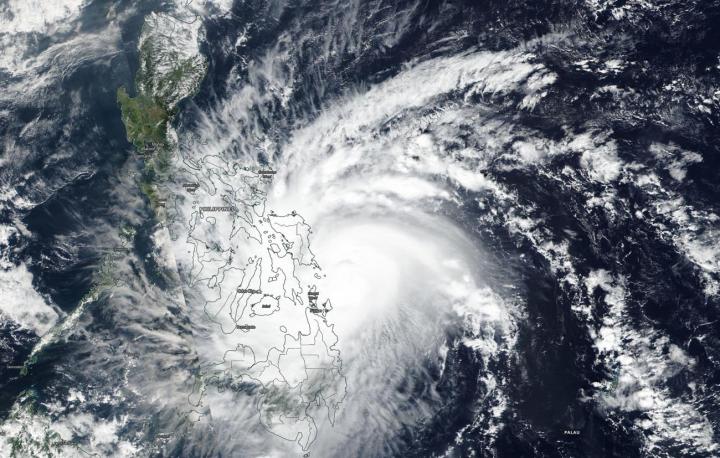
Typhoon Phanfone, known locally in the Philippines as Ursula, was making landfall in the central part of the country when NASA-NOAA’s Suomi NPP satellite passed overhead on Dec. 24.

Suomi NPP’s VIIRS instrument provided a visible image of Phanfone that showed its center had made landfall in the eastern Visayas region of the Philippines. The Visible Infrared Imaging Radiometer Suite (VIIRS) is one of 5 instruments aboard Suomi NPP. VIIRS and other satellite imagery has shown an intermittent eye feature peeking out within a compact area of sustained deep central convection.

At 4 a.m. EST (0900 UTC) on Dec. 24, there were many warning signals in effect for the country. Philippines tropical cyclone Signal #3 was in effect for Luzon (northern Philippines) that included Masbate including Ticao Island. In Visayas (central Philippines), the warning covered Northern Samar, eastern Samar, Samar, Biliran, Leyte and extreme northern Cebu.

Signal #2 was in effect in Luzon for the southern part of Cebu, Oriental and Occidental Mindoro, Romblon, Albay, Sorsogon, Burias Island and Calamian and Cuyo Islands.

Also in the Visayas region, Signal #2 included the central part of northern Cebu, northern Antique, Capiz, Aklan, southern Leyte and northern Negros Occidental Mindanao and the Dinagat islands.

Signal #1 was also posted for parts of Luzon that included Bulacan, Bataan, Metro Manila, Rizal, Cavite, rest of Quezon, Laguna, Batangas, Camarines Norte & Sur, Catanduanes, and northern Palawan. In Visayas the signal covered the rest of Cebu, Bohol, Aklan, rest of Antique, rest of Iloilo, Guimaras, rest of Negros Occidental and Negros Oriental. Signal #1 was also posted for Mindanao’s Surigao del Northe including Siargao and Bucas Grande Islands.

At 4 a.m. EST (0900 UTC) Phanfone (Philippines designation Ursula) was located near latitude 11.1 degrees north and longitude 126.5 degrees east, about 384 nautical miles east-southeast of Manila, Philippines. Phanfone was moving to the west-northwest with maximum sustained winds 65 knots (75 mph/120 kph).

Phanfone is forecast to strengthen to 80 knots as it moves over the Sulu Sea, and strengthen further once it moves into the South China Sea.

###

Media Contact
Rob Gutro
[email protected]

Original Source

https://blogs.nasa.gov/hurricanes/2019/12/24/phanfone-northwestern-pacific-ocean-2/

Tags: Atmospheric ChemistryAtmospheric ScienceClimate ChangeClimate ScienceEarth ScienceMeteorologyTechnology/Engineering/Computer ScienceTemperature-Dependent PhenomenaWeather/Storms
Share12Tweet8Share2ShareShareShare2

Related Posts

Precision Genome Editing: Targeted In Vivo Delivery Advances

January 12, 2026
Europe’s Cattle Face Rising Future Heatwave Risks

Europe’s Cattle Face Rising Future Heatwave Risks

January 12, 2026

AMPK: Key Player in Energy and Nutrient Sensing

January 12, 2026

Kesterite Solar Cells Made via Molecular Ink Chemistry

January 12, 2026
Please login to join discussion

POPULAR NEWS

  • Enhancing Spiritual Care Education in Nursing Programs

    154 shares
    Share 62 Tweet 39
  • PTSD, Depression, Anxiety in Childhood Cancer Survivors, Parents

    146 shares
    Share 58 Tweet 37
  • Robotic Ureteral Reconstruction: A Novel Approach

    69 shares
    Share 28 Tweet 17
  • Study Reveals Lipid Accumulation in ME/CFS Cells

    50 shares
    Share 20 Tweet 13

About

We bring you the latest biotechnology news from best research centers and universities around the world. Check our website.

Follow us

Recent News

Precision Genome Editing: Targeted In Vivo Delivery Advances

Europe’s Cattle Face Rising Future Heatwave Risks

AMPK: Key Player in Energy and Nutrient Sensing

Subscribe to Blog via Email

Enter your email address to subscribe to this blog and receive notifications of new posts by email.

Join 71 other subscribers
  • Contact Us

Bioengineer.org © Copyright 2023 All Rights Reserved.

Welcome Back!

Login to your account below

Forgotten Password?

Retrieve your password

Please enter your username or email address to reset your password.

Log In
No Result
View All Result
  • Homepages
    • Home Page 1
    • Home Page 2
  • News
  • National
  • Business
  • Health
  • Lifestyle
  • Science

Bioengineer.org © Copyright 2023 All Rights Reserved.